
GIACOMO da VITERBO, Blessed. - Augustinian theologian, born in Viterbo around the middle of the 13th century, died in Naples between the end of 1307 and the beginning of 1308. Historians after the 16th century claim that he descended from the noble Capocci family.
Very young, he was sent to Paris to attend the University and earn a doctorate in theology. In 1281, the Order’s registers describe him as a lector novus, i.e., recently appointed. This was the title given to students returning from Paris who were granted the rank of lector. After spending some years in Italy, he was sent back to Paris to lecture on the Sentences. In October 1287, he obtained the baccalaureate, and at Easter 1293, he earned his master’s degree in theology. He remained in Paris for a long time, continuing his teaching as one of the magistri actu regentes.
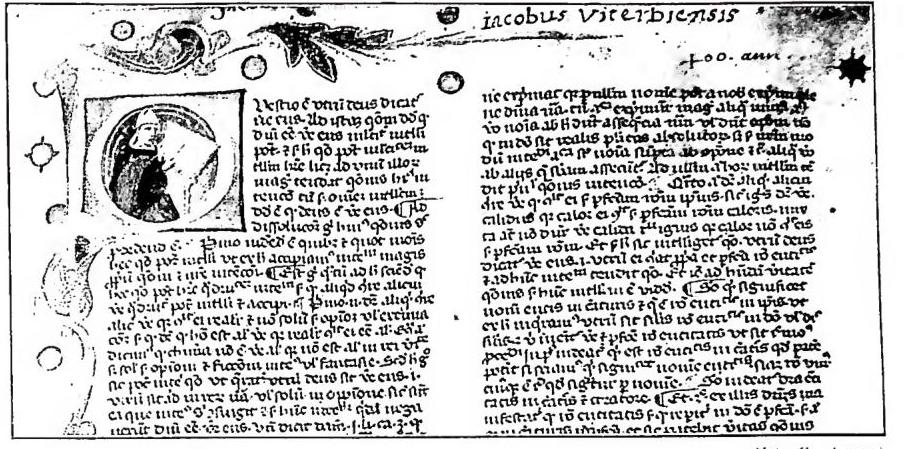
G. da V. was notably active as a writer. Some of his treatises were listed among the texts to be consulted by students in the official catalogue of the University of Paris, dated 25 February 1304. He was one of the most authoritative representatives of the Giles of Rome school. In his youth, he took a rather hostile stance toward Thomism and is cited as one of the opponents by the followers of Aquinas; later, however, he modified his views and repeatedly expressed praise for St. Thomas, whose system—inasmuch as it is a moderate Aristotelianism—he broadly accepted. Yet, in keeping with the school of his Order, he differed from Thomists on several important theories: he upheld the affective character of theology, affirmed the primacy of the will over the intellect, and placed bonum above verum in the hierarchy of transcendentals. He also merits recognition for composing the first treatise De Ecclesia in his De regimine Christiano, in which he does not merely define the Church, as his predecessors had done, but describes and illustrates, at some length, its distinctive features, its organization as a kingdom, its spiritual and temporal mission, and the powers assigned to the Supreme Pontiff.