
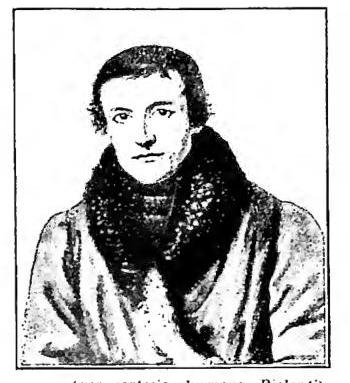
MÖHLER, JOHANN ADAM. – Theologian, born on 6 May 1796 in Igersheim (Württemberg), died on 12 April 1838 in Munich. Having completed his secondary studies at Mergentheim (1809–13) and Ellwangen (1813–15), he enrolled in the Faculty of Theology at Ellwangen (1816–18), which in 1817 was incorporated into the University of Tübingen. He entered the Seminary of Rottenburg in November 1818 and was ordained a priest on 18 September of the following year. In September 1822 he became a lecturer (Privatdozent) in ecclesiastical history in the Faculty of Catholic Theology at Tübingen (extraordinary professor in 1826; ordinary professor in 1828). The violent attacks to which he was subjected by Protestants following the publication of the Symbolik induced him to accept (1835) the chair of New Testament exegesis at the University of Munich. His frail constitution did not withstand his tireless work and, after only a year of teaching, he suspended his lectures in
in search of a more favorable climate (Merano); appointed
dean of the Chapter of Würzburg on
22 March 1838,
after twenty days
he died.
Drey (v.) Hirscher (v.), he underwent
their influence and followed
their method, becoming the leading representative of the
Catholic school of
Tübingen, which
studied Revelation
by the historical-
genetic method (a positive study of Scripture
imposed upon the loyal theologian that concluding chapter which confers upon the work the seal of Catholic orthodoxy. Therefore, rather than being among the origins of modernism, this work, despite the reservations mentioned, should be considered the foundation of that movement which had its glorious culmination in the encyclical of Pius XII, Mystici corporis (29 June 1943).
The writings that followed show the further development of M.’s thought, increasingly directed toward orthodoxy and increasingly fair in its assessment of Scholasticism: Athanasius der Grosse und die Kirche seiner Zeit im Kampfe mit dem Arianismus (Mainz 1827); Der hl. Anselmus von Canterbury (ibid. 1827).
M.’s most important work, with which he founded a new branch of theological science, is Symbolik oder Darstellung der dogmatischen Gegensätze der Katholiken und Protestanten, nach ihren öffentlichen Behentnissschriften (ibid. 1932). Observing that for centuries Protestants had offered courses in their faculties on the doctrinal oppositions dividing Christian Europe, M. thought of transferring this method into the Catholic sphere, introducing a novelty that constituted its most original element and the reason for its success: the rigorously scientific study of opposing doctrines considered in their mutual connection. The work, divided into two parts (I, the dogmatic oppositions between Catholics, Lutherans, and Reformed; II, the doctrinal oppositions between Catholics and the small Protestant sects), proceeds from the central idea of justification to the individual points that flow from the premise as corollaries: it is an ideological movement from the center to the periphery. According to M., the two great historical phenomena of the Renaissance and the “Reformation” are two parallel movements which, by breaking the bonds with the past, in which science and piety were harmonized, produced Socinian rationalism and the Protestant rebellion. Socinianism denies the divinity of Jesus, while Protestantism neglects his humanity; the former exalts reason, the latter despises II. These two errors, continuations of ancient heresies, display common characteristics that constitute the very essence of every heresy: they claim to return to pure Christianity, seeking it in Scripture separated from tradition and the Church. Their subsequent histories are analogous and have led the partisans of the two tendencies along the paths of a destructive critique of every religious foundation. Between the two extreme positions of Lutheran pietism and Socinian rationalism, the Church proceeds securely, recognizing reason’s imprescriptible rights while knowing how to impose serious duties upon it before faith. The success of this magisterial work was incalculable: illustrious scholars of history and philology (Hurter, Bickell, Hammerstein) owed their first step toward Rome to the Symbolik. Döllinger called M. the greatest theologian de re ecclesiologica of the nineteenth century; some Protestants as well (Augusti, Strauss) did not stint in their praise of the author, recognizing his integrity as a historian. There were attacks, however, particularly violent ones from Baur, Nitzsch, and Marheineke. M. victoriously replied with Neue Untersuchungen der Lehrgegensätze zwischen den Katholiken und Protestanten. Eine Vertheidigung meiner Symbolik gegen die Kritik des Herrn Prof. Dr. Baur in Tübingen (Mainz 1934), writing a new and important chapter on the history of Protestant variations: a noble complement to Bossuet’s work. In the Symbolik, M.’s ecclesiological thought reached maturity in the luminous pages where the Church is considered a continuation of the Incarnate Word (an idea later summarized by Leo XIII), and in whose theandric constitution he indicates the foundation of that interweaving of the human and the divine which accompanies the development of the Mystical Body.
M.’s minor writings are numerous (cf. A. Fonck, s. V. in DThC, X, cols. 2054–56). His collaboration with the historic journal founded in Tübingen in 1819, Theologische Quartalschrift, was especially fruitful. A critical and complete edition of the minor works and fragments is keenly desired; their manuscripts are preserved in Munich (at least before the Second World War of 1939–45).
A. M. Ein Gedenklatt zu dessen hundertsten Geburtstag, ivi 1896; L. Monartier, J. A. M. Etude sur sa vie et son temps, Losanna 1897; A. Schmid, Der geistige Entwicklungsgang J. A. M., in Historisches Jahrbuch, 18 (1897), pp. 322-56, 372-99; G. Goyau, L'Allemagne religieuse. Le catholicisme, II, Parigi 1905, pp. 24-42; id., M., ivi s. d.; E. Vermeil, J. A. M. et l'école catholique de Tubingue 1815-40, ivi 1913; L. De Grandmaison, L'école catholique de Tubingue et les origines du modernisme, in Recherches de science religieuse, 9 (1919), pp. 387-409; F. Vigener, Drei Gestalten aus dem modernem Katholizismus: M., Diepenbrock, Döllinger, Monaco 1926; A. Fonck, M. et l'école catholique de Tubingue, in Revue de sciences religieuses, 6 (1926), pp. 250-66; St. Lösch, Die katholisch-theologischen Facultäten zu Tübingen und Giessen 1830-50, in Theologische Quartalschrift, 108 (1927), pp. 159-208; J. Geiselmann, Die Glaubenswissenschaft der katholischen tübinger Schule und ihre Grundlegung durch J. S. Drey, ibid., 111 (1930), pp. 49-117; K. Eschweiler, J. A. M. Kirchenbegriff, Braunsberg 1930; J. Geiselmann, Geist des Christentums und Katholizismus: J. A. M. und die Entwicklung seines Kirchenbegriffs, in Theologische Quartalschrift, 112 (1931), pp. 1-91; P. Pouret, L'unité organique du catholicisme d'après M., in Irenikon, 12 (1935), pp. 328-50, 427-85; M. I. Congar, La pensée du M. et l'ecclésiologie orthodoxe, ibid., 12 (1935), pp. 321-29; L'Église est une. Hommage à I. A. M., Parigi 1938 (con articoli di P. Chaillet, H. Tristram, M. I. Congar); P. Chaillet, Introduction à L'Unité de l'Église, traduit par A. De Lielinfeld, ivi 1938, pp. 9-11; id., Centenaire de M. L'amour et l'unité. Le mystère de l'Église, in Revue apologétique, 66 (1938), pp. 515-40; G. Thils, Le centenaire de M., in Ephemerides theologicae Lovaniennes, 15 (1938), pp. 521-25; J. Geiselmann, J. A. M. und das idealistische Verständnis des Sündenfalls, in Theologische Quartalschrift, 125 (1944), pp. 19-37; F. Hoffmann, J. A. M.: Persönlichkeit und Theologie als Erbe und Verpflichtung, in Pastor Eonus, 40 (1938), pp. 221-40, 347-64; 50 (1939), pp. 12-20; A. Minon, L'attitude de J. A. M. dans la question du développement du dogme, in Ephemerides theologicae Lovaniennes, 16 (1939), pp. 328-84; M.-J. Congar, L'esprit des Pères d'après M., in Esquisse du mystère de l'Église, Parigi 1941, pp. 129-48 con la critica di M.-J. Nicolas, Theologie de l'Église, in Revue thomiste, 46 (1946), p. 372 sgg.; H. Hocedez, Histoire de la théologie au XIXe siècle, I, Bruxelles-Parigi 1949, pp. 231-50 (deciso difensore dell'ortodossia di M.); G. Martini, Catholicismo e storicismo, Napoli 1951, pp. 3-61, 320-26 (di tendenza laicista). Antonio Piolanti