
BOUTROUX, ETIENNE-EMILE-MARIE. – French philosopher, born in Montrouge (Seine) on 28 July 1845 and died in Paris on 23 November 1921. After completing his studies, part of which he pursued in Germany, he taught first at the lycée of Caen, then at the Universities of Montpellier and Nancy, and in 1874 defended his doctoral theses at the Sorbonne. Three years later he took up a teaching position at the École Normale Supérieure, and in 1885 became professor in the Faculty of Letters at the University of Paris. Elected a member of the Academy of Moral and Political Sciences in 1898, he entered the Académie française in 1912.
His fundamental work is his 1874 doctoral thesis: De la contingence des lois de la nature, a book small in size (170 pages in octavo, of which 40 consist of conclusions), but one that marked a turning point in philosophical thought in France. The remainder of his literary activity took the form of numerous articles and several important books: De l'idée de loi naturelle dans la science et la philosophie (1895; Italian translation by E. Liguori-Barbieri, Florence 1925); Questions de morale et d'éducation (1895); Etudes d'histoire de la philosophie (1897); Pascal (1900); Sciences et religion dans la philosophie contemporaine (1908); Nouvelles études d'histoire de la philosophie (posthumous; Paris 1925).
As a historian of philosophy, B. possessed uncommon gifts of insight and clarity. Presenting the most diverse doctrines—those of Socrates, Jacob Böhme, Pascal, Leibniz, Kant, William James, Henri Poincaré, and others—he examines them from within, with a sympathy that enables him to grasp their coherence, depth, and value.
His importance, however, lies in having opposed his philosophy of contingency to triumphant scientism.
The incessant development of the sciences and the positivistic interpretation of them had led people to conceive reality as subject to a rigid determinism, according to which every change and every novelty was merely the equivalent, in another form, of pre-existing states. It was repeated: “Nothing is created, nothing is destroyed.” Inflexible laws contained within beings regulated their activity and their reciprocal relations. The rigidity of the world of matter was extended to the world of spirit, both because the latter depends on the former and because psychological acts were subjected to the same determinism as physical or biological facts. H. Spencer was the standard-bearer of this current of thought, which regarded a higher degree of being as simply a higher degree of complexity, and held that the formation and dissolution of combinations obey universal laws incompatible with any true freedom.
Now, B. observed, such a conception implied that in the facts of experience the consequent was always the quantitative equivalent of the antecedent and nothing more. This supposition is not in agreement with the facts: quantity is never alone, but always exists with and beneath quality, which has no quantitative equivalent; motion does not disappear in becoming heat, but subsists beneath the heat. Moreover, there are different degrees of being: the mineral, the living, and the thinking. The emergence of a higher degree must indeed coincide with a determinate act of matter, but it is not identified with that act, nor can it be caused by it; on the contrary, higher forms are the cause of the material conditions they require. One may perhaps conceive the history of beings as a continuous evolution, but this evolution is at the same time a continuous creation: the higher never comes from the lower, but always derives its origin anew from above. We thus move beyond the necessity associated with a purely quantitative conception, and the existence of quality and finality is acknowledged. Finality presupposes at least a supreme, intelligent, and free principle—God, author and ruler of the universe—who communicates to the higher degrees of being their power over the lower.
These thoughts of B., so opposed to those then dominant in university circles, were later found, although in a new form and with various modifications, in the systems of Bergson and Blondel, just as they inspired the philosophy of science that appeared toward the end of the century in the works of Poincaré, Duhem, and Le Roy.
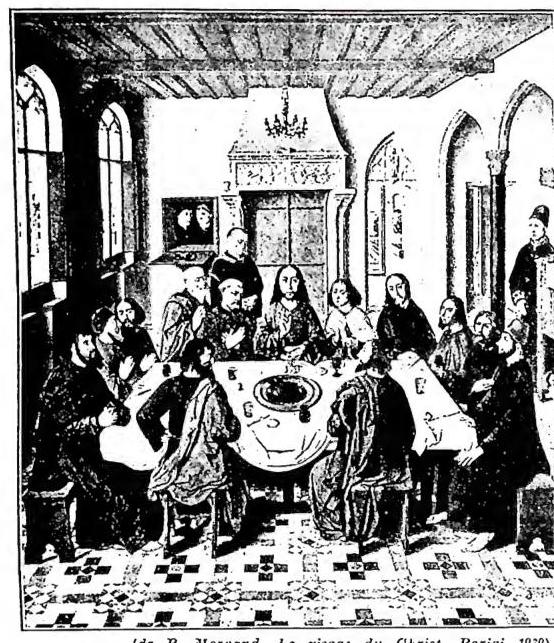
BOUTS, DIRK - The Last Supper - museum of Lovanio.
A sympathetic but inconclusive attempt, because weakened by a certain latent rationalism that introduces too absolute a distinction between the scientific and religious spirit, as between morality and religion.