
FINITE. — That which has an end, that is, a “limit” in any order. A number is f. when it results from the repeated addition of the same unit; a quantity is f., in the order of spatial and temporal magnitudes, when it can be measured by f. numbers (otherwise it is indefinite). In the ontological order, every material substance is f., since its form is limited by matter; every created substance is f. in the order of being, since it is a participation in the infinite perfection of the divine essence. The f. may therefore have as infinite (v.) or the negative infinite.
FINKE, HEINRICH. [- Eminent medievalist, born at Krechling in Westphalia on 13 June 1855, died at Freiburg im Breisgau on 14 December 1938. After graduating from the University of Tübingen, he devoted himself to historical studies, especially those of the late Middle Ages, in which he became a scholar of international renown. His studies on the Council of Constance led him to the Archives of the Crown of Aragon in Barcelona, where he found an inexhaustible mine of documents for the political, religious, ecclesiastical, and cultural history of Europe in the 13th–15th centuries, some of which he made accessible through his imposing publications. Professor at the University of Freiburg (1899–1928), he trained a host of students who continued their master’s work. A Catholic layman of unimpeachable integrity, he took part in every manifestation of the cultural world; he was pre-
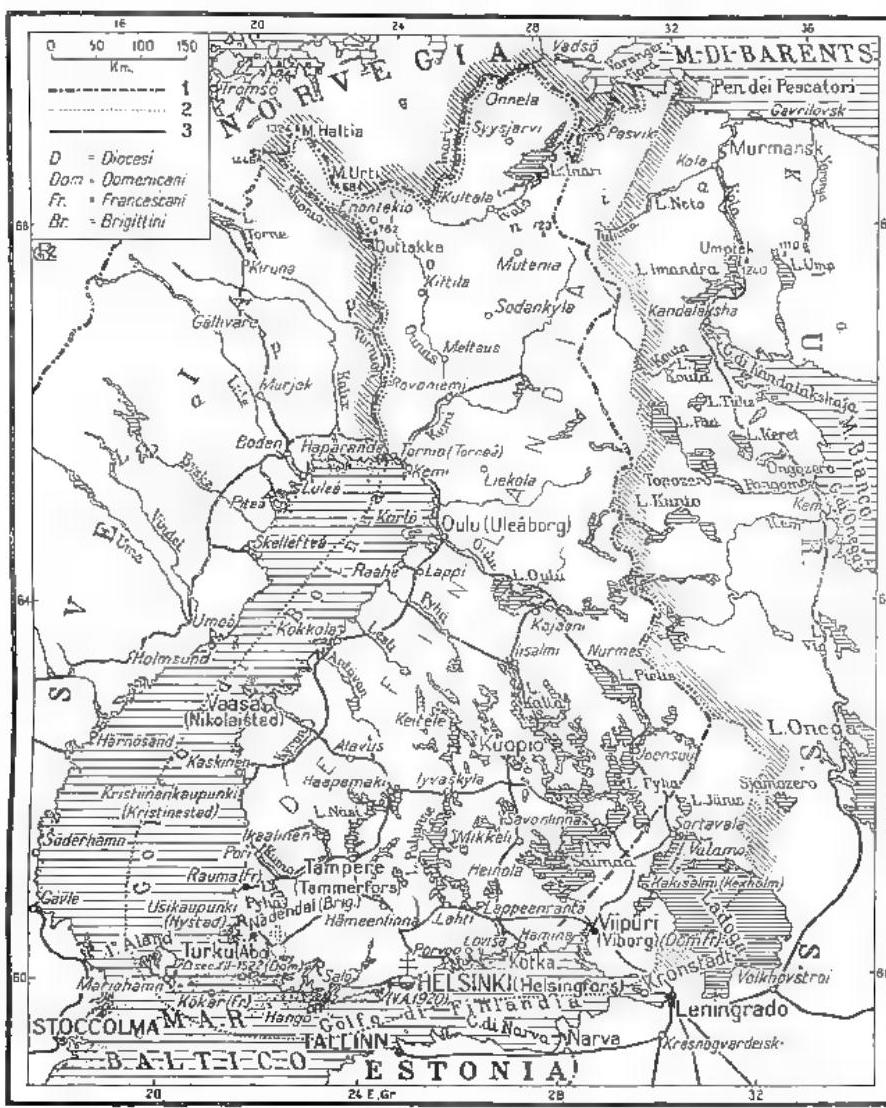
an extensive plateau resulting from the leveling of an ancient formation of granite rocks, on which the Quaternary glaciations left a thick layer of sediments and created a labyrinth of lake basins (more than 35,000). The surface area of these basins occupies one-eighth of the country, which is still covered by forest over more than two-thirds of its extent.
The climate is continental in character, though milder than that of the neighboring Russian plain; in the northern regions, however, it becomes harsher, and the tundra dominates (Lapland). Barely 7.4% of the country’s surface consists of arable land and 1.3% of pastureland; nevertheless, agriculture and livestock raising constitute the predominant occupation (60%) of the inhabitants, both being practiced intensively and with modern methods. The principal crops are cereals (oats, rye, barley); the cattle stock permits the large-scale export of butter. But the country’s richest resource is forestry, which sustains an intense and flourishing industrial activity (sawmills, woodworking, furniture manufacturing, wood pulp, cellulose), widespread espe-
sident of the Görresgesellschaft from 1924 until his death, and in that capacity he headed the section for Spain.
His works of general interest are: Forschungen und Quellen zur Geschichte des Konstanzer Kanzils (Paderborn 1889); Acta Concilii Constantensis (4 vols., Münster in Vest. 1896–28); Aus den Tagen Bonifaz VIII (IV. 1902); Publizum und Untergang des Templeverdens (2 vols., IV. 1907); Acta Aragonesis (3 vols., Berlin–Leipzig 1908–22, with a supplement published in 1933).