
ACQUA. - I. A. IN THE SCIENCES. - Every form of life, including human life, takes place in an aqueous environment. Some animals, such as jellyfish, contain more than 95% water: even in the human organism the quantity of water is considerable and decreases with advancing development and senescence: 97.5% in an embryo one and a half months old, 82.9 in the four-month-old fetus, 71.2 in the newborn, 64.5 in the adult, 58.3 in the old person. All the chemical reactions of the organism take place in water; and the respiration of terrestrial animals, including humans, is possible because the oxygen in the air dissolves in the aqueous film that moistens the pulmonary alveoli or other surfaces performing a similar function (v. HOCITUTICA, REPUTAZIONE). Of interest are the mechanisms by which living beings appropriate the water contained in the environment, defend themselves against excessive loss of water, and repeatedly exploit the same mass of water for the transformation of considerable quantities of organic matter. Indeed, large quantities of it are required for the various vital functions: to form one kg. of dry organic matter, plants require from 500 to 700 litres of water, and in the formation of the chick the limited quantity of water contained in the egg is exploited innumerable times.
Knowledge of the physical and chemical properties of water is important not only for chemistry and biology but also for the entire economy of our planet, for explaining its geological history and its present geophysical appearance. The erosion of igneous rocks, the formation and subsequent transformations of sedimentary rocks, phenomena in the troposphere, and many others are connected with the presence and action of water; and with water, insofar as it is human nourishment, a condition of plant life, and a means of river and maritime communication, are connected the distribution of life on earth and the formation, migration, and cultural development of human groupings.
The molecule of water consists of an oxygen atom bonded to two hydrogen atoms, which form with the former an angle of 104°31'. In this combination the hydrogen atoms acquire a positive character, while the oxygen atom acquires a negative character, so that the molecule exhibits electrical polarity which, together with more complex reasons of a quantum-mechanical order, causes the association between molecules and, ultimately, some extremely important and singular anomalies in the physical properties of water, which will be recalled here.
Water has a density (1.000) considerably lower than that which it should have (approx. 1.84), depending on its molecular radius (1.40 A; one Angstrom = 1/100,000,000 of a cm.), if its structure were not associated but were that of ideal monoatomic liquids. It is a general rule that the volume of bodies decreases as the temperature falls and in the transition from the liquid to the solid state. Water too contracts on cooling, but only down to 4°; with continued cooling it expands slightly until solidification, which is accompanied by a considerable increase in volume: 100 vol. of water at 0° (dens. 0.099868) yield approximately 109 of ice at 0° (dens. 0.91697). These facts are explained: 1) by the formation, through cooling, of polymer molecules (associations of two or more simple molecules) at the expense of monomeric (or simple) ones; 2) by the existence of a crystalline structure even in ordinary liquid water; 3) by the particular crystalline structure of liquid water and ice, as a result of which the molecules, in associating into crystalline groupings, assume a more spread-out arrangement and thus come to occupy a larger volume. One consequence of great importance in nature follows from this: the ice that forms on seas and lakes, being lighter than water, does not sink to the bottom but remains on the surface; and, being a poor conductor of heat, it prevents the freezing of the water beneath II. Thus the solidification of immense masses of water is avoided, and marine and lake life beneath the ice crust is made possible. When water freezes in a confined environment it can develop strong pressures capable even of bursting steel bombs several centimetres thick: this explains the action of frost in producing the disintegration of rocks.
Water crystallizes in the hexagonal system (v. CRISTALLO): groups of star-shaped crystals are observed in snow.
It is calculated that if water did not form molecular associations but had the constitution of ideal liquids, it should melt at — 130° and boil at — 100°; at ordinary temperatures liquid water could not exist, and all the water on our planet, instead of being found in seas and rivers, would constitute the greater part of the atmosphere. The values of the specific heat too (close to
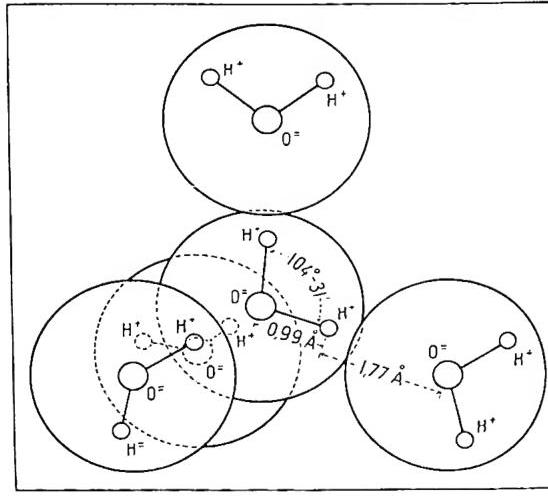
ACQUA—Diagram of the physical structure. In the crystalline state, and partly also in the liquid state, each molecule of a. is bound by intermolecular forces to four other molecules arranged around the former like the vertices of a regular tetrahedron around its center: the protons, or positive nuclei of hydrogen, of each molecule are directed toward the (negative) oxygen atom of two other molecules contiguous with the first.
1.00 at all ordinary temperatures), the latent heat of fusion (79.2 at 0°), and the latent heat of evaporation (595 at 0°, 585 at 20°, 574 at 40°, 540 at 100°) (v. TERMOLOGIA; UNITÀ E DIMENSIONI FISICHE) are greater than the corresponding quantities of almost all inorganic and organic substances. This must be attributed not so much to the associated state of the molecules as to the exceptionally low molecular weight of a. (18.016). Indeed, the same quantities referred to the gram-molecule, obtained by multiplying the specific quantities (expressed in cal/g or Cal/kg) by the molecular weight, are entirely normal when compared with those of other substances. Because of its high values of specific heat and latent heats of fusion and evaporation, a. is a great thermal regulator of the surface of our planet. The high value of the surface tension of a. (7.692 mg/cm at 0°, 7.086 at 40°), together with its capacity to adhere to the surface of many bodies (to wet them), is important in geology and biology for the phenomena of imbibition, capillarity, swelling, etc.
A. has been chosen as the reference substance in the definition of certain physical units (v.).
The particular manner in which its molecules associate partly accounts for the high value of the dielectric constant of a. (88 at 0°, 80.5 at 20°, 73.4 at 40°, 70.5 at 50°). This constant (v. ELETTROLOGIA) represents the extent to which the force of attraction between two electric charges of opposite sign is reduced when a. is interposed in place of a vacuum (practically, air), and it appears in the denominator of Coulomb’s classical formula. The high value of this constant explains the strong ionizing power of a.: salts, acids, and bases dissolved in it undergo electrolytic dissociation into a cation (or positive ion) and an anion (or negative ion). In turn, precisely because of their electric charge and the polarity of the molecules of a., these ions become hydrated—that is, they bind, more or less weakly or strongly, to an indeterminate number of molecules of a.; and the ions thus hydrated acquire certain characteristics of a. itself. This explains the high solvent power of a. for the greater part of substances, especially those of a saline nature. A. is also a good solvent for many non-ionizable substances, and this is explained by the presence in the molecules of these substances of:
1) partially polar bonds; 2) an asymmetrical distribution of electric charges; 3) groupings that react with a., forming polar bonds: all circumstances that favor the formation of associations between the molecules of the solute and those of the solvent.
In addition to being ionizing as a solvent, a. is itself ionized: one liter of a. at 22° contains 10⁻⁷ gram-molecules of a. dissociated according to the equation H₂O ⇌ H⁺ + OH⁻; and since one liter of a. contains 1000 : 18 = 55.6 gram-molecules, it follows that there is one dissociated molecule for every half-billion molecules (0.556·10°). At 6° the dissociation of a. is 1.3 times, and at 100° approximately 8 times, that measured at 22°. This dissociation, however slight, must be regarded as responsible for the capacity of a. to participate in many chemical reactions, some of which are fundamental to life. A. is indeed not only an essential constituent of living cells in every form of life, but also participates, no less than the other constituents, in marvelous biophysical and biochemical reactions. The imposing process of carbon fixation by green plants (v. FOTOSINTESI CLOBOFILLIANA) takes place with the intervention of a.; its oxygen is eliminated as gaseous molecular oxygen, while its hydrogen reduces carbon dioxide CO₂, with the formation of a. and a series of intermediate products, still poorly known today (1948), from which carbohydrates (starch and sugars) are ultimately formed. A. also participates in the oxidation-reduction phenomena that constitute cellular respiration.
Ordinary a. is a mixture of approximately 5000 parts of a. H₂O and one part of “heavy a.” D₂O: the latter differs from the former in having, in place of hydrogen with atomic weight 1, an isotope of hydrogen, heavy hydrogen or deuterium, with atomic weight 2 (it would be more accurate, however, to say that ordinary a. is a mixture of approximately 5000 parts of a. H₂O and 2 parts of water HDO, in which one oxygen atom is joined to one hydrogen atom and one deuterium atom). The content of heavy a. in natural waters is not uniform. Heavy a. has been obtained in a pure state: it has a density (d 20°/20°) of 1.10714, boils at 101°.42, solidifies at 3°.82, and has its maximum density at 11°.6.
BIBLIA. Fundamental works for the knowledge and theoretical explanation of the chemical and physical properties of water and its exceptional behavior: J. D. Bernat and R. H. Fowler, in The Journal of Chemical Physics, 1 (1933), pp. 515-45; R. H. Fowler and J. D. Bernat, in Transactions of the Paradox Society, 29 (1933), p. 1049; for chemical and physical properties and other information: P. Pascal, Traité de Chimie Minérale, I, Paris 1931, p. 121 1932; P. Rondoni, Elementi di Biochimica, 5th ed., Turin 1945; G. Oddo, Trattato di Chimica Generale ed Inorganica, 3rd ed., Palermo 1947. Cesco Toffoli
2. IN NON-CHRISTIAN RELIGIONS
Water, which by its natural properties serves to cleanse from all filth, was chosen from the most remote times, among all peoples, as a symbol of an interior purifying action. The mystery of its origins within the earth's depths, its voice now gentle and now powerful, its mobility as of a living thing, its breath revealed in evaporation, its power of irrigation—whether gushing from the earth or falling from the sky—have always led it to be considered a living and beneficent force. It is present in various forms: in the sea, in lakes, in rivers or torrents, and all these elements have been divinized and honored with cult; but especially the water that springs from the soil—called by Seneca (Quaest. nat., 3, 8) «viva seu nativa» to distinguish it from that which falls from the sky «caelestis seu collectiva»—has risen to sacred and at the same time cathartic, fecundating, and divinatory value among various peoples.As a fecundating element, water has everywhere been an object of cult. The Greeks expressed this power in various myths, where the nymphs, patrons of springs, signify, by their very name, its power of fertility. As a divinatory element, water acts either through the murmur of springs, through the casting of objects into it, or through ingestion: at Delphi, the Pythia, before ascending the tripod, tasted the water of the sacred springs Castalia and Cassotis. The divinatory power was revealed especially in cases of ordeal or «judgment of God» when it was a matter of judging the guilt of an accused, the legitimacy of a birth, etc. The safety of the individual thrown into the water was proof of his innocence.
As a lustral element, water has no equal for its capacity not only to wash but also to carry away, by flowing, impurities. Naturally, the number and manner of ablutions vary in different ceremonies, depending on the nature of the fault or the preparation necessary to approach or touch sacred things, to receive an initiation, etc. Precisely water, in baptism, is the matter that symbolically expresses the spiritually renewing power of Christian initiation, the cancellation of the stain of original sin and, where applicable, of actual sins. A particular case of water's lustral power is that represented by salutary or thermal waters, discussed below.
As a giver of oblivion, and thus in its own way a healer, water also holds a large place in myths of the afterlife: one need only think of the water of Lethe (whence the word lethargy) that grants the utmost oblivion at the entrance to Hades. The location of the underworld (where neither rivers nor lakes are lacking), situated in distant places reached by means of boats, may have been suggested by the experience of primitive navigation on rivers beyond the horizon or on the boundless sea. Nicola Turchi
3. HOLY WATER
It is the most common sacramental (v. SACRAMENTALI) of Catholic liturgy. Moses (Num. 19, 9-18) prescribed it mixed with the ashes of the burnt offering pro peccato, to cleanse those touched by legal impurities. Once worship was fixed in Jerusalem, the water of the fountain of Siloam served for the sacred uses of the Temple.Regarding Christian liturgical use, a distinction must be made between the water that today serves exclusively for conferring baptism, prepared on the vigil of Easter and Pentecost with the infusion of the oil of catechumens and chrism (baptismal water), and simply blessed water (holy water), which the Church commonly uses, preparing it with a mixture of salt while reciting appropriate prayers. This mixture of salt, a symbol of incorruptibility, was inspired not so much by the biblical fact of the prophet Elisha (II Reg., 2, 20-21) who healed with salt the waters of Jericho, as by the widespread belief that salt was endowed with a repulsive virtue against demons (A. Franz, I, p. 133).
The preparation of holy water, according to the prescriptions of the Roman Ritual, involves: a) an exorcism on the salt and water to purify them from any impure or harmful influence; b) a blessing on both, so that the salt «may be to all who taste it health for soul and body» and the water «may receive the virtue of divine grace to drive away demons, to heal diseases, so that whatever in the houses and places of the faithful shall have been sprinkled with this water, may be preserved from all filth and freed from all evil.»
The current formulas were already contained in liturgical books at the end of the 7th century (Sacram. gelasiano, III, 75-76; L. Muratori, Lit. Rom. Vet., I, 738-40), except for that of the mixture («Commixtio, etc.») introduced after the 9th century.
The use of holy water is attested in the East from the 3rd century, though the Greek Church in blessing it always excluded salt. In the West, its existence is not certainly attested before the 6th century, the time of the oldest redaction of the Liber Pontificalis. This attributes its institution to a decree of Alexander I (105-106?): «Hic constituit aquam sparsionis cum sale benedici in habitaculis hominum» (Lib. Pont., ed. L. Duchesne, I, 127). The decree is certainly apocryphal. It is difficult to believe that the Church would have appropriated in the 2nd century such a characteristic pagan use, in which Tertullian and other Fathers saw magic. But later, when Christianity had already imposed itself on the masses, it could consent to sanctify, like so many others, even the in itself innocuous use of lustral water. In any case, holy water was first blessed in houses for their purification; later the rite was performed in churches for similar purposes. For example, Pope Vigilius in 538 assumes it as a necessary element for consecrating a new church. The 7th Roman Ordo of the same period (cf. M. Andrieu, Les Ordines rom., I: Les Manuscrits, Louvain 1931, p. 168) allows that on Holy Saturday the faithful may draw from the baptismal font the water itself, consecrated with chrism, to sprinkle in houses and fields. Later this was expressly forbidden; and it was permitted only to draw it before the priest had infused the chrism, as the rubric of the Roman Missal still prescribes. The Latin Church still makes very broad use of holy water, especially in exorcisms and in the blessing of persons and things. Its use is regulated by the norms indicated in the Roman Ritual. A solemn blessing of water, in memory of the baptism of Jesus, is performed on the day of Epiphany (6 Jan.) by the Greek Church. In the past, it was also performed in many Latin churches in southern Italy, Magna Graecia, the Venetian coast, at Aquileia, and even in Rome (cf. C. Respighi, La bened. sol. dell'a. nell'Epifania, in Rass. Greg., 10 [1911], p. 54). In general, the formulary adopted for this function in most of the aforementioned churches had nothing in common with the official text of the Byzantine Church. Wilmart (in Rev. Bénéd., 29 [1912], p. 29), who published an ancient recension of it (9th-10th centuries, for use, it seems, in an Italian church), notes the characteristic epiclesis contained therein: «Tu Jordanis aquas sanctificasti hodie, e coelo mittens Spiritum tuum Sanctum... Tu ergo, piissime Rex, adesto nunc per adventum Sancti tui Spiritus et sanctifica aquam istam.» The blessing concluded with the Te Deum.
A particular holy water, prepared with salt, wine, and ash, is prescribed by the Roman Pontifical for sprinkling the external and internal walls of a church with a hyssop branch during the solemn rite of consecration. This water, in rituals after the year 1000, is called gregoriana, perhaps because St. Gregory alludes to it in his famous letter to St. Augustine of Canterbury: Aqua benedicta fiat, et in eisdem fanis aspergatur (Epist., IX, 71). However, St. Gregory does not specify which elements were used to compose II. The Gelasian Sacramentary (I, 78; cf. L. Muratori, Lit. Rom. Vetus, I, 610) for the dedication of a new church contains a formula for the blessing of a mixture of water and wine but makes no mention of the other two elements, salt and ash. All three, however, appear in liturgical use in the Ordo dedicationis ecclesiae published by G. Bianchini (Anast. Bibliot. Opera, t. III) according to a codex from the Capitular Library of Verona written around 830. This represents the pure Roman rite. The blessing of Gregorian water is reserved to the bishop.
4. SALUTARY WATERS
An old medical interpretation, still followed by many historians of medicine, sees in lustral rites nothing more than hygiene precepts veiled by religion, whereas in fact they must be considered as ritual acts aimed at restoring a lost state of purity.Thus, they often coincide with precepts now defined as hygienic. In these rites, water has the principal role: recall the baths in rivers and springs found in all civilizations and religions. A spring had to exist in Asclepieia; it was the water sacred to the god, an essential condition for healing. Countless shrines, small temples, votive altars, etc., were built near spring sources, especially mineral waters endowed with particular therapeutic virtues. This marks the transition between the recognition of water’s natural virtues and its sacralization.
With the advent of Christianity, the cult of salutary waters could not be eradicated from the mentality of the masses, who continued to flock to certain springs and fountains or to use, for curative purposes, this or that water once sanctified by this or that deity. Unable to eliminate such practices, the primitive reason for their beneficial effect was changed; a new power was attributed to the ancient salutary waters through the proximity of martyrs’ bodies, miraculous events connected to them, etc.