Machine translation of the 1948–1954 Italian original. The original text is authoritative.
MANISMO. - From the Latin manes "the good ones", a euphemistic epithet referring to the deceased, manism is the theory that explains the origins of religions from ancestor worship.
Even Euhemerus had maintained that the gods were originally illustrious men, kings, sages, priests,
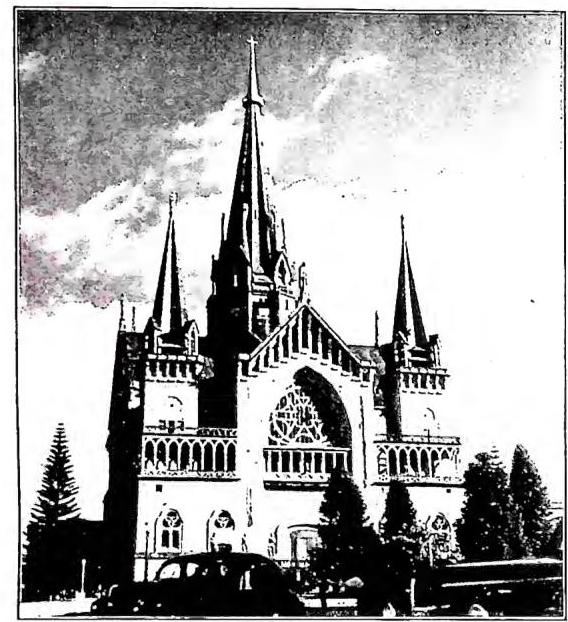
(courtesy of Mons. A. P. Frutaz) MANIZALES, DIOCESE OF - Facade of the cathedral of M.deified by the veneration that arose at their tomb. And N. D. Fustel de Coulanges, in a suggestive study on the institutions of the ancient city, La cité antique (Paris 1874; Italian trans. by G. Perrotta with notes by G. Pasquali, Florence 1923), placed the cult of the dead as the beginning of the religion of Indo-European peoples: "it seems that religious sentiment began from here. Perhaps in the presence of death man had for the first time the idea of the supernatural" (p. 18). This theory received indirect confirmation from E. B. Tylor in his well-constructed study on primitive civilizations, Primitive culture (2 vols., London 1872), who placed the origin of the idea of the spirit—developed around the tomb of the illustrious ancestor of both family and tribe—in the phenomena of dreams, hallucinations, and finally death. But H. Spencer gave it a more complete formulation in Principles of Sociology (3 vols., London 1876-1882-1896), in the first of which he, by understanding ancestor veneration as encompassing all forms of veneration of the deceased, concludes that "this is the root of every religion" (p. 503).
The manistic theory is not sufficient to explain the origin of religion because it takes no account either of the fantastic and myth-making element aroused in man by the spectacle of nature, which is reflected in the varied and sometimes extremely rich mythologies, or of the logical faculty that has forged among so many primitive groups the figure of the Supreme Being, whose existence provides the primitive with the explanation of his origin, of the norms that regulate the life of the tribe, and of the sanctions that await those who transgress them.
For manism insofar as it refers to beliefs about the afterlife and practices relating to the dead, V. DEFUNTI, VENERAZIONE dei.
BIBL.: E. Rohde, Psiche, trad. it., 2 voll., Bari 1914-16; W. F. Otto, Die Manen, Berlino 1923; J. P. Jacobson, Les Manes, trad. franc., Parigi 1924. Nicola Turchi
Cite this article
“MANISMO.” Enciclopedia Cattolica, vol. VII (1951), p. 1165. Azione Romana digital edition, https://azioneromana.com/article/manismo.