
MANIPOLO (manipulum, mappula, fano, sudarium, mantile, manuale, sestace). — Liturgical vestment worn on the left forearm so that two bands hang down on either side, made of the same fabric as the chasuble. The manipulo is proper to all major orders, especially the subdiaconate, since this began to be counted among the major orders (11th–12th centuries). It is used, besides at Mass, only at the Epistle and Gospel during the blessing of palms, and at the Exultet on Holy Saturday; it is never used with the cope. The bishop places the manipulo on the altar after reciting the Confiteor; the priest after the cincture, before the stole; the ministers after the tunicle or dalmatic.
The manipulo, of Roman origin, derives from the mappa or mappula, a kind of pocket handkerchief used by Roman nobles on certain gala occasions (high state officials, e.g., consuls in ceremonial dress as seen in consular diptychs), held in the hand as a mark of etiquette and merely for ornament. This decorative mappula came from the common one (Amalarius, De eccl. off., II, cap. 24). It is not known precisely when the manipulo entered sacred furnishings. The first notice of a diaconal manipulo is found in the lives of the popes Sylvester I (314–24) and Zosimus (417–18) in the Liber Pontificalis; it is called “pallium linostimum,” a precious cloth of wool or silk on a linen warp, given as an honor to be worn on the left hand. The Pope’s manipulo appears in the Ordo Romanus I (its delivery serving as a sign to begin the Introit chant); the subdeacon’s in the Ordo Romanus VI; sometimes acolytes too (Ordo Romanus V) used the manipulo, but not in hand, “in sinistro latere ad cingulum,” and Cluniac monks on feast days; later, however, the use was reserved to monks of major orders (subdeacons, etc.). The manipulo was the prerogative of Roman clergy, but from St Gregory the Great, at Ravenna’s insistence, it was granted also to the first deacon of that cathedral. In the 9th century the manipulo is found in use everywhere in the West. At Rome it is char-
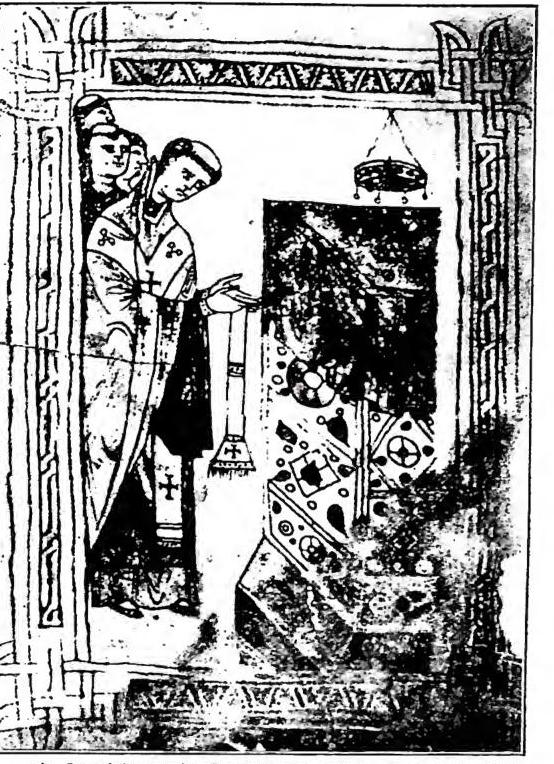
MANIPOLO — Vescovo with a manipolo. Praeparatio ad missam, but executed by Bp. Warmondo (967–1015) — Ivrea, Biblioteca capitolare, cod. IV.
Called mappula outside Rome, the latter term became standard; other names recur: fano (phano-cloth) and mantile in Rabanus Maurus, sudarium in Amalarius, sestace at St Gall.
Down to after 1100 (v. Rome) the manipolo was carried in the left hand; toward the 12th–13th centuries it began to be fixed on the forearm. The manipolo retained its ancient handkerchief shape beyond the 9th century; later, folded over, it gradually took on the form of a strip or band. By the close of the 14th century the modern form had become current. In Amalarius’ day it was made of wool; silk was later used; fringes, sometimes bells, embroidery or gold threads were added at the ends. The rubric of the Missal prescribes only an ornament with a cross in the middle. In the Greek rite there is a vestment corresponding to the manipolo, called encheirion, proper to the bishop alone, worn to the right in the girdle, not in or on the hand; it was later transformed into the rhomboidal epigonation (J. Braun [V. BIBLICA.], pp. 550–54).