
CANCELLO. – A movable closure made of metal or wood; if fixed and continuous, in which case it is sometimes made of stone, it is called a cancellata; if used inside churches, it pluteo (v.).
No examples of cancelli properly so called have been preserved from before the 12th century; they become increasingly frequent, however, from the 14th century onward; at that time the Gothic taste had the opportunity to express in them all its elegant ornamental stylization. Among the many 14th-century wrought-iron cancelli still in existence, we may recall that of the collegiate church of Bobbio, which perhaps provides the first example of a cresting with floral ornaments; that of Orvieto Cathedral, the work of Conte di Lello da Siena and his son Giacomo (1337–38); and that of the Rinuccini Chapel in S. Croce in Florence (1371), highly elegant, with quatrefoils within circles and slender columns supporting pointed arches and
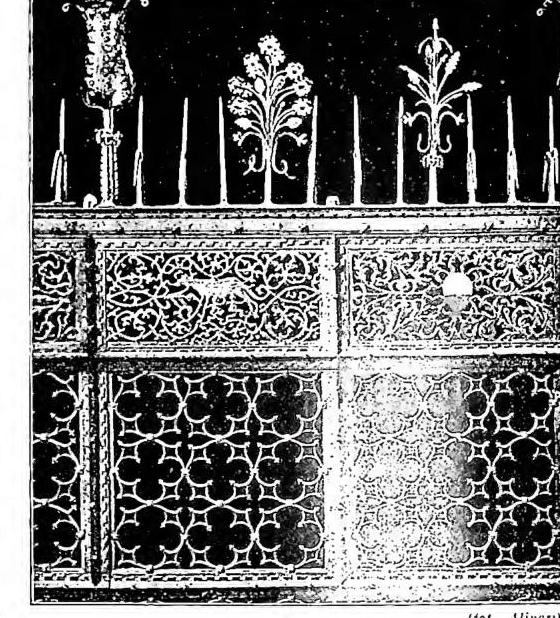
Among the grilles in which a marble framework frames metallic elements, the grille of the tabernacle of Orsamichele in Florence should be recalled: bronze hexafoliate motifs within marble frames, probably based on a design by Orcagna (1366). Among fifteenth-century grilles, in addition to the iron one in the chapel of Cardinal Branda at S. Clemente in Rome, mention should be made of the bronze one in the chapel of the Holy Girdle at Prato and that of the chapel of the Council in Siena. Typical is the marble grille of the Sistine Chapel in the Vatican, the work of Andrea Bregno’s workshop.
In the following centuries, the c., almost always made of iron and often ornamented with brass, gradually became more imposing and richer, in accordance with changes in taste, and sometimes represent with evident clarity the evolution and characteristics of taste in the various regions. The examples are innumerable. We may cite the c. of the chapel of the Madonna in the Annunziata at Trapani, the work of Giuliano Musarra (1591); that in the chapel of S. Gennaro in the cathedral of Naples, based on a model by Cosimo Fanzago (second half of the seventeenth century); that in the presbytery of the basilica of S. Antonio at Padua (Camillo Mazza, 1661); that of the basilica of S. Pietro, which served as a model for the c. of many other Roman churches of the seventeenth and eighteenth centuries. The doors of Sansovino’s loggetta in Venice, the work of Antonio Gai (1734), deserve particular mention; as does the c. of the altar of the scuola of S. Rocco in Venice, by Giuseppe Filiberti and son (1751).
Among modern works, we may cite the grille in front of the Colleoni Chapel in Bergamo, designed by the architects Muzio and Moretti, and modelled and cast by Giovanni Lomazzi (1912–13).
In France, wrought iron was used in c. from the end of the thirteenth century; during the fourteenth century, grilles were also made of iron sheet applied to a framework. In the fifteenth and sixteenth centuries, richly worked marble screens were constructed, such as those of the cathedrals of Amiens and Chartres, which take the distinctive form of the Jubé (v. coro).
We should also recall the grille originating in Angerolles and later placed in the Cluny Museum. In the seventeenth and eighteenth centuries, the
c., in accordance with the taste of the period, assumed an exceptional richness of forms and movement of lines.
In Germany, Austria, and England as well, c. took on distinctive forms, almost always more complex than their contemporary Italian counterparts. The same was true in Spain, where in the sixteenth century rich iron and bronze grilles are found; those of the cathedrals of Valencia, the work of Francesco di Villalpando; those of Pamplona, Saragossa, Burgos, Toledo, Seville (the cathedral choir), and Salamanca deserve particular mention. All these works unite the nobility of conception on the part of the designers with great skill on the part of the craftsmen. - Vedi Tav. XL.