CAMPANA. —
A bronze instrument shaped like an inverted cup, which sounds when its walls are struck by a clapper on the inside or by a hammer on the outside. Its use dates back to the most remote antiquity.
I. HISTORY
According to Isidore of Seville (Origines), the word c. derives from Campania, where the first c. are said to have been made from the local bronze called campanum; since one of the workshops producing them was located at Nola, legend attributed the invention to s. Paolino, bishop of that city (409–431). Similar instruments, though of smaller dimensions, certainly existed earlier, and from these was derived the c. used in Christian worship.The ancient peoples of Europe perhaps did not know bells; it appears, however, that large ones were made in the East before Christianity: in China they were cast in the 5th and 6th centuries, and some still remain in Buddhist monasteries. It is impossible to determine when Christian worship began to use them. We see, however, that from as early as the 6th century the terms c. (campanam) and signam occur in Latin documents; the former alludes to the region of origin, the latter to the use for which the object was intended, and certainly by the 7th century bells were in use in Italy, Gaul, and the British Isles; according to the Liber ordinum, Spain had also known them for some time.
In the 8th century Pope Stephen II (752–57) had a bell tower with three c. built in S. Pietro. The use of bells was in fact soon linked with the construction of the bell tower, which arose from the need to raise the bells so that their sound could spread suitably.
The earliest c. were made of hammered iron sheet and had an almost tubular shape, slightly widening toward the bottom; in the 7th and 8th centuries they began to be cast in bronze, with an alloy composed of four parts copper and one part tin. It is uncertain whether silver was sometimes added; more probably, the alloy contained lead, and certainly antimony, which Italian founders of the 14th century used to strengthen the sound. In the 17th century, in Austria, Germany, and Switzerland, iron bells were also cast, though only for a short time; in the 19th century, some were likewise made of steel.
Bells had been cast since the 9th century in itinerant workshops. The craft was passed down from father to son; in France we find the De Croisilles active in the 13th–14th centuries, and we know of many German and Dutch families working until the 18th century. In Italy, from the 13th century onward, the Pisan, Lucchese, and Florentine founders were particularly distinguished (Bartolomeo, Loteringio di Bartolomeo, Guidoccio, Guidotto and Andrea Pisano di Guidotto, Bonaguida and Rico Fiorentini, Andreotto and Giovanni). Many of the bells in Italian cathedrals date from the 16th century.
Quite early, inscriptions began to be placed on bells, bearing the names of saints, the names of founders and donors and the date, as well as phrases relating to the object’s purpose; the practice spread more widely in the 12th century. Inscriptions that frequently occur are those taken from the epitaph of s. Agata: Mentem sanctam spontaneam, honorem Deo et patriae liberationem and the other Vox mea, vox vitae, voco vos ad sacra, venite. Bells were also embellished with various ornaments, such as figures of saints, etc., produced with molds sometimes prepared by artists of considerable merit.
In Italy, Rome had the greatest number of bells and also those of the largest dimensions; probably among the oldest is the bell found at Canino, cast in bronze and adorned with two raised crosses and an inscription, dating from the 8th century or the beginning of the 9th (Lateran Museum); as is also that of S. Benedetto in Piscinula; those of S. Cosimato (1238), S. Adriano (1249), S. Maria in Domnica (1288), and S. Maria in Cosmedin (1289). Also dating from 1289 are one bell of S. Maria Maggiore (Lateran Museum) and another of S. Pietro in Vaticano, works by Guidotto Pisano, assisted by his son Andrea in the one from S. Maria Maggiore, with inscriptions and the names of the authors. Two other bells of S. Maria Maggiore are one from Guidotto’s workshop (late 13th or early 14th century) and another from a 14th-century foundry. The bells of S. Maria Maggiore were considered the finest in Rome and were famous for their harmonious sound, attributed to the presence of silver in the alloy. In S. Nicola in Carcere there are still two bells by Guidotto Pisano, bearing the date 1286 and the founder’s name. Also by Guidotto Pisano is the bell of S. Angelo in Pescheria, dated 1291 and likewise bearing an inscription. Bartolomeo Pisano cast bells for S. Francesco d’Assisi in 1239 and for many other Tuscan churches (Pisa, S. Paolo a Ripa, 1242; S. Cosimo, 1248; Florence, museum of S. Marco, 1249); Loteringio, his son, cast those now in the museum of Lucca (1242) and those of the bell tower of Pisa (1262); Guidoccio, also a Pisan, made the bell of the comune of Spoleto, dated 1283; Bonaguida and Rico Fiorentini made a bell at S. Michele di Pontorno (1278). In the cathedral of Anagni there is a bell from the time of Bonifacio VII, by Andreotto and Giovanni. We should also mention the bells of S. Martino di Lucca, those of Loreto and Parma, and those of the cathedral of Milan.
(courtesy of mons. Faltani)
CAMPANA - Ritorno in Belgio delle campane asportate durante la guerra 1930-45.
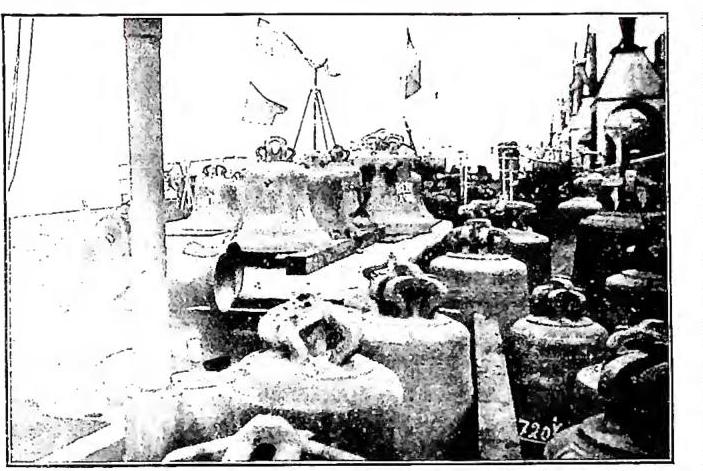
Nel campo profano vanno specialmente ricordate le c. delle torri civiche (ad es. Firenze, palazzo Vecchio). Un posto a parte hanno i cosiddetti carillons, concerti di c. accordate e distribuite a scala; notissimi quelli delle torri civiche fiamminghe.
Tra le c. italiane moderne ricordiamo la c. di bronzo omaggio dei comuni d'Italia alla tomba di Dante in Ravenna (1921), modellata da D. Cambellotti e fusa da F. Lucenti; la grande c. fusa col bronzo di varie nazioni e posta sul castello di Rovereto perché porti il saluto di pace a tutti i morti della prima guerra mondiale, disegnata e modellata da S. Zuech (1924).
Vincenzo Golzio
II. LITURGY
The bells are intended for the service of worship, and serve to call the faithful to the sacred functions, to exhort them to prayer at certain hours of the day and on various occasions, for the dead and the dying, during storms, fires, etc. Ringing them for other reasons is permitted only with the authorization of the Ordinary, except in cases of necessity or where a different custom exists; ringing them for non-Christian reasons is prohibited. The Ordinary may order the bells to be rung ob causam publicam even in exempt religious houses, unless there is a contrary privilege or custom (can. 612). The bells are part of the endowment of the church, which is their legitimate owner. Considered res sacrae, the Church requires that bells be consecrated or blessed (CIC, can. 1169). This rite dates back to the eighth century and is contained in its essential elements in the Ordo romanus V. In today’s liturgy we have three formularies. The first is in the Roman Pontifical: De benedictione signi vel campanae, and is used for the bells of consecrated churches. The second is in the Roman Ritual: Benedictiones reservatae I, no. 7, and is for solemnly blessed churches or oratories. The third is for the blessing of bells intended for profane but lawful use, and is in the same Ritual: Benedictiones reservatae I, no. 8. All three are reserved to the bishop or to a delegated priest. In the eighteenth century the bell made its appearance in the orchestra, but its use remained limited to certain compositions described or endowed with picturesque and evocative elements. Generally, the orchestral bell is made of steel, tubular in shape, and struck with wooden hammers; it is therefore more manageable, has moderate sonority, and produces definite pitches.Filippo Oppenheim
III. ITALIAN LEGISLATION
In pre-Concordat Italian law, although the Church’s competence in matters concerning the use of bells was recognized, there were nevertheless certain restrictive provisions. Thus, for example, the Penal Code of 1889 punished anyone who “by abusing bells disturbed the occupations or rest of citizens or public gatherings”(art. 457). Royal Decree no. 297 of 12 February 1911 and subsequently art. 131 of the Consolidated Law of 4 February 1915 no. 148 authorized municipalities to establish regulations “to prevent the abuse of the ringing of bells.”
After the Lateran Pacts, once the recognition of the free exercise of worship had been reaffirmed in art. 1 of the Treaty, the possibilities for state intervention in this matter necessarily diminished. Consequently, the provision granting municipalities the aforementioned authority was no longer reproduced in the new Consolidated Law on Municipal and Provincial Administration of 3 March 1934 no. 383; and the new Penal Code no longer expressly provided for the abuse of bells, but rather, in general terms, for the abuse of sound instruments or acoustic signals (art. 659), although bells are certainly included among sound instruments (the provision, however, also and especially concerns abuse committed by outsiders without the authorization of the ecclesiastical authority).
Mention should also be made of art. 40 b of Royal Decree no. 2262 of 2 December 1929, which prohibits church-factory boards from interfering in the manner and times of ringing the bells; and of art. 41 of the same decree which, translating can. 1185 of the CIC, reserves to the rector of the church, subject to legitimate customs and agreements and to the authority of the ordinary, the appointment of the bell-ringer.
Pio Ciprotti
IV. FOLKLORE
The customs and beliefs relating to bells constitute an interesting aspect of popular tradition. The efficacy of the sound of bells in warding off hail has assumed different forms of expression in various localities. For example, in some villages of Umbria it is the bell of the parish church that must ring first, whereas in others it is the bell of the municipal tower. It is a widespread belief among the common people that, if the bell-ringer is prompt to ring the bells before the hail has reached the territory of the parish, it will no longer be able to enter II. Hence the grave responsibility placed upon the bell-ringer, from whom extraordinary vigilance and promptness are consequently required. In Abruzzo the lower classes believe that the sound of the bells is effective when the devil has only just mounted his horse on the “evil cloud”: if he has already set out, there is little hope that the sound will hold him back. The terminology used to designate this ringing against hail likewise varies from one region to another: malacqua, a tempesta, a scongiuro, etc.; also acqua bona, as a good omen. Certain particular bells are considered endowed with virtues superior to those of others for driving away hail, especially those baptized in the name of a patron saint against hail, such as s. Pietro Martire, s. Vincenzo, and s. Potenziana. The popular customs associated with the ringing of bells for Baptism and death are also interesting. The sex of the person being baptized can be distinguished by the different sound of the bells. Thus, for a male child, the large bell is rung, and for a female child, the small one; the duration of the pealing is also longer in the former case than in the latter; it sometimes depends as well on the greater or lesser generosity of the godfather toward the bell-ringer. The ringing of the bell for death presents a greater variety of customs; the differences serve to distinguish both age and sex. For example, the custom of ringing festively for the death of a child is very widespread: this is called “ringing for an angel”; for the death of an elderly person, the first pealing is longer. As regards sex, generally a greater number of strokes is used for a man than for a woman (for example, 12 in the former case and 9 in the latter). The ringing of the bells also differs in that a certain number of strokes is given first, followed by a pealing. Local varieties are extremely numerous. Also noteworthy is the onomatopoeic interpretation that the people give to the voices of the bells, transforming them into words, phrases, or little verses, almost always appropriate to the circumstance in which the bells are rung or to the church to which they belong. The people’s natural humorous and satirical disposition finds expression in apt, charming, or fanciful formulations, and at times even in irreverent ones. – Vedi Tav. XXXII.