CAMPAILLA, TOMMASO

TOMMASO CAMPAILLA. - Naturalist and philosopher, born at Modica (Ragusa) in 1668, died there in 1740.
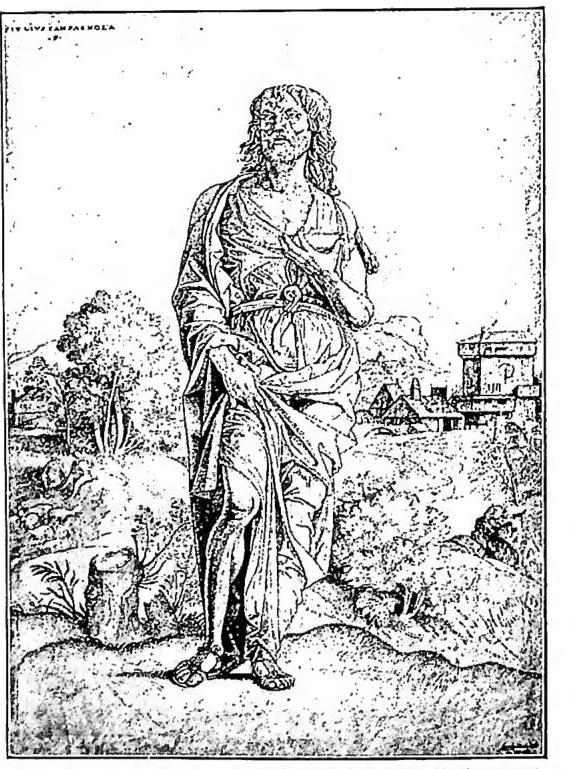
Article illustration
(Courtesy of Dr. B. Gegenhart)

Campagnola, Giulio - St. John the Baptist. Copper engraving.

Self-taught in many respects, he studied at the University of Catania. He was in contact with Berkeley, who called him “vir doctissimus” and from whom he drew “clarissimos ingenii fructus” (Letter from Messina 1718, and from London 1723: published in the Life prefixed to Idamo), and a friend of L. Muratori, who described him as “the Italian and Christian Lucretius” (Letter to Ceva and Prescinone, ibid.) and invited him to occupy a chair at the University of Padua.

He wrote on scientific subjects, criticizing several of Newton’s doctrines (Considerazioni sulla fisica di I. Newton, Milan 1710). In philosophy he followed Descartes, though modifying some of his doctrines, such as that concerning the relationship between body and soul. In general he attempted to reconcile Descartes with Scholasticism (cf. the philosophical poem: Adamo ovvero il mondo creato, Syracuse 1783).

Article illustration

BIBL.: A. Grammatico, T. C., filosofo cartesiano, in Acta II Congressus Thamistici internationalis, Turin 1936, p. 130 sq.; S. Scime, Indagini sul pensiero del Risorgimento, Rome 1949, passim, and especially Part I, ch. 2.

Salvatore Scime

CAMPAN. A bronze vessel shaped like an inverted cup, which sounds when its walls are struck from within by a clapper or from without by a hammer. Its use dates back to the most remote antiquity.

I. History

The word c., according to Isidore of Seville (Origines), would derive from Campania, where local bronze called campanum was used to make the first c.; since one of the workshops producing them was located at Nola, legend attributed the invention to St. Paulinus, bishop of that city (409–431). Similar instruments, though smaller in size, certainly existed earlier, and from these the c. used in Christian worship developed.

The ancient peoples of Europe may not have known c.; yet large ones seem to have been cast in the East before Christianity: in China they were cast in the 5th and 6th centuries, and some still remain in Buddhist monasteries. When Christian worship began to use them cannot be determined. We do see, however, that as early as the 6th century Latin documents contain the terms c. (campanns) and signum; the first referring to the region of origin, the second to the purpose for which the object was intended, and by the 7th century they were in use in Italy, Gaul, and the British Isles; according to the Liber ordinum, Spain had known them for some time as well.
