
CASTELLO, BERNARDO. – Painter, born in Genoa in 1557, died there on 4 October 1629. He was a pupil of Andrea Semino; but, drawn to the art of Luca Cambiaso, he soon adopted his manner. While still young, having gone to Ferrara and become a friend of Torquato Tasso, in 1586 he illustrated the latter’s Gerusalemme liberata.
He then returned to Genoa, where he devoted himself to his activity as an eclectic painter, linked to the most varied currents of Mannerism, executing, among other works, altarpieces for the churches of S. Francesco, S. Siro, and S. Maria di Castello, and frescoing Genoese palaces and villas. In 1604 he was in Rome, and thereafter, for a short time, in Turin. He was friendly with poets and men of letters, especially Chiabrera, to whom he owed much of his fame, perhaps greater than his actual merits warranted.
His brother, GTOV. BATTISTA (1547–1637), was a well-known painter and miniaturist, a pupil of Cambiaso.
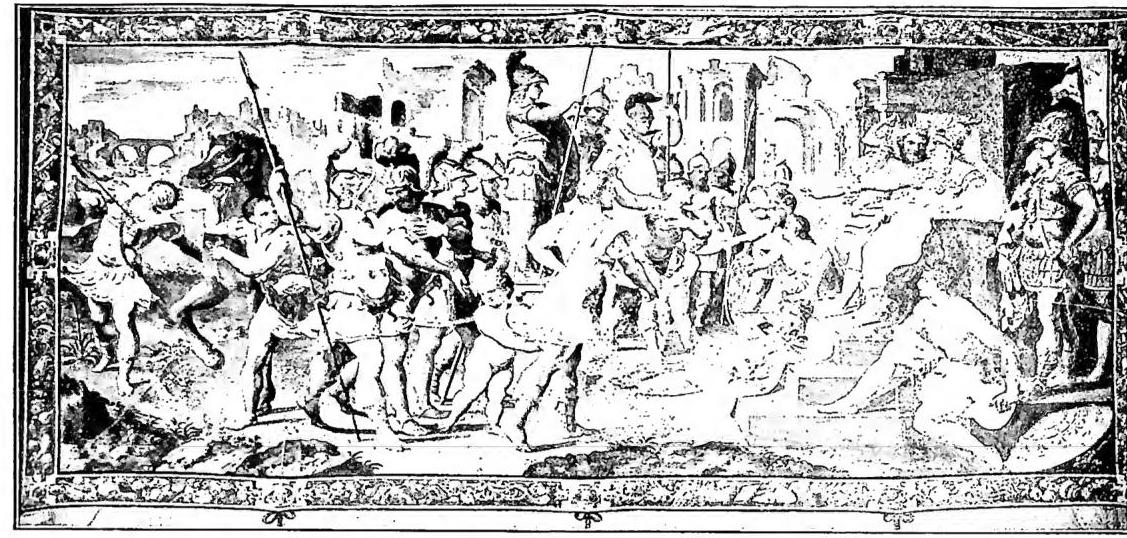
(phot. Alessi)
The art of C. is among the most spontaneous and personal of the Genoese seventeenth century: refined and lively in color, he perceived, and at a very high level, the value of the vibrant and dynamic line.
In the frescoes, more than in the canvases, this pictorial dynamism of his—entirely characterized by chromatic preciousness and full of refined elegance—had the opportunity to unfold fully and reveal the height of his creative qualities, which seem truly to anticipate even eighteenth-century painting. His sketches at times seem like an anticipation of the art of Alessandro Magnasco.
Among his most significant works are the Danaids (A. Doria Gallery, Genoa); the Marriage of the Virgin (Spinola Gallery, Genoa); the Virgin of the Veil (Museum of the Civic Hospitals, Genoa); the sketch for the Rape of the Sabines (De Ferrari Collection, Genoa); and, among the frescoes, those adorning the hall of the Balbi Palace, also in Genoa.