
CORALLO. — The working of coral for artistic purposes was characteristic of the peoples of the Mediterranean basin from the earliest times. Although there are insufficient data to establish where it first appeared, it can nevertheless be ascertained, at least from literary references, that it was practiced in Greece during the Alexandrian period, and in Italy during the indigenous civilizations and the Roman period (as demonstrated by certain finds near Bologna, at Arna, in Campania, and in Rome itself).
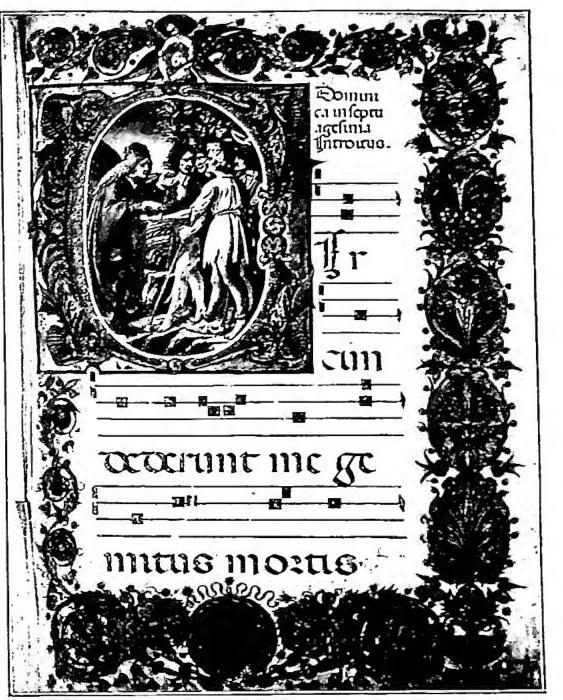
CORALE – Introit of the Mass of Septuagesima, with a scene referring to the parable of the laborers in the vineyard. Page from a choirbook illuminated by Liberale da Verona (15th century) – Siena, Piccolomini Library.
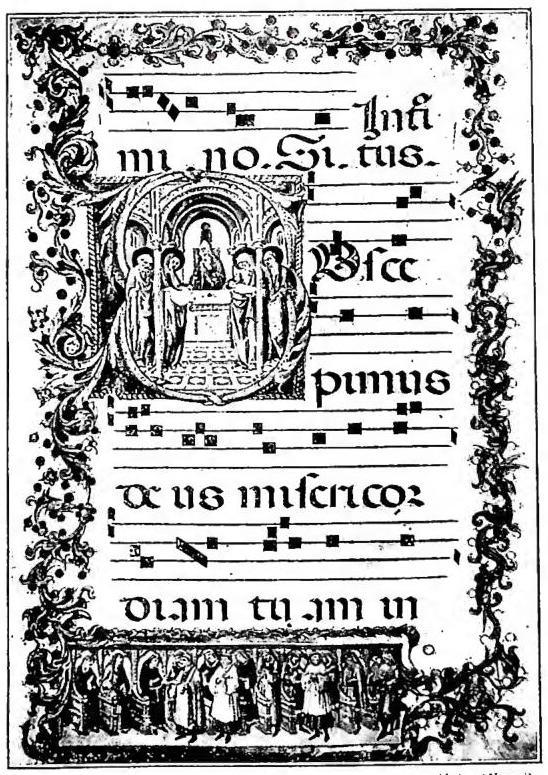
CORALE - Introit of the Mass of the Purification (2 February), with scenes referring to the feast. Page from a choral book illuminated by Sano di Pietro (15th century) - Siena, Libreria Piccolomini.
to use it, since no surviving trace of it is found in the excavations or in the testimony of the sources. In the Baroque period, however, adapting its distinctive decorative possibilities to the requirements of contemporary taste, coral was widely employed, especially in the so-called minor arts.
The school of Trapani deserves particular mention: it produced works of undisputed interest, such as the richly decorated Baroque altar frontals, crucifixes, reliquaries, monstrances, chalices, and copes in coral, preserved in the Pepoli Museum of that city, in the National Museum of Palermo, and at Monreale. The schools of crafts in Torre del Greco (Naples) have recently been given new impetus for the production of coral work, both for religious objects and for the decoration of goldsmiths’ wares. Vedi tavv. XXI-XXII.