
CORNICE. — In addition to being a decorative complement to an object, and particularly to a painting, the c. is also, according to a more strictly aesthetic purpose, a framing intended to delimit its field of gravitational attraction in space and to emphasize the figurative reality of the work. In architecture, it is a crowning member of an architectural organism (v. ORDINI ARCHITETTONICI).
The earliest frames isolating Byzantine icons were for the most part made of metal, often precious, belonging more directly to the goldsmith’s art than to the craft of carving. The use of wooden frames became established in the late Middle Ages, when triptychs, political panels, and altarpieces had frames richly carved in the same wood on which the painter then executed his figures, with profiles varying according to the pattern and taste of the workshop, the artist, or the patron himself. During the Gothic period the frame adapted itself to the international style prevailing in architecture and was highly ornate, with spires, pinnacles, etc., and almost always gilded. Sometimes the profile was obtained by applying gesso to the wood, and cases were not uncommon (especially among Sienese and Venetian political panels) of fully rounded sculptures included in the small tabernacles and on the pilasters framing the painted compartments. The great Spanish retablos carried this practice to its extreme, alternating sculpted compartments with painted ones within their rich frames.
The lines of Renaissance frames were simpler, generally consisting of restrained decorations with motifs of garlands and festoons of flowers and fruit; the use of round frames was also introduced,
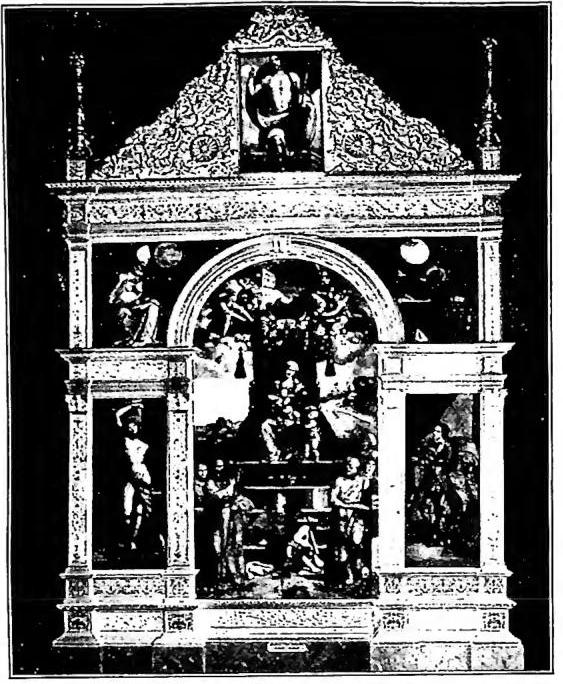
In the seventeenth and eighteenth centuries, the magnificence of the Baroque also imposed extraordinarily rich and complicated profiles on frames, and production was very extensive, especially in Venice, Genoa, and Bologna, from where it then spread to southern Germany, Spain, and France; here an orderly system arranged a succession of forms, linked, like the other furnishings, to the changing taste of the period.
In the last century, the profiles were reduced to a less demanding decorative treatment, thus preparing the modern appearance which, having abolished gold, relies instead on the simple isolation of the work from its surrounding environment. - Vedi tav. XXIII.