
SAINT-MAURICE D'AGAUNE. — “Nullius” abbey in the Canton of Valais in Switzerland, immediately subject to the Holy See.
It has an area of approximately 97 sq. km, with a population of 4,250 inhabitants, of whom 3,700 are Catholics; all the clergy are regular. The vicar general is generally the prior of the Abbey, and by a brief of Gregory XVI (4 Aug. 1840) the canons have the privileges of the canons of cathedral churches.
The territory of S.-M. consists of the abbey and its college; the Sanctuary of Notre-Dame du Scex (7th century), formerly the hermitage of St. Amatus, founding abbot of Remiremont; the motherhouse of the sisters of S.-M. at Vérolliez, with a 12th-century chapel, the orphanage and the home for the elderly; the parishes of Choëx,
Vernayaz, Salvan and Finhaut in the Canton of Valais, and Lavey-Morcles in the Canton of Vaud. All the parishes are grouped into a single deanery. Also united to the abbey « pleno iure » are another five parishes of the diocese of Sion, which nevertheless do not form part of the territory nullius; within its boundaries there are four women’s religious communities.
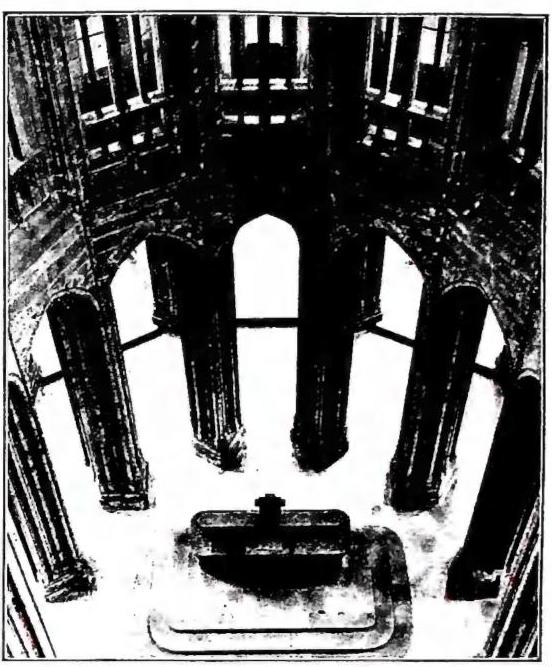
The religious became secular canons in the 9th century and regular canons in 1128 (v. S. AGOSTINO, III. Congregazioni tuttora esistenti, n. 4). The abbot of S.-M. and his Chapter exercised exclusive spiritual jurisdiction over several parishes; but, since the territorial extent of the abbey had not been clearly defined, the bishops of Sion claimed from the 17th century onward diocesan jurisdiction over the parishes dependent on the abbey. From that time, however, the nullius character of part of the abbey’s territory began to be established. The territorial question, which had been progressively clarified beginning under the pontificate of Benedict XIV, received a definitive solution under Pius XI, who, by the apostolic constitution Pastoralis cura of 11 October 1933, precisely constituted the territory nullius (AAS, 26 [1934], pp. 50–51). By the apostolic constitution In amplissimo of 3 July 1840, Gregory XVI permanently united the episcopal title of Bethlehem with that of the abbey of S.-M. (Acta Gregorii PP. XVI, Rome 1902, pp. 69–70).
The abbey church is a cathedral; recently restored (1947–49), it was raised by Pope Pius XII to the dignity of a minor basilica by the brief Quandopnidem of 30 November 1948 (AAS, 41 [1949], p. 352). The highly valuable Treasury of the Abbey has now been appropriately installed in a new location.