
SAN SEBASTIANO DE RIO DE JANEIRO, ARCHDIOCESE of. — In the federal district of Brazil. It belongs to the homonymous ecclesiastical province, which also includes the dioceses of Niteroi, Espirito Santo, Barra do Piraí, Campos, and Valença. The archdiocese covers an area of 1,350 sq. km, with approximately 2,000,000 inhabitants. It has 105 parishes, 250 diocesan priests and 286 religious priests, 65 male and 145 female religious communities, a major and minor seminary, a Catholic university, numerous colleges directed by religious orders and other cultural centers, social works, etc. Its patron is s. Sebastiano.
I. HISTORY
The Bay of Rio was discovered on 1 January 1502 by Portuguese explorers, among whom was Vespuci, who believed it to be the mouth of a great river (River of January). Despite the beauty and richness of the region and the excellent harbour it offered, the discoverers founded no colony there until they became aware of the establishment of a Huguenot republic by French emigrants led by Niccolò di Villegaignon, who had allied themselves with the Indians and were making extensive use of the region’s commercial advantages. Moved by religious and patriotic zeal, the Portuguese fought and finally expelled the French, subsequently erecting a village there (1567) which, in honour of the Saint whose feast was celebrated on the day of the victory, and in honour of the king of Portugal, was called S. S. The Jesuits who accompanied the expedition and directed the first construction works devoted themselves to the instruction of the natives and shortly afterwards succeeded in establishing a college in the centre of the emerging city, whose first rector was the celebrated Fr. Manuel da Nobrega.Rio, which in 1572 was already the seat of the government of southern Brazil, was chosen three years later as the seat of a prelature nullius (bull In supereminenti militantis Ecclesiae of 19 July 1575); raised on 16 November 1676 to a suffragan diocese of Salvador (bull Romani Pontificis pastoralis sollicitudo), it encompassed the whole of southern Brazil and part of the west, until the great division carried out by the motu proprio Candor lucis aeternae of 6 December 1745, which gave rise to the dioceses of S. Paolo and Mariana and to the prelatures nullius of Cuiabá and Goiaz. For political reasons, however, shortly after this division Rio recovered all the regions from S. Caterina to the Rio de la Plata, which were administered by a vicar general until the creation of the diocese of Porto Alegre, in 1848. In 1763, Rio became the capital of the State of Brazil, that is, the seat of the viceroys, who did much to promote its prosperity; later it became a Portuguese metropolis, housing for thirteen years the dynasty and government whom Napoleon had driven from Lisbon.
Alongside the radical improvements that the city underwent during the last 40 years, the diocese experienced increasing religious progress. The bull Ad universas orbis ecclesias of 27 April 1892 erected it as the metropolitan see of the ecclesiastical province of southern Brazil; at that time its remaining territory was divided through the creation of the dioceses of Petrópolis (now in Niteroi) and of Espirito Santo. The events of greatest religious significance to have taken place in Rio in recent years were the national Eucharistic Congress of the centenary (1922), the coronation of Our Lady Apa-
(From P. Füss, Brasil, in Orbis Terrarum, Berlin-Zurich n. d.)
SAN SEBASTIANO DE RIO DE JANEIRO, ARCIDIOCESI di. — Monument to Christ the Redeemer, on Corcovado — Rio de Janeiro.
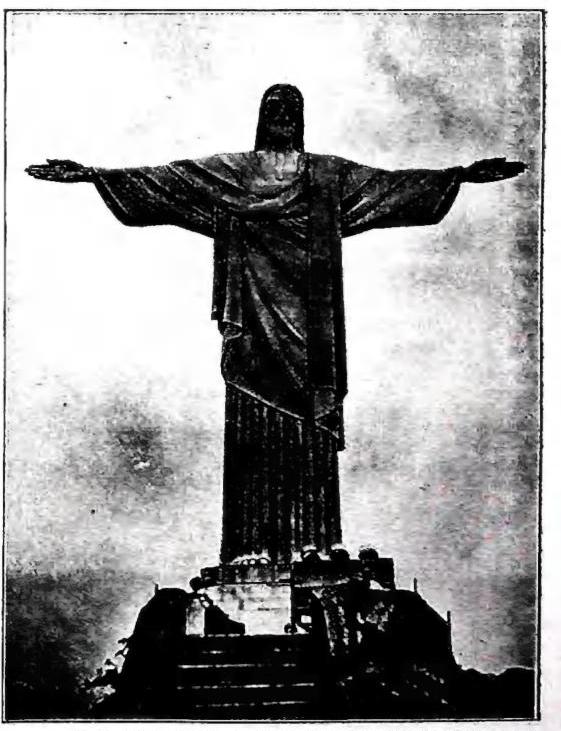
recida, proclaimed queen of Brazil (1931), the inauguration of the image of Christ the Redeemer on the summit of the mountain called Corcovado (1931), and the first Brazilian Plenary Council (1939).
The first bishop of Rio was Manuel Pereira, who, however, resigned before going to the diocese; he was followed by José Barros de Alarcao (1680–1700); Francisco de S. Jeronimo (1702–21); José Antonio de Guadalupe (1725–40), etc., up to João Eckerard (the first archbishop, 1894–97); Joaquim Arcoverde de Albuquerque Cavalcanti (1897–1930), the first cardinal; followed by Card. Sebastiano Leme da Silveira Cintra (1930–42) and by the present Card. Jaime de Barros Camara (1943). Among the most representative Catholic laymen of recent years are: Carlos di Laet (1928), man of letters and polemicist; Jonatas Serrano (1944), historian; Alceu de Amoroso Lima, man of letters and sociologist.
In the archdiocese there are the abbey of S. Benedetto and the convent of S. Antonio, which exercised considerable scientific and religious influence on the life of the city. There are also the ancient monasteries of the Carmelite nuns (S. Teresa) and the Franciscan nuns (Ajuda). The city preserves some old colonial monuments; besides the Arcos aqueduct, the remains of several fortresses, the Palace of the viceroys and those of the emperors, Rio also has churches built in a typical colonial style (v. Arte sacra), such as the Cathedral, S. Cruz dos Militares, S. Antonio, S. Bento, S. Francisco de Paula, Gloria do Outeiro, Rosario and Lapa; of them all, however, the splendid Candelaria is pre-eminent.
II. THE CENTER OF STUDIES
Rio is also Brazil’s most important center of studies. The Museum of Natural History and the National Library are noteworthy.1. The Seminary
Founded in 1739, closed in 1904, reopened as a minor seminary in 1924 and as a major seminary in 1944, it is a flourishing institution with new premises, whose foundation stone was laid by Msgr. J. de Barros Camara on 15 Sept. 1944.2. The Catholic University
The idea of a Catholic University, fostered by Cardinal Leme (1930–42), first took shape with the Instituto católico di studi superiori, inaugurated on 24 May 1932. In 1939 the Brazilian episcopate, gathered at the First Plenary Council, announced it to the country in a collective pastoral letter. On 21 June 1940 the founding body (Sociedade civil « Faculdades Católicas »), required by Brazilian law, was constituted; on 30 October of the same year (decree 6409), the government granted authorization for the Faculties of Philosophy (and Letters) and Law, solemnly inaugurated on 15 March 1941; in 1943 the School of Social Service was added.After five years of operation, the government issued the constitutive decree of the « Universidade Católica do Rio de Janeiro » (decree 8681, dated 15 January 1946) and the decree approving its Statutes (decree 21.968, dated 21 October 1946). Its canonical erection, with the title of pontifical university, took place through the decree Laeta caelo of the S. Congreg. of Seminaries and Universities, 20 January 1947 (AAS, 40 [1948], p. 43 ff.). In the same year the Istituto sociale, founded in 1927, was incorporated into the University; in 1948 the Polytechnic School and the Institute of Comparative Law were established.
The University is located in the « bairro de Botafogo »; its grand chancellor is the cardinal archbishop. Direction is entrusted to the Jesuits (the organizer and first rector was Fr. Leonel Franca, who died in 1948). Periodicals: Verbum, a quarterly review of higher culture; Anuário, concerning the life, organization
and activities of the University; Coleção Servir, for the dissemination of the social sciences. — Vedi tav. CXVI.