SAN LUIGI DE CACERES (SAO LUIZ DE C.), DIOCESI DI

SAINT LUIS DE CACERES (SÃO LUIZ DE C.), DIOCESE OF

In the State of Mato Grosso, Brazil, a suffragan of the archdiocese of Cuiabá.

Its area is 300,000 sq. km. and it extends over a territory that is very rich but little explored and inhabited by a population of 50,000, of whom 45,000 are Catholics. It has four large parishes administered by the only religious present in the diocese, members of the Third Regular Franciscan Order; in addition, there are the Sisters of the Immaculate Conception of Albi. The patron saint is St. Louis, King of France.

The oldest city within the diocese’s boundaries is Mato Grosso, formerly Vila Bela de Santíssima Trindade, founded in 1734 and soon made the capital of the province because of the gold mines found there and its strategic position near the Spanish frontier. Its fourth governor, Luiz Albuquerque de Melo Pereira e Caceres, carried out several important works for the good of his province: he founded many settlements, including Vila Maria on 18 Oct. 1782, a name later changed to the present São Luiz de Caceres in his honor. The religious history of the diocese is identical to that of Cuiabá until the elevation of that see to metropolitan status on 10 March 1910. From its territory were detached the prelatures of Porto Velho (1925) and Guajará-Mirim (1929). The first bishop of São Luiz de Caceres was Modesto Augusto Vieira.

---

SAINT LUIS DE CACERES — SAINT LOUIS OF ARGENTINA

See ARGENTINA, SAINT LOUIS OF.

---

SAINT LUIS OF MARANHÃO

The evangelization of the natives was undertaken by the Jesuits, who arrived in Maranhão in 1615. The Portuguese, however, attacked and defeated the invaders at the end of 1614, signing an armistice with them that was later broken with the total expulsion of the French in 1620. From 1624, for geographical reasons, the government of Maranhão was separated from that of Brazil. Soon, however, a bitter struggle of long duration flared up between the Jesuits and the colonists over the enslavement of the Indians. In this dispute, which assumed great proportions, the famous Jesuit orator and politician Vieira distinguished himself. Maranhão was not spared Dutch domination (v. OLINDA E RECIFE, ARCIDIOCESI DI), nor did it lack occasions for uprisings, such as that of 1682–85 against commercial monopoly and that of 1838 for reasons of internal politics (v. CAXIAS DO MARACANÃ). It is noteworthy that Maranhão did not accept Brazilian independence without difficulty.

The diocese was erected by the bull *Super universas* of 30 Aug. 1677 as a suffragan of the metropolitan see of Lisbon, becoming part of the ecclesiastical province of Brazil only in 1827. The vast territory of the diocese was subsequently divided to create the new sees of Belém (1719) and other jurisdictions now subject to it, since the apostolic constitution *Rationi congruae* of 10 Feb. 1922 raised the church of São Luís to metropolitan status.

Among the bishops of Maranhão, some came into serious conflict with civil authorities, others took part in the Portuguese reaction against Brazilian emancipation, and still others distinguished themselves by their zeal and virtue. The following is their list: Antônio de Santa Maria (1677, never took possession); Gregório dos Anjos (1679–1680); Francisco de Lima (1690); Timóteo do Sacramento (1691–1700); José del Garte (1717–23); Manuel da Cruz (1738); Francisco de Santiago (1747–52); Antônio de São José (1756–78); Jacinto Carlos da Silveira (1779); José Domingos Jesus (1780); Antônio de Pádua e Bellas (1783–90); Joaquim Ferreira de Carvalho (1795–1801); Luiz de Brito Homem (1802–13); Joaquim de Nossa Senhora de Nazaré (1820–23); Marcos Antônio de Sousa (1826–42); Carlos de São José (1844–50); Manuel Joaquim da Silveira (1851–61); Luiz da Conceição Saraiva (1861–76); Antônio Cândido de Alvarenga (1878–98); Antônio Xisto Albano (1901–1905); Santino da Silva Coutinho (1906); Francisco de Paula e Silva (1907–18); Helvécio Gomes de Oliveira (1918–22); Otaviano Pereira de Albuquerque (1923–33); Carlos Carmelo de Vasconcellos Mota (1935–1944). The present archbishop is Msgr. G. de Medeiros Delgado.

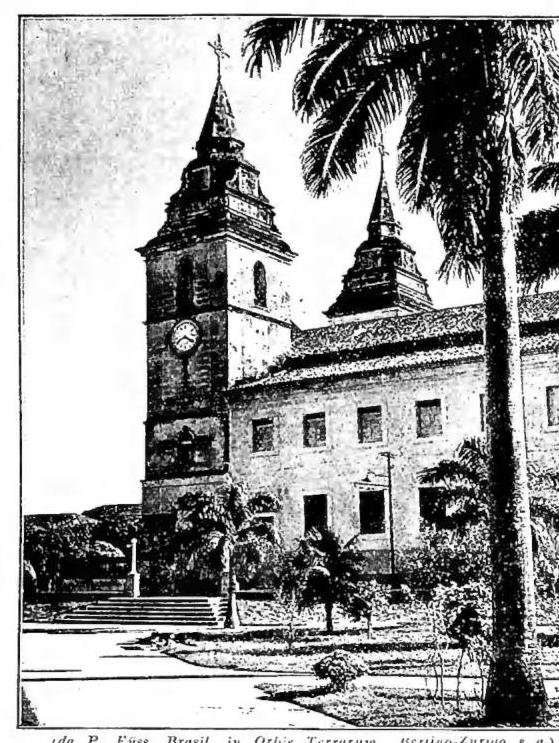
Notable examples of colonial art include the Cathedral, the Archbishop’s Palace, the Governor’s Palace, and several churches.

BIBL.: L. M. Jordão, *Bull. patron. Portugalliae*, II, Lisbon 1868, p. 172; R. Galanti, *Hist. do Brasil*, São Paulo 1911; F. de Paula e Silva, *Apontamentos para a hist. eclesiás. do Maranhão*, Bahia 1922; AAS, 14 (1922), p. 331; J. B. Lehmann, *O Brasil católico*, Juiz de Fora 1947, p. 353 sg.; Maurílio César de Lima