
VESPUCCI, AMERIGO. – Navigator, one of the greatest, indeed the foremost among Columbus’s followers, born in Florence in March 1454, the third of four
sons of ser Nastagio, a notary, died in Seville on 22 February 1512.
The name, which was later to remain forever attached to the New Continent, was traditional in the family. As a young man, V. education; in 1479 he accompanied, as a “servant,” one of his relatives sent by the Medici as ambassador to the king of France, and on his return entered the “bank” of Lorenzo and Giovanni di Pier Francesco de’ Medici, thereby gaining the full confidence of his principals. At the end of 1491 they sent him to Seville, where they had an active agency directed by a Giannotto Berardi, which dealt in various businesses but, apparently above all, in the outfitting of ships. V. therefore in all likelihood witnessed Columbus’s return from the first expedition, which Berardi had helped to finance; later he must have collaborated, again with Berardi, in preparing a ship for Columbus’s second expedition and others for the third; on this occasion V. and Columbus became personally acquainted. When Berardi died at the end of 1495 or the beginning of 1496, V. acted as executor of his will and thereafter remained the effective head of the Seville agency.
The period during which V. undertook his voyages falls between 1497 and 1504. At the beginning of 1505, summoned to the Spanish Court for a consultation on confidential matters, V. was engaged as an expert by the famous Casa de Contratación de las Indias, established two years earlier at Seville; subsequently, in 1508, he was appointed piloto mayor at the same institution: a very high and highly trusted office, which included the duty of examining all pilots and sea captains seeking a license for overseas voyages, as well as that of preparing the official chart of the newly discovered lands and the routes leading to them (padron real), by evaluating and coordinating all the information that pilots and sea captains were obliged to provide. This chart was a jealously guarded secret, and its custodian had to be known for scrupulous integrity and fidelity. V., who had obtained Spanish citizenship, held this office until his death; his widow, Maria Cerezo, was granted a pension in recognition of the important services rendered by her husband.
Two series of documents concerning V.’s voyages are extant. The first consists of a letter by V. himself, dated at Lisbon 4 September 1504, in Italian, perhaps addressed to the gonfalonier Pier Soderini, printed at Florence in 1505; and of two Latin versions or reworkings of this letter, circulated in print under the titles Quatuor Americi navigationes and Mundus Novus; the second series consists of three private letters (that is,
not intended for printing) addressed by V. to his patrons Lorenzo and Giovanni di Pier Francesco de’ Medici. The documents in the first series speak of four voyages by V.; those in the second speak of only two. Until a few years ago, the documents in the first series were considered authentic, although the sequence of the four voyages gave rise to an infinity of uncertainties and doubts; according to a hypothesis formulated by Alberto Magnaghi, however, those documents were the result of skilful manipulations (to which V. himself was unconnected), and the only authentic documents were, on the contrary, the private letters, so that the verified voyages would be reduced to two. The question, fundamental for assessing V.’s work, has given rise to heated controversy and is not yet settled. The attempt to reconcile the two series of documents, recently repeated also by an Argentine historian, R. Levillier, cannot be considered successful.
The voyage certainly authentic is the one undertaken by V. between May 1499 and June 1500 as pilot in an expedition of four ships sent by Spain and commanded by Alonso de Ojeda (this is the second expedition in the traditional series). Since he took part in it as pilot, it must certainly be assumed that this was not his first experience; but an earlier voyage (1497–98), allegedly undertaken along the coasts of the Gulf of Mexico and the Atlantic coasts from Florida to Chesapeake Bay, does not appear in any way admissible as having actually occurred.
During the voyage of 1499–1500, V. separated from Ojeda after reaching the coasts of present-day Guiana and sailed southward, discovering the mouths of the Amazon; he then proceeded along the coasts of present-day Brazil as far as C. de la Consolación or C. S. Agostino (approximately 6° S latitude), then retraced his course, reached Trinidad, saw the mouths of the Orinoco, and rejoined Ojeda’s ships at Haiti. From the scientific point of view, the voyage was of enormous importance: V. Asia, the one on which Ptolemy placed the commercial emporium of Catticara; indeed, he sought the western extremity of that peninsula, Cape Catticara, as V. calls it, after passing which the ships would, according to his ideas, have reached the seas of southern Asia. And as soon as he returned to Spain he began preparing a new expedition (in competition with the one being organized at that time by Vasco de Gama), with the objective of reaching the Indian Ocean, the Gulf of Ganges, and the island of Taprobane. But the Spanish government did not accept V.’s proposals, and at the end of 1500 he entered, for unknown reasons, the service of Portugal; under Portuguese auspices he undertook a second expedition, which departed from Lisbon on 13 May 1501. After stopping at the Cape Verde Islands, the ships crossed the ocean in a southwesterly direction, reached the coast of Brazil near C. Agostino, discovered (in January 1502) the bay called Rio de Janeiro, and certainly sailed as far as the Rio de la Plata, of which V. must be regarded as the first discoverer. In all probability, a rapid run carried the ships still farther south along the coasts of Patagonia, as far as the Gulf of S. Giuliano or perhaps beyond. The return itinerary is unknown. The ships arrived at Lisbon on 22 July 1502.
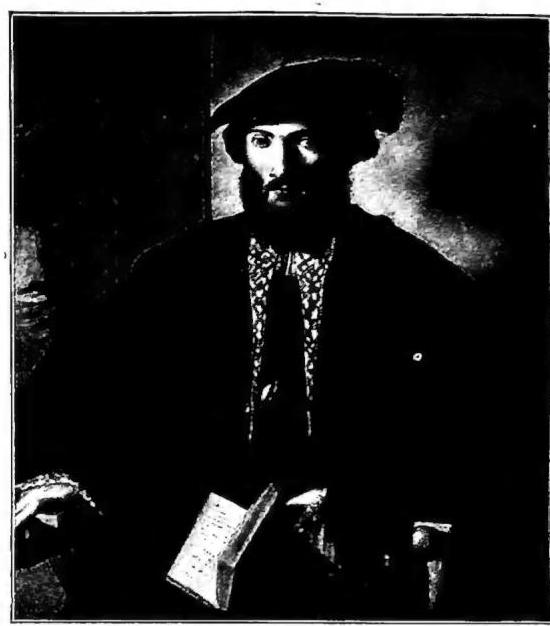
(Alinari photograph)
VESPUCCI, AMERIGO – Portrait, attributed to Parmigianino (16th century) – Naples, National Museum, Picture Gallery.
Nevertheless applied only to South America. The proposal met with perhaps unexpected success; but the extension of the name to North America occurred later. In the upper part of the map, corresponding to the hemisphere encompassing the Old Continent, appears a portrait of Ptolemy; corresponding to the one in which the New World is delineated, the portrait of V.
That he took part in yet another expedition on behalf of the Portuguese government (it is said, in the rather doubtful one commanded by G. Coelho) is uncertain, indeed improbable. In any case, this expedition contributed no new knowledge. Subsequently, V. returned to the service of Spain and certainly, in his capacity as piloto mayor, contributed to the preparation of other expeditions, but took part in none of them personally.
The judgments passed on V. have been extremely diverse: there have been those who regarded him as an ignorant man, a forger, a charlatan who usurped the ideas of others, and so forth. To refute these accusations, it is enough to point out that Spain entrusted to him, a foreigner, in preference to any of its own nationals, the highly important office of piloto mayor, which implies that he was recognized as possessing eminent scientific and practical qualities in matters of navigation, moral integrity, and such scrupulousness as to make him capable of being the custodian of materials and elements of exceptional and highly confidential importance. Whatever the reasons for his temporary transfer to Portuguese service may have been, it is certain that the Spanish government held this against him in no way. V.’s reputation is now definitively established as that of a seaman and navigator of the highest merit, such that he may be placed on a level with Columbus, who likewise held him in the highest esteem, as is shown by an autograph letter. The antagonism by which the two great Italians were formerly set against each other has long since been definitively resolved: Columbus deserves the incomparable merit of having been the first to cross the western Ocean, regarded for millennia as uncrossable, and of having discovered the lands of the “other shore”; V. Asia, but constituted a new Continent.
(phot. Alimari)
VESTA and VESTALIA – A Vestal, sculpture of the 1st century A.D.
Rome, Museum of the Baths.
(in addition to the one already mentioned by Waldseemüller) of direct or indirect Vespuccian provenance.