
LOTARIO I, EMPEROR, KING OF ITALY. — Firstborn son of Lodovico il Pio and Queen Ermengarda, born around 785, died at Prüm on 28 September 855. In July 817, his father Lodovico conferred upon him the title of emperor at Aachen, and in 822 entrusted him with the Kingdom of Italy. After the Assembly of Attigny, he came to Rome and on 5 April 823 was consecrated emperor by Pasquale I. The following year he returned to Rome in order to
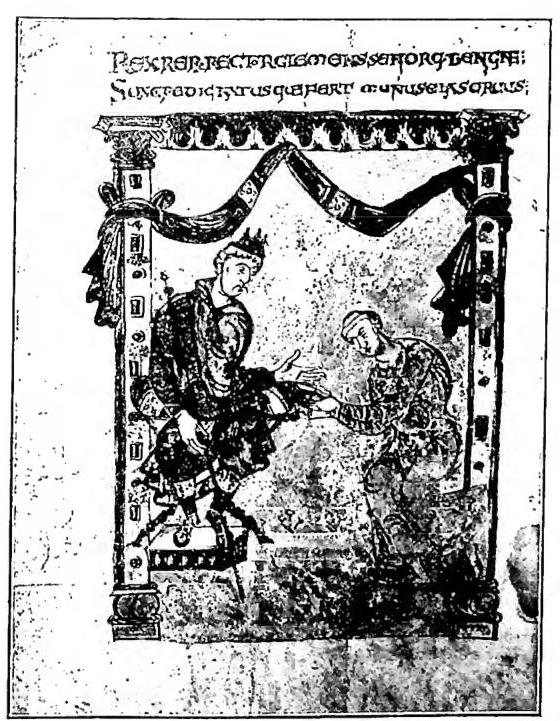
LOTARIO I, IMPERATORE, RE D'ITALIA - Miniature (9th–10th century) contained in the Martyrology of Vandelberto of Prüm - Vatican Library, cod. Pal. lat. 438, fol. IV.
to quell the disturbances that had broken out; with the «Roman Constitution» he regulated relations between the Papacy and the Empire and established rules for the election of the pope. Then, at Corteolona (May 825), he enacted the capitularies concerning the administration of the Italian Kingdom, ecclesiastical discipline, and the organization of the schools.
When Lodovico il Pio (Worms, Aug. 829) wished to modify the division of the Empire in order to favor his youngest son Carlo il Calvo, L., having risen up with his brothers against his father, forced him to annul the new division (Compiègne, May 830). At the new Assembly of Nimega (831), having obtained confirmation of his possession of Italy, he returned there; but, as the divisions in France had been renewed, his best supporters wished the Constitution of 817 to be observed, as an effective guarantee of the unity of the Empire and of the peace of the Christian world. L. crossed the Alps again, together with Pope Gregorio IV, and at Rothfeld joined his brothers in humiliating their father at the Assembly of Compiègne (Oct. 833), presided over by L. himself. Lodovico was deposed; but six months later he had been restored to the throne and L., after brief resistance, was forced to submit (834) and return to Italy. In the new division (Worms, June 838), Italy was recognized as L.’s possession, together with a strip of territory bounded on the west by the Rodano, the Saona, and the Mosa. Important was the treaty concluded by L. with Venice, known as the Pactum Lotharii (22 Feb. 840), which sanctioned their mutual relations in the region. After his father’s death (20 June 840), L. claimed the Empire for himself in the form prescribed by the Constitution of 817, but after the Battle of Fonteney (25 June 841) he abandoned the struggle and finally reached an agreement with his brothers through the Treaty of Verdun (Aug. 843). His capitulary De speditione contra Saracenos facienda has remained famous. L., crushed by remorse and disappointments, died in the monastery of Prüm in monastic habit, and was succeeded by his son Lodovico II, to whom he had entrusted the Kingdom of Italy as early as 844.
d. Ostfrähnischen Reichs, 2ª ed., ibid. 1887, passim (v. indice): L. M. Hartmann, Gesch. Italicus im M. A., I, ibid. 1897, pp. 194-201; L. Duchesne, Les premiers temps de l'Etat Pontifical, Parigi 1911, p. 96 ff.; A. Solmi, Capitolare di L. dell'anno 825 relativo all'ordinamento scolastico in Italia, in Rendic. Ist. stor. lond., 56 (1923), pp. 823-33; G. Romano-A. Solmi, Le dominazioni barbariche in Italia, Milano 1940, pp. 460-668; R. Cessi, Il Pactum Lathartii dell'8, in Atti Ist. ven. di sc. lett. e arti, Classe scienze morali e lett., 99 (1939-40), pp. 1111-49; F. Lot.-F. Ganshof, Les destinées de l'Empire en Occident de 768 à 888, Parigi 1941, p. 536 ff. and passim. Innocenzo Giuliani