
LOT. — Son of Aran, of the Tharcite lineage, Abramo (v.), together with whom he emigrated from Haran in Mesopotamia to the land of Canaan, taking with him his family and a considerable number of servants and herds (Gen. 12, 4 ff.). After accompanying his uncle Abramo to Egypt, he returned to Canaan, near the locality of Bethel (ibid. 13, 1 ff.). But when a dispute arose between the shepherds of L. and those of Abramo, the latter, in order to remove every cause of dissension, decided to separate the two groups, leaving his nephew the choice of territory. L. chose the more fertile region, the area of the Jordan near the Dead Sea, and settled with his family in Sodom (v. ibid. 13, 5-13). In the conflict that took place in the Valley of Siddim between the four eastern kings and the five kings or chiefs of the Palestinian Pentapolis, L. too was captured and deported with his family; Abramo, with a band of brave men, pursued the invaders as far as Dan on the northern borders of Palestine, and after a successful night attack drove them back beyond Damascus, thus liberating L. and recovering his possessions (ibid. 14, 1-16). Although living among sinful people, L. remained righteous and deserved, also through the prayers of Abramo, to escape the destruction of Sodom (cf. Sap. 10, 6; II Pt. 2, 6-8).
Many rationalist critics, denying any truth to the biblical account, maintain that L. is nothing more than an imaginary eponym designating the supposed common ancestor of the two peoples of Moab and Ammon; indeed, some of them (such as H. Ewald and A. Dillmann) arbitrarily identify him with Lotan, son of Seir, one of the chiefs of the Horite tribe, subjugated by the descendants of Esau (Gen. 36, 20).
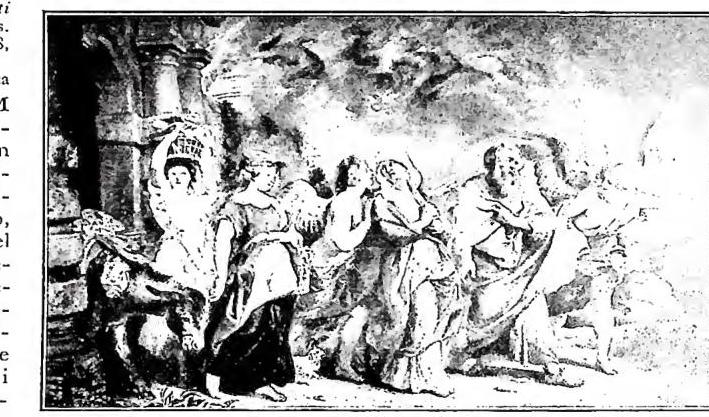
The name of L. is linked to the tragic fate of Sodom and Gomorrah («the days of L.», Lc. 17, 28-31). The name that the Arabs give to the Dead Sea (bahr Löf, «lake of L.») also perpetuates his memory. In the surroundings southwest of the Dead Sea, numerous highly distinctive little columns of salt can still be seen today, and popular imagination has identified L.’s unfortunate wife with a salt prominence in the form of a column on the Gebel Usdum (Mount Sodom), 15 meters high. Flavius Josephus already mentions a statue or column of salt, existing in his own time, which was believed to be the woman’s petrified body (there are also references in Clement, I Cor. 11, 11; Ireneo, Haer., IV, 31; in the Peregrinatio Etheriae; numerous fabulous details in the «poem of Sodom», falsely attributed to Tertulliano: PL 2, 1104). Sap. 10, 7 likewise mentions the statue of salt into which the unfortunate woman was changed as a permanent memorial of the destruction of the Pentapolis: but from this it cannot be inferred that the «statue» was still standing at the time of the hagiographer.
Jesus adduces the example of L.’s wife to exhort people to constancy and vigilance (Lc. 17, 32).