
LUCACIĆ, GIOVANNI MARCO. — Musician, born in Sebenico around 1575, died in Spalato on 20 September 1648, after having resided there for over 30 years as organist and choirmaster at the Cathedral.
A priest of the Order of Friars Minor Conventual, he composed the Sacrae cantiones, a collection of noteworthy liturgical songs (Venice 1620; cf. Miscellanea Francescana, 25 (1925), p. 39). The edition contains 27 compositions, of which 6 are for one voice, 14 for two, and the others for three, four, and five voices. A copy of this musical work is held in the State Library of Berlin. Recently D. Plamanac transcribed and reprinted several pieces (Izdanja-Hrvatskov
Glazbenog Zadova, Zagreb 1934, p. 56 ff.), intending to publish a critical and complete edition of L.’s works, who was one of the oldest and most renowned Croatian musicians.
I. GEOGRAPHY
Extending over just under 10,000 sq km, it is one of Italy’s most mountainous regions (70% mountains and 22% hills); the short coastal plains along the Ionian Sea are unhealthy and almost deserted. In terms of absolute population, L. ranks last among the Italian regions; only after 1931 did the tendency toward decline, which had appeared after the end of the nineteenth century and was due to intense emigration, itself caused by difficult economic conditions, come to a halt. Agriculture (extensive in character: wheat, vines, olives) and sheep farming (with sheep overwhelmingly predominant) are the dominant occupations: the percentage of the population engaged in them (75.4%) is the highest among those of the Italian regions. The population is for the most part concentrated in settlements; nevertheless, only one municipality, that of the provincial capital, has more than 30,000 inhabitants.| Provinces and provincial capitals (population in 1940 in thousands of inhabitants) | Number of municipalities | Area in sq km | Population | ||
|---|---|---|---|---|---|
| 1936 Census | Estimate at 1 January 1940 | ||||
| absolute, thousands of inhabitants | density per sq km | ||||
| Matera (28) | 29 | 3442 | 149.312 | 174 | 51 |
| Potenza (31) | 97 | 6545 | 393.950 | 436 | 68 |
| Basilicata or L. | 126 | 9987 | 543.262 | 610 | 62 |
II. HISTORY
Ancient L., the third region under Augustus and the ninth under Diocletian, stretched from the Tyrrhenian to the Ionian Sea, but in the Middle Ages lost its unity. At the time of the barbarian invasions it suffered the fate assigned to it by its very position as a passageway, and became a battlefield, a field of plunder, and a place of settlement for new races of peoples; yet very little is known of its history during this period. The harsh Byzantine rule, on the other hand, left an indelible mark upon it: L., like almost the whole of southern Italy, consequently acquired a stronger Greek character, in its language, worship, and, generally, its institutions and customs. Nor did Lombard penetration succeed in erasing these traces; indeed, they became more pronounced at the time of the struggle over iconoclasm, when groups of Basilian monks established their communities there, first in laurae (cells excavated in the rock) and later in churches and convents; and with them the Greek rite also penetrated the region.The martyrs attributed by the Hieronymian Martyrology to L. on 29 October and 18 December probably came from other regions; on 11 March 494 Gelasius I addressed a letter to the bishops “per Lucaniam, Brutios et Siciliam,” but the letter of the priest Uranio concerning the death of Paolino of Nola (431) already speaks of an “Exuperantius episcopus de Lucaniae partibus.” Likewise, a rescript of Constantine
the Great (31 October 319) refers to Christianity in L., thus permitting the conclusion that organized Christian Churches existed there in the first decades of the fourth century.
In the ninth century, when the Duchy of Benevento was divided, most of the region was incorporated into the Principality of Salerno and divided into gastaldates. It was subsequently absorbed into the state organization that the Normans created in southern Italy, and it was then that the name Basilicata appeared; since this name is unquestionably derived from the title of Greek officials, it must certainly have pre-existed. The name L., however, remained in learned usage.
Under the Normans, Melfi acquired enormous importance because of its geographical position at a crossroads and its protection from attack: there, in 1059, the new state (the Duchy of Apulia) was recognized by Pope Nicholas II. To the pre-existing institutions the new rulers added the feudal system, which for centuries characterized the economic and social structure of all southern Italy. Consequently, almost all of L. was enfeoffed; and since the kingdom was founded upon the coexistence of monarchy and baronage, it is natural that, in the subsequent Swabian, Angevin, and Aragonese periods, the region should have witnessed on its soil the continual conflict between kings and barons—a conflict that rendered the life of the Kingdom precarious and prepared its decline into a viceroyalty under Spanish rule. The struggle reached its most critical phase under the Aragonese, when a single family, that of the Sanseverino, held almost the entire province in fief. Here the famous barons’ conspiracy against Ferrante I (1485–87) was prepared and brought to its conclusion; here the last stronghold of the Sanseverino, the castle of Diano, fell after being besieged in 1497 by Federico d’Aragona.
The region’s administrative system was transmitted almost unchanged to the new Spanish dominion, though not without obstacles. Signs of discontent repeatedly appeared among the subjects: famous was the uprising of Matera (which at that time in fact formed part of the Terra di Bari) against its feudal lord Gian Carlo Tramontano (1514–15); noteworthy also was the province’s participation in Masaniello’s revolution (1647) under the leadership of Matteo Cristiano, who incited several cities to revolt. Nevertheless, apart from the damage suffered during the conflicts between France and Spain at the beginning of the sixteenth century, and apart from reducing the disturbances against local petty lords to the level of episodes common to the rest of the Kingdom and to all Spain’s Italian dominions, the country found during this period, in peace, a long-desired blessing. Thus the population grew considerably, and from its midst there began to emerge a bourgeoisie whose relative prosperity enabled it to provide a new generation with the means to study in the capital and in diocesan seminaries. In the eighteenth century, following prolonged efforts to obtain exemptions from feudal services, the condition of the peasants also improved. Moreover, the commune, which had made a timid appearance in the Middle Ages, increased its prerogatives by struggling daily against baronial arrogance and wresting from the feudal lords, often through substantial monetary payments, part of their extremely extensive jurisdiction. An expression of this evolution, the new class formed in the Enlightenment of the eighteenth century proved itself during the revolution of 1799. Figures such as Pagano and Bishop Serrao represented it in the sacrifice that southern Italy offered to the anti-absolutist cause. Also memorable in this regard were the defenses of Picerno and Avigliano against the reaction. The abolition of the feudal regime, decreed and implemented by the French government in 1806, facilitated the rise of the bourgeoisie, which grew rich through landed possessions at the expense of the nobility; but the lowest classes, left in their misery, did not share in the benefits of the measure. Meanwhile, sects and brigandage seriously disturbed the country. The constitution of 1820 was celebrated in Potenza, but that enthusiasm was harshly repaid. Class conflicts erupted more violently in 1848, because the peasants did not hesitate then to interpret the revolution as the means of obtaining possession of the land, or at least a revision of the contracts that kept them in a state of barbarism and poverty. The bourgeoisie, for its part, gathered—though not without disagreements—in the Constitutional Circle of Potenza, and was unable to carry out its plan of sending forces to the Neapolitan Parliament after the events of 15 May, much less to support the Calabrian revolt. In any event, its political unpreparedness was paid for with numerous convictions. Since republican ideas had not spread widely in L., in 1860 the bourgeoisie stood united in advocating union with the Kingdom of Sardinia. But signs soon appeared of the discontent of those who had hoped for social reforms; the reactionary party exploited this discontent, and the second period of political brigandage began. In fact, annexation was initially highly disadvantageous to the modest Lucanian economy, which was subjected to a fiscal burden previously unknown. The impoverishment of the country provoked a strong migratory current toward the Americas. Certainly, the national government did not do, or was unable to do, all that the backward region required: the roads built during the first twenty years after unification, the schools established, the law of 1904, and the subsequent measures proved quite insufficient to raise L. to a civilized standard of living. Today, the voices raised by scholars of the so-called “southern question” offer hope for a prompt solution to the major problems of Lucania.
III. CONCILIAR REGION
L. forms, together with the Salernitan area, an ecclesiastical conciliar region comprising the three ecclesiastical provinces of Salerno, Acerenza and Matera, and Conza, as well as the archbishopric of Amalfi and the immediately subject sees of Campagna, Cava and Sarno, Melfi and Rapolla, and finally the nullius abbey of the Most Holy Trinity of Cava.The episcopal conferences are held every year under the presidency of the archbishop of Salerno or, in his place, the archbishop of Acerenza or Conza (S. Congregation of Bishops and Regulars, 24 Aug. 1889; S. Congregation of the Council, 15 Feb. 1919, 22 Mar. 1919; S. Congregation of the Council, 21 June 1932); the deliberations are sent to the S. Congregation of the Council for approval and any observations. The work of coordination is carried out by the secretary of the conferences. The regional plenary council must be held every 20 years, with the participation of all the dioceses of the region, under the presidency of a papal legate (can. 281). The Regional Tribunal for matrimonial cases at first instance is located in Salerno; jurisdiction for appeals belongs to the Regional Tribunal of Naples (motu proprio: Qua Cura, 8 Dec. 1938; Normae of the S. Congregation of the Sacraments, 10 July 1940).
The Pontifical Salernitan-Lucanian Regional Seminary Pio XI is also located in Salerno, while the Pontifical Lucanian Minor Regional Seminary is located in Potenza.
Agostino Pugliese
IV. ART
1. Architecture
The Byzantine rule, which lasted from the 6th to the 11th century, and the influence of Basilian monasticism brought about a profound artistic renewal in L. and stimulated the construction of buildings of considerable merit; today, however, very few testimonies of that period survive. Besides the small rock-hewn churches scattered among the Vulture, the Materano, and the Agri Valley, decorated for the most part by the monks themselves and modeled on the churchesof the East, and certain Byzantine elements remaining in the 13th-century construction of the church of Anglona, the only Basilian monument in L. still preserved is the abbey of S. Angelo al Monte Raparo, dating from the 10th century. It has a single nave, with a square drum supporting a second, cylindrical one, which then terminates in a truncated-conical dome and is decorated on the exterior with blind arches. The first of the two churches of the abbey of the Trinity at Venosa dates from the mid-11th century; it was rebuilt over another church dating from the 5th century, of which some remains in the apse were identified not long ago. In the following century the Benedictines began constructing the second church, which nevertheless remained unfinished. The mutilated complex of the two buildings is among the most evocative in southern Italy. The Romanesque forms of the second church at Venosa were repeated in the cathedral of Acerenza, in the bell tower of Melfi, decorated with animal figures of Arab-Sicilian derivation, in S. Lucia at Rapolla, and in S. Maria di Pierno, built between 1189 and 1197 by a certain Sarlo of Muro Lucano, who was also responsible for the bell tower of Rapolla cathedral. Influences of the Romanesque architecture of neighboring regions can be recognized in many 13th-century buildings: for example, the portal of S. Francesco in Tricarico and the abbey of Banzi, remodeled during the Aragonese period, draw on Apulian architecture, to which L. repeatedly owed a debt. By contrast, the church of S. Giovanni Battista in Matera displays transalpine features and is rigorously Burgundian; together with a few other constructions, such as the cathedral of Rapolla, of Cistercian type but much remodeled, and the bell tower of Irsinia cathedral, which has harmonious decoration with blind arches and beautiful twin-lancet windows, it documents the scant vitality of the Gothic style in L. During the Renaissance, the architecture of L. drew especially on the Catalan-Aragonese forms imported from Naples. Other influences can be discerned in belated adaptations of older buildings. See the castle of Venosa, and the portals and other architectural decorations of S. Francesco in Potenza and S. Antonio in Tricarico.
Baroque architecture is not of great importance and is for the most part derived from Neapolitan architecture: buildings reli-
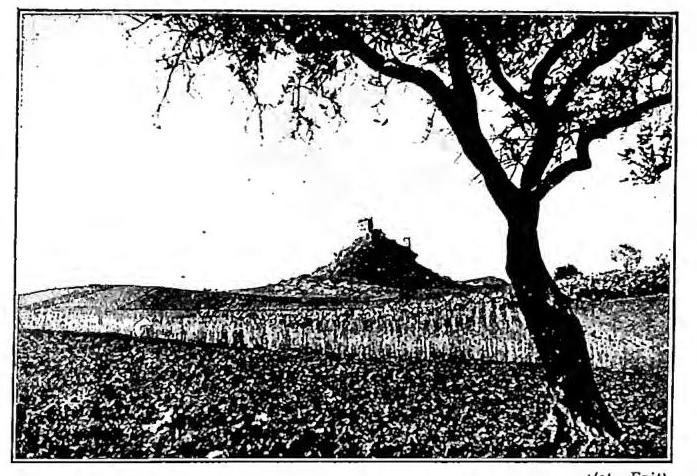
LUCANIA – Materan countryside.
2. Sculpture
The most important example of medieval sculpture in L. is constituted by the sumptuous decorations of the abbey of Venosa, partly still in situ, partly dispersed among various buildings of the town. Portals such as that of the cathedral of Matera, and reliefs on the bell towers of Rapolla and Tricarico, derive from Apulian decorative sculpture. Tombs, sarcophagi, and marble altars, besides a few sculptural groups, attest to L.’s modest participation in the Renaissance renewal. Such are the tomb of Balzo in S. Biagio at Venosa and the Ferrillo tomb in the cathedral of Acerenza, of Neapolitan derivation.3. Painting
The earliest testimony, though not yet fully studied, of medieval painting in L., dating back at least to the 11th century, consists of the remains of frescoes in the hermit caves; these are followed by other Byzantine-influenced works in S. Ambrogio at Monte Raparo, in the cathedral of Melfi, and in the church of Banzi. In the crypt of the church of S. Francesco at Irsina there is an interesting fourteenth-century cycle of modest quality, which nevertheless reveals the infiltration into the region of modes drawn from contemporary Neapolitan painting and from central Italy.With the Renaissance, an influx from outside began in L., and the patrons’ preference for Venetian art of the fifteenth century is noteworthy. Paintings by the Vivarini are found at Matera and Tricarico, while a large polyptych by Cima da Conegliano is at Miglionico. A southern current, centered on Neapolitan Mannerism and led by Andrea da Salerno, was also active; by him there is a triptych at Banzi, as well as evident influences in other provincial works scattered throughout the region. The Museo Ridola of Matera and the d’Errico collection at Lagonegro, which are the only collections in L., preserve examples of them. A local Mannerist of the end of the sixteenth century, Pietro Antonio Ferri, and his contemporary Giovanni di Gregorio, called il Pietrafesa, were active in churches and convents, especially in the Materan area. In the seventeenth and eighteenth centuries, painters such as Giordano, Lanfranco, and Solimena sent works from Naples, Monrealese from Sicily, while Maratta introduced knowledge of Roman painting. After that period, there are no artistic documents of particular note in L. – Vedi tav. CXII.