Machine translation of the 1948–1954 Italian original. The original text is authoritative.
SEBENICO (ŠIBENIK), diocese of. — City and diocese in northern Dalmatia, in Croatia (Yugoslavia). The diocese has an area of 3,625 sq. km., with a population of 176,570 inhabitants, of whom 135,826 are Catholics, distributed among 60 parishes served by 60 diocesan priests and 35 religious priests; it has one seminary, 6 male and 15 female religious communities (Ann. Pont. 1952, p. 372).
The diocese was created by Pope Boniface VIII on 1 May 1298 as a suffragan of Spalato, by division from that of Traù. It was enlarged with the territories of the suppressed dioceses of Knin (1688) and Scardona (1828). From that year the diocese was a suffragan of Zara until 1920, when it became immediately subject to the Holy See. It is the only one among the more important Dalmatian cities not to have had an ancient origin. S. arose in the early Middle Ages and is mentioned for the first time in 1666, as part of the Croatian Kingdom of Cressimiro IV. In 1107 S. acknowledged the sovereignty of King Coloman of Hungary, followed successively by those of Venice, Hungary-Croatia, Byzantium, and Hungary-Croatia. In 1221 the prerogatives enjoyed by the other Dalmatian communes were recognized for S. by Andrew, King of Hungary and Croatia, thereby bringing about its complete autonomy. In 1485 it obtained the right to mint coins. During the long war between Venice and the Sublime Porte, S. was besieged by the Turks. To secure and protect the city, it was decided to fortify II. Among the military works of that period, the most notable is the fort of S. Niccolò (1546), designed by G. G. Sanmicheli, who also built the beautiful loggia in the Piazza del Duomo (1542): destroyed by bombardment in the Second World War, it was rebuilt according to the same model.
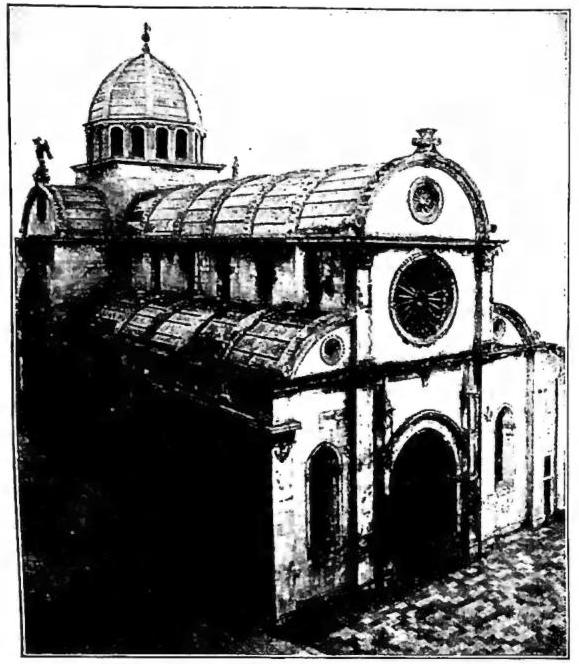
(courtesy of V. Brajevic) SEBENICO, DIOCESE of — The exterior of the Cathedral (15th century).S. submitted, together with the other Dalmatian cities, to Venice in 1412, remaining under its rule until the fall of the Republic (1797). From 1797 to 1805 it came under Austria, and from 1805 to 1814 it formed part of the new French province created by Bonaparte; after his defeat it returned under Austria for approximately one hundred years. Since 1918 it has formed part of the Yugoslav state.
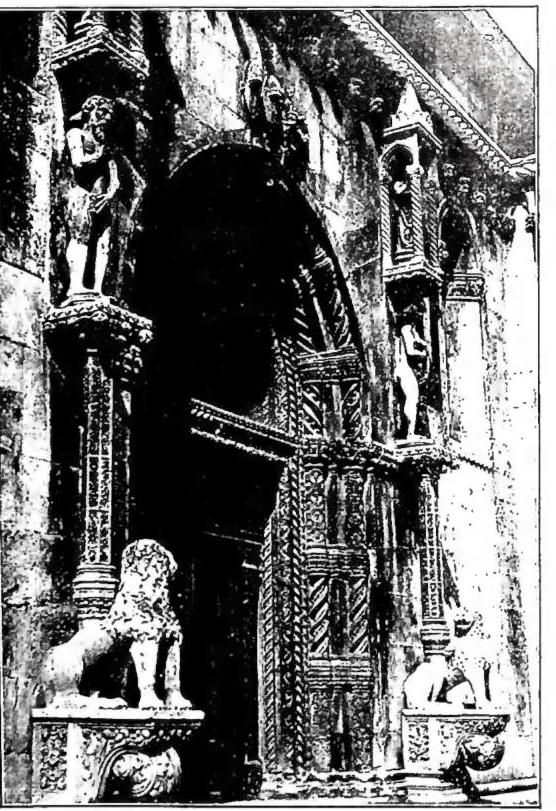
Its Cathedral (S. Giacomo) is famous; it was rebuilt after the fire of 1382, between 1431 and 1555. The architects Giorgio Orsini da S. Niccolò Fiorentino, Giovanni Pribislavljić, Andrea Alessi, and Fr. Laurana took part in its construction. It is an imposing Greek-cross building with three naves, in the Renaissance style, except for the base with two magnificent portals, executed in the Gothic-Venetian style; the baptistery has a dome. Among the city’s other sacred buildings, the following should be mentioned: the church of S. Maria di Valverde (1502, the work of Niccolò Fiorentino); the church and convent (founded in 1229) of S. Francesco, destroyed in 1321 and subsequently rebuilt; and the church of S. Giovanni Battista, with a beautiful flight of steps, the work of Pribislavljić, a pupil of Giorgio Orsini.
S. was the birthplace of many illustrious men, such as the painter and engraver Martino Rota (Kolunić), the musician Fr Giovanni Lukačić (16th–17th century), the humanist Giorgio Sisgoreo (Šižgorić), «primas Hungariae», the statesman Antonio Veranzio (Vrančić, 16th century), the writer Francesco Diphnicus (Divnić, 17th century), the bishop and writer Antonio Fosco (19th century), Nicolò Tommaseo, and others. B. Nicolò (Nikola) Tavilić, the Jerusalemite martyr (1391), was also born in S.
BIBL.: Volumen statut., legum et reformationum civitat. Sibenici, Venice 1608; G. Lucio, Hist. di Dalmatia et in particolare delle città di Traù, Spalato e S., there 1674; D. Farlati, Illyricum sacrum, IV, there 1769, pp. 449 ff.; F. A. Galvani, Il Re d'armi di S., there 1883; A. G. Fosco, La cattedrale di S., Sebenico 1893; A. Alacevich, Pagine della storia di S., there 1920; K. Stošić, Katedrala u Šibenika, there 1926; U. Inchiustri, Cod. ined. di stor sebenicense, in Arch. stor. per la Dalmazia, 7 (1929), pp. 211–18; A. Dudan, La Dalmazia nell'arte ital., 21 vols., Milan 1921–22, passim; C. M. Ivković, Dalmatient Architektur und Plastik, 8 vols., Vienna 1910–27 (passim); Li. Karaman, Umjetnost u Dalmaciji, XV–XVI, Zagreb 1933; Eubel, I, p. 449; II, p. 260; III, p. 317; IV, p. 314; V, p. 356. Vincenzo Brajević
Cite this article
“SEBENICO (ŠIBENIK), DIOCESI DI.” Enciclopedia Cattolica, vol. XI (1953), p. 147. Azione Romana digital edition, https://azioneromana.com/article/sebenico-sibenik-diocesi-di.