
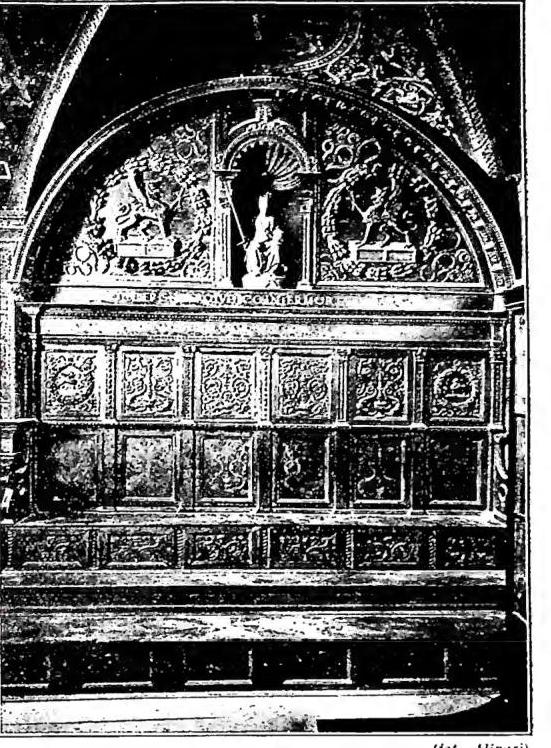
BANCO (Ger. med. Panch, Lat. med. Banchum, Fr. Banc). - A piece of furniture used since antiquity, consisting of a board resting on two or four feet, with side supports and sometimes with a backrest; it can stand alone or be placed against a wall. In its primitive form it appears to be cut into the thickness of the wall, or is made of masonry material (for example, in the Roman catacombs).
In the 15th-16th centuries it often turns into a cassapanca (v.).
Some miniatures document the entirely elementary form of the benches of the early Middle Ages, not otherwise known; one of the oldest surviving originals (12th-13th centuries), from the church of Alpirabach and preserved in the museum of Stuttgart, is still of a very simple form.
In private houses benches were placed near the bed or the fireplace, and were adorned with cushions or with specially made cloths (bancali, pancali). The walls against which benches were sometimes placed were decorated with fabrics or embroideries, and this especially when the benches ran along all the walls of halls, sacristies or presbyteries; many inventories record these dossalia (vela), of which some originals remain. In northern houses, and especially in the Gothic period, the benches are fixed to the walls, when, as often happens, these too are of wood.
In the Renaissance, especially in Italy, the dossal of benches is richly decorated with reliefs or inlays (for example, the hall of the Cambio in Perugia, etc.). From the 17th century benches almost disappear from the richest settings and their use spreads in ordinary homes. They are found as a rule, sometimes in fine forms, in churches, especially of the northern countries; in this case a kneeler is joined to the bench properly so called.
Bibliography4 works
G. Federico Volbach