
APOCRIFI, LIBRI. — Jewish and Christian writings presenting themselves as biblical books, composed between the 2nd century B.C. and the 4th–6th centuries A.D.
The origin of the word (ἀπόσφυρος) is controversial, some deriving it from the pagan world, others from the Jewish world. In pagan sects it was customary to call a. a book containing doctrines that were intended to be kept hidden from the uninitiated. Thus Clement of Alexandria (Stromata, I, 15, 69; CB, ed. O. Stählin, II, p. 44) speaks of “hidden” or “apocryphal” books, reserved for those who wished to learn the esoteric doctrine of Zarathustra. In this case the term distinguishes an inaccessible book, “hidden” from the profane, from an ordinary, public writing (φανερός, κοι-
νός). This concept seems also to have been widespread in the Jewish world, since IV Eud. 14, 46-47 speaks of books in which “est vena intellectus et sapientiae fons et scientiae flumen”, destined to remain secret, with the obligation to make them known only to the “wise men of the people”. Flavius Josephus too (Bell. Ind., II, 142), speaking of the Essenes, mentions books to be kept secret because they contained an esoteric doctrine. But there is no evidence that the Jews called these books “a.” or “hidden.” With an equivalent adjective they designated rather those sacred scrolls unusable for liturgical purposes, either because they had deteriorated or because, for other defects, they were judged unsuitable for reading in the synagogue; given their original sacred character, they were “deposited” or “hidden” (ᾔ-ᾶς) in the repository (ᾔ-ᾶς) attached to the place of worship (Sabbath, IX, 6; Sanhedrin, X, 6).
In Christianity the term a. acquired a particular meaning, designating those books which, by their title, the subject matter treated, and the intention of their author—generally unknown and concealing himself under the name of some ancient patriarch, prophet, or apostle—claimed to be placed on a par with the Bible, whereas the Church denied them any divine character. The canon of the books accepted as inspired thus also came to delimit, by contrast, the l. a. excluded from public reading in the churches (“Ceteras vero Scripturas apocryphas nominarum [Patres], quas in ecclesiis legi noluerunt”, Rufinus, Expositio symboli Apostolorum: PL 21, 374). Among the Fathers, only St. Jerome (Prologus galeatus: PL 28, 601) also applies the term a. to that small group of books concerning whose canonicity not everyone agreed, the ἀντιλεγόμενα or “controversial” books of the Greeks, today called “deuterocanonical” (v. BIBBIA).
Nevertheless, despite this categorical assertion, in his exegetical works Jerome clearly distinguishes between these “controversial” books, which he quite frequently—especially Ecclesiasticus and Wisdom—cites like any other biblical book, and those writings whose extracanonical character was not seriously doubted. The latter would be works by delirious persons (In Is. 64, 4: PL 24, 646; In Ez. 44, 29-30: PL 25, 443) or dreamers (In Mt. 23, 35: PL 26, 180).
The Protestants, following Jerome’s opinion in the Prologus galeatus in this matter, use the word a. to designate the deuterocanonical books, reserving the term “pseudepigraph” for the a. of Catholics; this applies to the Old Testament, since there is no difference in the use of the term with regard to the New Testament.
The a. largely date from the first three centuries of the Christian era. Some, at least in their first form, belong to the 1st or 2nd centuries B.C.; but it is often difficult to determine the date of each one because of subsequent recensions or reworkings. The original language of many of them was Greek, which is almost the only language of the a. of the New Testament. Quite a few of those of the Old Testament must have been written in a Semitic language (Hebrew and, more commonly, Aramaic). But, except in very rare cases, we know the latter only through translations, particularly into Ethiopic, Coptic, Syriac, Armenian, or Greek.
THE A. OF THE OLD TESTAMENT are generally of Jewish origin; but quite a few of them underwent more or less substantial interpolations by Christian hands.
(Int. Alinari)
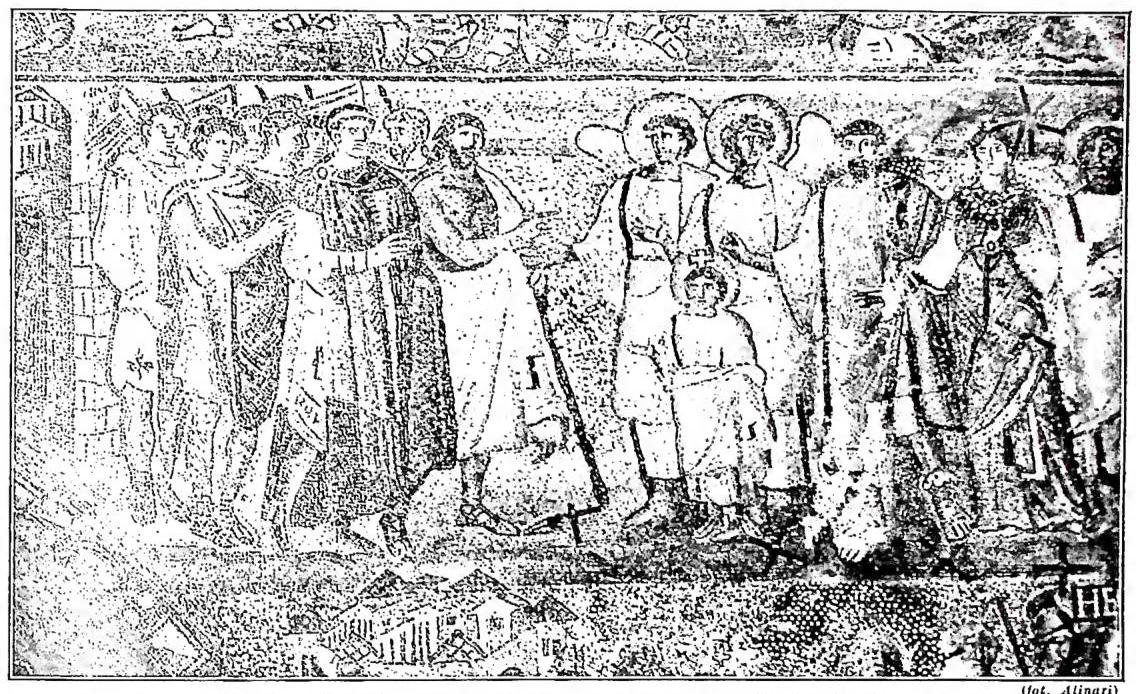
APOCRIFI - Meeting of the Holy Family with King Aphrodisius, according to the account in the Gospel of Pseudo-Matthew, chap. 24. Mosaic of the triumphal arch of S. Maria Maggiore (432–40) - Rome.
(hālahhāh), which specifies and multiplies legal provisions, now the narrative element, which adorns the biblical material with often fantastic stories, with paraenetic aims (haggādāh). Finally, numerous are the works with an apocalyptic background (v. APOCALITTICA), which seek to alleviate the misery and suffering of the oppressed people with remote prospects for the future.
Since all these a. are treated separately here, it is sufficient for now to list them, dividing them according to their predominant subject:
1. - HISTORICAL A.: Book of Jubilees, III Esdras, III Maccabees, Life of Adam and Eve (Apocalypse of Moses, Testament of Adam, Armenian Writings of Adam), Ascension of Isaiah, History of the Rechabites, Paralipomena of Jeremiah (or of the Words of Baruch), Prayer of Aseneth, Testament of Job, Testament of Solomon.
2. - MORAL OR DIDACTIC A.: Testaments of the XII Patriarchs, Idiosyncratic Psalm of David, Psalms of Solomon, Odes of Solomon, Prayer of Manasseh, IV Maccabees.
3. - PROPHETIC A. OR APOCALYPSES: Book of Enoch (Ethiopic), Book of Enoch (Slavonic), Book of Enoch (Hebrew), Assumption of Moses, IV Esdras, Apoc. of Baruch (Syriac), Apoc. of Baruch (Greek), Apoc. of Abraham, Apoc. of Elijah (Apoc. of Zephaniah), Apoc. of Ezekiel, Sibylline Oracles.
THE A. OF THE NEW TESTAMENT, as is natural, are all of Christian origin. They reflect the desire to complete the scant information transmitted by the canonical writings concerning the life of Jesus and the Apostles. Hence the preferred themes are the infancy of Jesus, the history of the Virgin Mary, and the missionary activities of the various Apostles. Nor are more or less fantastic representations of eschatological events lacking.
The curiosity of the faithful, mingled with great veneration for the protagonists, led the obscure authors to piece together their more or less serious narratives. Tertullian (De Baptismo, 17) already informs us that the Acts of Paul were composed by a priest of Asia who, called upon to answer for them, confessed that he had acted out of love for Paul.
Quite a few a., however, reflect heretical ideas (encratism, Gnosticism) proper to their authors; indeed, according to the statements of many Fathers, some of them were composed with the precise intention of supporting and disseminating heretical opinions.
According to literary genre, the a. of the New Testament are divided, like the canonical writings, into Gospels, Acts, Letters, and Apocalypses.
1. A. GOSPELS: Gospel of the Hebrews, G. of the Egyptians, G. of the Ebionites, G. of the XII Apostles, G. of Peter, Proto-Gospel of James, G. of Thomas, G. of the Infancy of the Savior (Arabic), G. of Pseudo-Matthew, History of Joseph the Carpenter, G. of Nicodemus (comprising: Acts of Pilate, The Descent into Hell), Transitus of Mary, G. of Bartholomew, G. of Philip, etc.
2. A. ACTS: Acts of Peter, Preaching of Peter, Acts of Paul, Acts of Peter and Paul, Acts of John, Acts of Andrew, Acts of Thomas, Acts of Philip, Acts of Matthew, Acts of Barnabas.
3. A. LETTERS: Letters of Jesus and of Abgar, King of Edessa, Letter of the Apostles, Letter of Paul to the Laodiceans, to the Alexandrians, to the Corinthians, Letter of the Corinthians to Paul, Letters of Paul to Seneca and of Seneca to Paul.
4. A. APOCALYPSES: Apocalypse of Peter, Apoc. of Paul, Apoc. of Thomas, Apoc. of Stephen, Apoc. of John, Apoc. of the Virgin Mary, Apoc. of Bartholomew, Apoc. of Zechariah.
It is difficult, however, to establish a precise list of the a., particularly those of the New Testament, given the indeterminacy of the criteria to be followed. Anyone wishing to register as a. all writings regarded as inspired by some ancient ecclesiastical writer would have to lengthen the list presented above by several entries. Thus, for example, works of the Apostolic Fathers, such as the letter of Clement, that of Barnabas, and the Shepherd of Hermas, are not infrequently counted among the a.; some ancients considered the last two inspired (for the latter two cf. Origen, De principiis, III, 2nd ed. by P. Koetschau: CB, V, p. 251 and PG 11, 309). Various catalogues of the a. may be read in ancient works: Apostolic Constitutions, VI, 16: PG 1, 949–56, Decretum Gelasianum: PL 59, 159–80, Synopsis Scripturae Sacrae of Pseudo-Athanasius: PG 28, 432, stichometric index of Nicephorus of Constantinople: PG 100, 1055–60.
Many a. are known only by their titles; others have reached us fragmentarily or in translations, while few can still be read in their original text. Quite a few fragments have recently been discovered in papyri or in the libraries of ancient Eastern monasteries. The discovery of the apocryphal Gospel of John in an Arabic codex of the Ambrosiana is also recent (cf. Biblica, 24 [1943], pp. 194–95).
From a literary standpoint, the a. do not merit particular consideration: they are popular narratives, in an unadorned language. The mania for the marvelous, and the desire to specify down to the smallest details the implausibility of many narratives, place these works at a considerable distance from the simplicity and freshness that make the Gospels and the canonical books so attractive, even from a literary point of view.
As is clear from their titles alone, the a. of the Old Testament, like those of the New, claim to be part of the sacred books, whether Jewish or Christian. Indeed, it has been maintained concerning certain a. of the Old Testament that they were used as canonical books by the New Testament authors. Today very few attach weight to Origen’s statement (Comm. series 117 in Mt., 27, 9, ed. Klostermann: CB, XI, p. 250) that Paul cited (I Cor. 2, 9) the Apocalypse of Elijah (in secretis Eliae) as an inspired writing and that he derived the detail concerning Jannes and Jambres (II Tim. 3, 8) from an a. (Liber Jamnes et Mambres). St. Jerome already judged the passage in the letter to the Corinthians to be a free citation from Is. and spoke contemptuously of the «deliri degli a.» («apocryphorum deliramenta conticant, quae ex occasione huius testimonii ingeruntur ecclesiis Christi», In Is. 64, 4: PL 24, 646). Nor does a citation from the Book of Enoch in Iud. 9 and 14 appear certain. Perhaps these passages derive from the Jewish oral tradition; in any case, they do not legitimize the deduction that the two Apostles regarded the aforementioned a. as inspired.
Certain Fathers and certain particular churches paid undue honor to writings of this kind, subsequently rejected absolutely by the Church. In the works of the Apostolic Fathers, expressions are found, introduced as biblical citations, whose provenance is unknown or which occur only in a. writings (e.g.: Clement, Ad Cor. 17, 5; 23, 5; 46, 2; Barnabas 4, 3; 16, 5 [cf. Enoch 89, 56, 66]; 12, 1 [cf. IV Esd. 5, 5]. The same fact is found in other writers, such as Justin, Irenaeus, and Origen. The question is more delicate in the case of III Esd. (v.), which formed part of the Greek Bible, at least until the fifth century.
In the Clementine edition of the Bible, it was thought appropriate to place certain a. in an appendix (Prayer of Manasseh; III and IV Esd.), so that they would not disappear: «ne prorsus interirent, quippe qui a nonnullis sanctis Patribus interdum citantur, et in aliquibus Bibliis latinis tam manuscriptis quam impressis reperiuntur».
Nevertheless, the official Church, despite the differing attitude of individual scholars, always showed a justifiable hostility toward such works. Already in the Muratorian Fragment one can note a disdainful repudiation, in which the a. are compared to gall in relation to the honey of the canonical books («Fel enim cum melle miscere non congruit»). Innocent I, writing to Bishop Exuperius of Toulouse, qualified them not merely as «to be rejected», but as «to be condemned» («non solum repudianda, verum etiam noveris esse damnanda», Euchir. Bibl. 17). An identical judgment is Decree of Gelasius (v.) and in other ancient documents.
The texts of the a. are now eagerly sought out, and their content is studied in order to derive from them information concerning the milieu in which they were composed. From them, in fact, it is often possible to ascertain what religious ideas were preferred in particular circles, or the vicissitudes of certain institutions.
Their use, however, as historical documents is more difficult. A natural sense of scepticism accompanies the reader in this labyrinth of minute information and apocalyptic descriptions. Today there is an attempt to reassess at least the historical core of certain a., but the undertaking is highly uncertain. In the absence of other documents, one cannot rely on fanciful accounts written for purposes of edification, or of more or less heretical propaganda. Even more foolhardy is the attempt to trace, through the a., the existence of a simple Christianity, quite different from the doctrinal and juridical Christianity already manifested in the earliest writings of the Fathers. It is undeniable, however, though perhaps less than one might expect, that the study of the a. is useful for understanding the religious mentality of the period immediately preceding or following the beginning of the common era. The a. are especially useful for our knowledge of Palestinian Judaism in those years. Thus, for example, in the field of angelology, the Book of Enoch is exceedingly valuable; in IV Esd. (8, 46-49) one finds one of the clearest statements concerning original sin. Finally, the history of Jewish messianism receives from the a. certain fundamental testimonies, which explain the slow and gradual misunderstanding of the prophetic statements.
The study of the l. a. of the New Testament is useful for learning about, in addition to certain sectarian tendencies, some aspects of ancient Christian piety, all the more so because they in turn influenced later works, the liturgical life of the Church, and art in particular.
In the liturgical life of the Church, James (v.) had a particularly significant influence; from it derives the institution of particular feasts, such as the Presentation of Mary in the Temple (21 Nov.). Finally, the liturgical books contain not a few texts taken literally from a. The very common invocation for the dead, Requiem aeternam, is an adaptation of a passage from IV Esd. (2, 34-35). The well-known liturgical verse for Christmas Eve is taken from IV Esd. 16, 53. Other brief prayers in the Roman missal or breviary are of similar origin.
The influence of the a. was even greater in art. From the simple depictions of the presentation of Mary in the Temple or of the bathing of the Infant Jesus, which can be admired in very ancient frescoes, to the paintings of the finest modern artists, the detailed narratives of the a. and their animated pageantry have abundantly inspired art. Thus certain pictorial scenes cannot be fully understood unless one turns, as an inspirational source, to the distant a., inexhaustible feeders of popular legends.
These writings exercised no lesser influence on literature, particularly Italian literature. The Divine Comedy, and even more works of the type of the Legenda aurea of Giacomo da Varazze, are considerably indebted to the ancient fantastic narratives preserved in the a. This can also be observed in other literatures, and not only European ones, since there are definite traces of a. in the Qur’an, explainable by the existence of very ancient Arabic translations or adaptations.
General treatments: M.-J. Lagrange, Le Messianisme chez les Juifs, Parys 1909; E. Schürer, Geschichte der jüdischen Völkes, III, 4ª ed., Lipsia 1909, pp. 268-468, 524-92; G. Felten, Storia dei tempi del Nuovo Testamento, Italian trans., II, Torino 1913, pp. 289-404; St. Székely, Bibliotheca apocrypha, I, Friburgo in Br. 1913; W. Ferrar, The uncanonical Jewish books: a short introduction to the Apocrypha, Londra 1918; J. B. Frey, Apocryphes de l'Ancien Testament, in DBs, I, coll. 354-460; id., De libris apocryphis, in Institutions biblicae, I, 5ª ed. Roma 1937, pp. 158-210; E. Amann, Apocryphes du Nouveau Testament, in DBs, I, coll. 460-535; P. Volz, Die Eschatologie der jüdischen Gemeinde im Westestamentlichen Zeitalter nach den Quellen der rabbinischen, apokalyptischen und apocryphen Literatur dargestellt, Tubinga 1934; R. H. Malden, The Apocrypha, Londra 1936; A. Oepke, Bibliae anaequo, in G. Kittel, Theologisches Wörterbuch zum N. T., III, Stoccarda 1938, pp. 987-99. Angelo Penna