
CAPITALISM. - A term commonly used to denote the structure of the economy in the modern and contemporary periods, understood in two distinct senses depending on whether one considers the technical-productive aspect or the ethical-social aspect under which economic life may be viewed.
The tendency to replace human labor with mechanical means—a phenomenon observed almost continuously and marking, in a certain way, the great stages of humanity’s economic history—could assert itself more strongly in recent times due to the more extensive exploitation of natural energy sources, the increasingly widespread application of scientific discoveries, and the use of machinery in production methods. Considered in its technical-productive aspect, capitalism, or more precisely the capitalist economy, is the economic system corresponding to the different proportion in which the two factors were employed in production proper and in the circulation of goods, with a growing prevalence of the material factor (capital), contrary to what had occurred in earlier periods, during which labor was more widely used. In this sense, capitalism must undoubtedly be credited with having contributed enormously to the well-being of humanity in general, having lightened human toil, increased labor productivity, reduced production costs, accelerated the formation of savings, and augmented global wealth. However, this way of considering capitalism does not offer special interest, insofar as the most serious problems it has raised and continues to raise do not directly concern the transformations introduced into the productive process, which constitute an undeniable progress compared to the technically more backward production methods previously in use.
Greater interest, by contrast, lies in the ethical-social aspect of capitalism, that is, the system of economic relations arising from the aforementioned transformations, both among nations in the world and among the classes of production, as well as between capital owners and the consuming community within individual countries. Taken in this sense, it may be said that, historically speaking, capitalism began with the rise of the enterprise, the complete productive unit of the modern economy. Unlike the small artisan workshop, in which the factors of production were embodied in the same subject—at once owner of the tools of labor, worker (with few employees), and responsible director of production—in the enterprise, the productive factors were divided into two distinct groups: on the one hand, the owners of the means of production, and on the other, mere workers, while the arbiter of production became the entrepreneur, a figure sometimes distinct, but more often identified with that of the owners of capital goods. The cause of this separation was the new demands of production, whose significantly increased flow required capital investments, both fixed (buildings, installations, machinery) and circulating (raw materials, financial means), not only of large dimensions but also capable of being easily and skillfully managed according to market fluctuations. Hence, especially in industry, the nearly universal diffusion of wage labor as the legal institution governing economic relations between the classes of production; the multiplication of joint-stock companies, which facilitated the collection of large amounts of savings by distributing the risk of investment among a great number of savers; and the formation of a managerial class of administrators and entrepreneurs who freely disposed of substantial masses of wealth, whether entirely external to or participating in the ownership of the means of production (share capital) to a sufficient extent to gua—
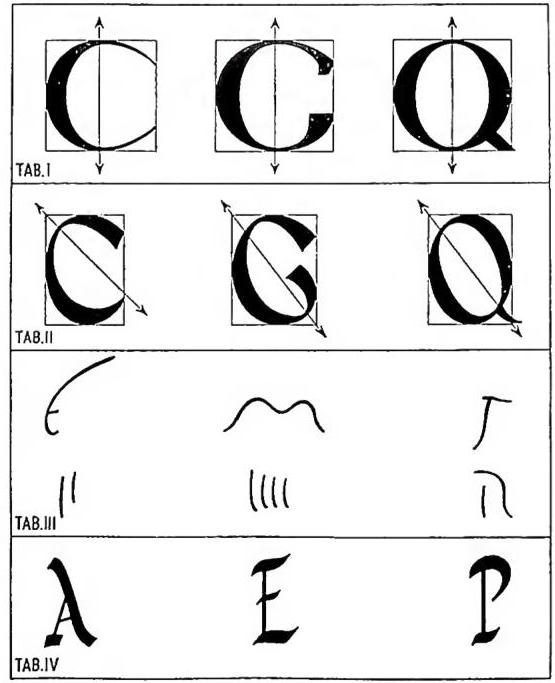
The form of letters in the various types of capital script.
These phenomena, characteristic of the capitalist economy, were made possible by the principle of unlimited individual freedom, which constitutes its intimate essence and distinguishes it from other economic-social systems that have sought to address its perceived drawbacks. Capitalism (c.) indeed emerged from liberal economic doctrines, putting into practice the principle of perfect freedom of initiative and choice, theoretically recognized for all economic subjects—producers (capitalists and workers) as well as consumers—within a society governed by private property rights. However, the concept of economic freedom is highly ambiguous and, in reality, amounts to true servitude for those in a position of inferiority relative to wealth, namely workers and others who do not directly participate in national production with their own means. Those in privileged positions ultimately exercise despotic power over them for their exclusive benefit. If one could distinguish theoretical capitalism from historical capitalism, the former would align with the theoretically perfect scientific constructs of classical economics, while the latter corresponded to an economic system that, though inspired by the ideal model of science, diverged from it in practice in multiple respects—not only in the strictly economic sphere but even more so in the social one. In the latter, anti-liberal manifestations of capitalism, and its particular characteristics, included the systematic exploitation of human labor by entrepreneurs and the rise of de facto monopolies to the detriment of consumers. In countries where capital was scarce and labor supply high, competition meant that individual economic freedom translated for workers into low wages, excessively long working hours, and the replacement of men with women and children, all to the advantage of entrepreneurs seeking to reduce production costs by any means, even at the expense of wages, either to increase profits or to withstand competition by lowering commodity prices. Workers' conditions were incomparably better in countries experiencing significant economic development and well-supplied with capital, where the labor market favored them. Yet even in these countries, entrepreneurial competition led to the ruin of firms unable to precede price reductions with parallel cost cuts, resulting in their absorption by more economically efficient enterprises that dominated the market to a greater or lesser extent, depriving consumers of the benefits of competition. More frequently, market dominance fell into the hands of compact groups of entrepreneurs who, rather than continuing a struggle often marked by unfair and ruthless tactics, preferred to merge their enterprises into associative bodies (consortia, industrial syndicates, trusts, cartels) to set commodity prices by mutual agreement and in their common interest. Contrary to the liberal principle from which it originated, the capitalist economy everywhere assumed a monopolistic character, albeit to varying degrees, allowing capital holders to exercise arbitrary dominion—not always directly over workers, but over the mass of consumers, i.e., the entire population, rendered economically and politically subject to a limited number of individuals whose economic power could also easily impose itself on public authorities. Among capitalist monopolies, those controlled by high finance leaders (major banks) deserve mention. Through their shareholdings in the most important industrial complexes, they were able to dominate entire sectors and the entire national economic system.
Similar to those described within individual countries were the phenomena that capitalist economics presented on the international stage, both in terms of competition among capital owners for market conquest, which often spurred political tensions and armed conflicts between nations; and in terms of monopolies, arising from the coalition of industrial complexes located in different countries or from the control of globally significant natural resources by individual groups of owners; and finally, in terms of the unequal distribution of wealth among nations. Particularly regarding this last point, in which capitalism has demonstrated its failure from a social perspective, the same phenomenon of concentration and scarcity of wealth among the classes of a people is observed among nations—some abundant in capital, in the form of soil resources and large industrial infrastructures existing within their borders or in empires somehow subject to their influence, others instead overpopulated in relation to the economic resources of their territory. The consequence of such an imbalance between people and wealth is a stark inequality in the living standards of their respective populations and the periodic recurrence of global economic crises, previously mentioned. The crisis represents the peak of the so-called cyclical fluctuations, that is, those periods of expansion and depression in economic activities that recurred at nearly regular intervals during the two centuries of capitalist economics. While acknowledging the serious social drawbacks arising from the downward phase of such fluctuations, economic theory nonetheless discerns positive effects in the upward phase and attributes the cause of the entire phenomenon to an imbalance between the flow of savings and the volume of investments, determined by the state of saturation in which the available markets find themselves at that moment. The imbalance initially occurring in a given country then reverberates in others, linked to the first by trade relations, until the excess wealth is absorbed by the normal demands of consumption, thus overcoming the depression. New prospects for profitable investments then reopen to savings, allowing the resumption of productive activities and the beginning of a new economic cycle. However, the profound cause of cyclical fluctuations, rather than the imbalance between savings and investments—a merely immediate and, in a sense, local cause of the phenomenon—must be more properly attributed to the liberalist praxis as implemented by capitalism. The functioning of an international economic system based on the freedom of trade is possible only under the hypothesis of a freedom that is effectively shared by all the elements constituting it—namely, people, capital, and goods—and that simultaneously obeys the exigencies of the system itself, which must present a certain equilibrium between the availability of capital and the size of the population, and thus between labor yields in individual countries, a necessary condition for establishing lasting and roughly balanced trade flows between them. Yet the criterion governing the exercise of economic freedom in capitalist economics was the immediate advantage of the country and entrepreneurs, without any reference to future benefits or the just interests of other countries. Consequently, capital did not flow, as would have been necessary, to the places most in need of it, given that the profit, if not lower, was certainly longer-term. Moreover, the movement of people and goods, objectively unattainable in the described form, was positively hindered by certain categories of citizens interested in preventing variations in economic life unfavorable to them. In particular, capitalist producers obstructed the entry of goods that threatened domestic production; the working classes of richly endowed countries opposed the entry of new workers, whose presence would have driven wages downward. Governments, for their part, in addition to accommodating such demands of producer groups, did not fail to impose further obstacles to the freedom of international trade for political reasons. On the other hand, the economic freedom as understood and practiced in capitalist economics, while widening the gaps between nations and accentuating the imbalance between people and capital within them, naturally led to overproduction, due not to inevitable misjudgments of market capacity but to the impossibility of making a system function that was essentially based on the principle of a real equilibrium of economic forces among its constituent parts. The weakness of capitalism in the field of international relations lies precisely in this constitutional contradiction between the equilibrium requirements imposed by the very logic of the system, as well as the necessity of maintaining national economic life in conditions of stability—of interest to populations—and an economic freedom that, left to itself, is neither nor can be what those exigencies would require. For the same reason, the repeated attempts in the interwar period to return to more or less moderate forms of international trade freedom have all failed, including, as far as can be foreseen, the latest in 1948, undertaken by the International Trade Organization (I.T.O.), in which, however, an effort was made to reconcile the restoration of some freedom in economic relations between nations with the exigencies of a "full employment" policy within each country.
The effects of the aforementioned drawbacks led, as peoples—and especially the working classes—became increasingly aware of their social rights, to the progressive decline of liberal-capitalist economics, which, moreover, never existed in a pure state. Even before the First World War, capitalism had to retreat to less liberalist positions within individual countries regarding the problem of mutual relations among production classes. To the employers' trade union organizations, created to protect their own category interests, analogous workers' organizations were opposed for the same purpose, transforming the labor market from a regime of near-monopoly held by entrepreneurs into one of bilateral monopoly, regulating the same relations through collective bargaining. Public authorities were also prompted to protect working classes with appropriate labor legislation, which also disciplined, on a legal level, the freedom of action of entrepreneurs with respect to workers. In the interwar period, labor relations were further regulated through mixed trade union organizations (various forms of corporatism), more or less subject to the political influence of the State, in countries governed by totalitarian regimes, among which Italy, which, at the end of the last conflict, returned to the former system, to which democratic countries had remained faithful. At the end of the First World War, the problem of relations between capitalist producers and the consumer community was addressed differently depending on the economic—
The system of regulated economy, adopted as an extraordinary measure during the years of crisis and then continued without interruption during the periods of war emergency and reconstruction, is destined to persist in the internal life of nations, at least as far as the countries of Western Europe are concerned. The economic union of Europe, toward which they strive, indeed requires effective state action to discipline and direct individual activities toward a harmonious coordination of the various national economies, with the aim of raising production and the well-being of all countries. Even from this perspective, the classical postulates of liberal economics must now be considered obsolete. According to these postulates, under the stimulus of individual interest, economic freedom is the most suitable means to achieve the highest level of production, in which the purpose of the economy would consist. On the contrary, as is increasingly acknowledged today, the purpose of the economy is not so much the increase of wealth as rather a wealth distributed according to justice among the various social classes and the various countries of the world—a goal to which economic freedom alone has proven incapable of attaining. The problem of the survival of capitalism (c.), often discussed, must be viewed within this different framework of the entire economic question. Having surpassed the principles of traditional liberalism—of indiscriminate maximum production and the private interest of the entrepreneur as the sole end and criterion of economic activity, from which originated what was called the "spirit" of capitalism, thoroughly imbued with utilitarianism and materialism—the more humane and just principle of collective well-being is affirmed everywhere, both in theory and in political practice, to which individual interest must be subordinated and therefore contained within well-defined boundaries. It is not a matter of suppressing private ownership of the means of production and private initiative, replacing the old capitalism with a more oppressive state capitalism; nor, even less, of halting the evolution of economic life or altering the current structure of the modern economy by returning to more backward methods of production. Rather, the question is to establish in which sectors and to what extent, given the technical progress achieved by the economy, the means of production and economic choices should be left to the discretion of private owners and entrepreneurs, insofar as they contribute to the public good of greater social justice and sufficiently widespread well-being in society. More than a question of the survival or definitive decline of capitalism, the issue is to determine what should be preserved of capitalism, having proven useful to humanity, and what, for the opposite reason, should be subjected to a more or less radical process of revision. As can be seen, this is a problem of limits as well as of means to be employed in order to resolve it in the best way, taking into account the natural purpose of the economy and the factual conditions relative to the national and international environment in which the problem arises. Among the means generally employed today in democratic countries, in addition to the direct and indirect action of the state in the nation's economic life and the control of public opinion over its external manifestations, so-called structural reforms are recalled, still in their initial stages, aimed at transforming the wage relationship into some form of partnership contract, calling the working classes to participate in the management and profits of the enterprise alongside owners and entrepreneurs. In other words, seeking to avoid the drawbacks of old private capitalism and recent state capitalism, an attempt is made to follow a "third way," intermediate between the two extremes, along which the economy should proceed, allowing private initiative to operate within a well-defined scope, such that it does not oppose the achievement of the social ends inherent in economic life. With due limitations on individual freedom, capitalism is therefore not destined to disappear entirely but to renew itself in the awareness of a more deeply felt social responsibility on the part of wealth holders, there being no alternative other than state supercapitalism, which, along with the disappearance of economic freedom, leads to the loss of every other individual freedom.
CAPITALISMO (aspetti etici e religiosi).
The ethical and religious aspects of capitalism have been the subject of extensive discussion, particularly within the context of Catholic social doctrine. The Church has never condemned capitalism in toto, but it has repeatedly pointed out the dangers inherent in an economic system that, if left entirely to the free play of individual interests, risks generating profound social injustices. Already in the encyclical Rerum Novarum (1891), Pope Leo XIII denounced the exploitation of workers and the concentration of wealth in the hands of a few, calling for a more equitable distribution of goods and the recognition of workers' rights. This teaching was further developed in subsequent encyclicals, such as Quadragesimo Anno (1931) by Pius XI, which introduced the principle of subsidiarity and criticized both unbridled capitalism and collectivist socialism, and Centesimus Annus (1991) by John Paul II, which, while acknowledging the efficiency of the market economy, reaffirmed the need for ethical limits to prevent it from becoming an instrument of oppression.
The fundamental ethical problem posed by capitalism lies in its tendency to reduce human labor and economic relations to mere commodities, subject to the laws of supply and demand, without regard for the dignity of the person. The Church teaches that the economy must serve man, not the other way around, and that the pursuit of profit cannot justify the exploitation of workers or the creation of glaring inequalities. In this regard, the concept of the "common good" occupies a central place in Catholic social doctrine: economic activity must be oriented toward the integral development of the person and the well-being of the entire community, not merely toward the enrichment of individuals or social groups.
From a religious perspective, capitalism has also been criticized for its materialistic and individualistic tendencies, which can lead to a weakening of spiritual values and a loss of the sense of solidarity. The Church has repeatedly warned against the dangers of consumerism and the idolatry of wealth, which can alienate man from his true end, which is union with God. At the same time, however, the Church recognizes that capitalism, when properly regulated and guided by ethical principles, can be a tool for promoting human flourishing and alleviating poverty. The challenge, therefore, is not to reject capitalism outright but to purify it of its distortions and integrate it into a broader vision of social justice and human dignity.
BIBL.:
- LEONE XIII, Rerum Novarum, in Acta Sanctae Sedis, XXII (1890-1891), pp. 641-670;
- PIO XI, Quadragesimo Anno, in Acta Apostolicae Sedis, XXIII (1931), pp. 177-228;
- GIOVANNI PAOLO II, Centesimus Annus, Città del Vaticano 1991;
- TONIOLO G., La questione sociale e l'enciclica « Rerum Novarum », Roma 1931;
- NELLI V., Il pensiero sociale cattolico, Brescia 1945;
- FANFANI A., Cattolicesimo e protestantesimo nella formazione storica del capitalismo, Milano 1934;
- MESSNER J., Das Naturrecht, Innsbruck-Wien 1950.
A. FANFANI.
THE THOUGHT OF THE CHURCH CONCERNING CAPITALISM. — The previously expressed judgment of a revision, not total suppression, of capitalism corresponds to the thought of the Church regarding the same problem. The two social encyclicals of Leo XIII and Pius XI, Rerum novarum and Quadragesimo anno, important also for the completeness of the synthesis with which capitalism is described in its historical manifestations, and more recently some letters, messages, and discourses of Pius XII, do not condemn capitalism in itself, as an economically advanced system technically founded on individual initiative and private ownership of the means of production. Therefore, they took a stance against the communist system and the extreme forms of regulated economy proper to totalitarian States. Indeed, given the current tendency of the State to invade the natural field of individual activities, the Supreme Pontiffs have repeatedly denounced the danger of excessive interventions and unjustified substitutions of public powers in the sector of the economy and labor relations, pronouncing unfavorably both on the nationalization of enterprises not required by the demands of the common good, and on political systems that render « practically impossible or vain the right of property, both over consumer goods and the means of production », and affirming the right of citizens to associate, within the framework of the laws, in autonomous bodies for the defense of their class interests. In particular, Pius XII, following in the footsteps of his predecessors, has indicated the most effective remedy for addressing one of the gravest social inconveniences caused by the dissociation of the factors of production, namely the subordination of workers to employers and their mutual distrust and hostility, in the establishment of professional and corporate organizations of employers and workers, founded on the commonality of interests and responsibilities, through which the working classes would be called to participate in the direction of the national economy in accordance with the dignity of conscious contributors to production.
Indeed, once the legitimacy of the institution of private property is admitted, and given that the dissociation of the factors of production cannot be entirely eliminated from the current structure of the economy—though it may be reduced by extending cooperative or quasi-cooperative forms (worker shareholding, labor cooperatives) in the ownership and management of enterprises—the best solution for correcting the abuses of capitalism in labor relations seems to be that which, without resorting to direct State action, creates the climate and offers the means for constant class collaboration, founded on the convergence of interests regarding the development of production. For the same reasons mentioned above, the legitimacy of the wage contract must also be affirmed, which Quadragesimo anno denies to be « inherently unjust »—though « it is more prudent, insofar as possible, ... that it be somewhat tempered by the contract of partnership »—provided it entails just remuneration for the work performed, such that, considering the particular conditions of the enterprise and the general conditions of the national economy, it allows the worker and his family, along with an honest livelihood, the possibility of improving their standard of living and of acquiring, through savings, their own property.
Pius XII also indicated with two felicitous expressions the irreducible opposition between Catholic social doctrine and communist doctrine regarding the goals they respectively pursue and the methods of action they propose to achieve them. « Not all proletarians, but all proprietors »; « not revolution, but evolution »: an evolution « harmonious, ... progressive and prudent, courageous and consonant with nature, enlightened and guided by the holy norms of justice and charity ». Although these two phrases signify an open condemnation of communist objectives and methods, they also implicitly reprove the fundamental principles and practices of capitalism regarding the purpose of the economy, the concept of national wealth, and the means and forms that must be employed to better achieve II. According to Catholic doctrine, « the economic wealth of a people does not properly consist in the abundance of goods, measured according to a purely material computation of their value, but rather in what such abundance truly and effectively represents and provides as the material basis sufficient for the due personal development of its members ». For « the national economy, as it is the fruit of the activities of men who work united in the state community, so it aims at nothing other than to continuously ensure the material conditions in which the full individual life of citizens may develop ».
Catholic doctrine therefore rejects, both on the scientific plane (classical theory) and on the practical plane (liberal capitalist economy), a conception of the economy that intends to resolve the problem of production separately and independently from the problem of the distribution of wealth based on the foundations of true social justice. A science that studies the way in which the wealth of nations increases, abstracting from the natural demands of man and considering economic subjects as mere centers of force, without due recognition of their dignity as persons and their moral duties, in an exclusively materialistic vision of social reality, is a science that Pius XI defined as built on « false opinions » and « fallacious suppositions ». Nor can the Christian conscience in any way accept an economic system that, inspired by the principles of such a science, generates or perpetuates social inequalities incompatible with the natural purpose of material goods, arousing rivalry and conflicts between classes and peoples within the national and international society. The Church has therefore reproved « as contrary to natural law » traditional capitalism, insofar as it is a cause, on the one hand, of « excessive concentrations of economic goods, which, often hidden under anonymous forms, succeed in evading their social duties and almost place the worker in the impossibility of forming his own effective property »; on the other, of an « innumerable multitude of those who, deprived of any direct or indirect security for their own lives, no longer take interest in the true and high values of the spirit, ... slaves of whoever promises them in some way bread and tranquility ». Capitalist economy is wont to boast vainly of having accumulated great quantities of savings, which have made possible an unprecedented increase in production, with which the needs of a humanity considerably grown over the last century could be satisfied. This, however, does not invalidate the gravity of the accusation that such savings were too often the fruit of unspeakable sacrifices of workers, to which they were compelled for a long period, until, only later, united in trade unions, they succeeded in tipping the scales of justice in their favor in the distribution of the product.
It suffices to consider that, limited to Italy, before 1868, the year in which the Zanardelli penal code came into force, the strike was considered a crime; while the first official affirmation of international importance, which denied that labor could be considered a mere commodity, was pronounced by the newly born League of Nations, some years after the First World War had yielded its fruits of blood spilled on the battlefields of an entire continent. The Church does not ignore the irreplaceable function of savings in the economic process; indeed, it exhorts to it as an expression of the natural virtue of temperance. But it denies
that savings should be solely a privilege of the few—and moreover, of those who, on the scale of individual needs, have reached such a high degree of satisfaction that it equates to the lack of basic necessities for vast segments of the population. The compensation due to the owner of the means of production and to the entrepreneur must indeed be higher than that of their other collaborators, given their responsibility for the enterprise and the greater risk they assume in production initiatives. Yet they also bear a greater obligation than others "to contribute through savings to the growth of national capital. Since it is highly advantageous for a sound social economy that such capital growth derive from the most numerous sources possible, it is therefore highly desirable—according to Pius XII—that workers, too, may participate with the fruit of their savings in the formation of national capital." Advocates of liberal economics object that, in solving the problem of distribution according to Catholic principles, one cannot obtain the amount of savings required by production needs, particularly in countries poor in capital, since the working classes are more inclined to allocate their income to immediate consumption needs. However, this objection loses much of its force if savings—especially modest ones—are appropriately encouraged and effectively protected by institutions of both private and, above all, public character, as it is the general duty of public authorities to intervene and assist or even replace private initiative when it proves insufficient to secure the common good of society, which in this case consists in an equitable distribution of national wealth.
This latter point more directly concerns the method by which the Catholic and capitalist conceptions believe progress should be made toward the goal of the economy. Born and developed in the early period of its existence during the so-called "Industrial Revolution," capitalism has remained, in a sense, revolutionary in the way it has implemented its program of maximum absolute production. Classical theory had indeed demonstrated that individual freedom and private interest, through a dense network of seemingly disconnected and disordered actions, would bring the economic system into a state of equilibrium, provided the ideal conditions it assumed were met (one may think of Bastiat's "economic harmonies"). In reality, however, those conditions either do not occur at all or occur only very imperfectly, and capitalist economics has given rise to a varied and continuous series of imbalances—not only social (imbalances in the distribution of individual incomes within the same country, in the distribution of capital and wealth among regions of the same country and among nations of the world) but also economic (imbalances between savings and investments, between production and consumption). The former are represented by a more or less unequal participation of citizens in the enjoyment of material goods and other advantages of economic progress, while the latter result in a loss of wealth in the form of underutilized productive factors and consumer goods. Recent and more accurate investigations by economic thought more closely aligned with reality have therefore led to the conclusion that imbalance constitutes the norm of economic life and that, in particular, the cyclical fluctuations previously described—precisely the consequence of the aforementioned economic imbalances—should not be regarded, as in the past, as pathological phenomena, but rather as physiological, assuming, of course, a market economy. Economic becoming would thus naturally follow a wave-like movement, in which phases of expansion alternate with phases of depression, originating primarily in those countries that, from time to time, hold global economic initiative and subsequently spreading to other countries. The concept of "order," which appeared as a true achievement of early economic thought—and certainly was so on the strictly scientific plane of pure economics and in the hypothesis of an ideal world—has been repeatedly contradicted by facts. Today, one speaks rather of an "order sui generis," which in practice amounts to a true disorder, generating economic and social distress both within individual countries and in the international community. Its cause is traced back to the principle of individual freedom and private interest, which, so to speak, constituted the soul and driving force of capitalism. Catholic doctrine does not accept an economic freedom placed exclusively at the service of individual interest, insensitive to the social needs of the community and especially of the economically weaker classes; nor does it accept a market economy, the collective expression of that freedom, which allows only the strongest to survive, only to oppress them in some cases under the weight of their own strength, as is easily visible in times of crisis, when the exuberant production of prosperity periods is exhausted. "Those very few who seem to hold in their hands, along with the greatest wealth, the fate of the world; those very few men—observed Pius XI in the encyclical Caritate Christi compulsi, while the great crisis of 1929 raged—who, through their speculations, have been or are largely the cause of so much evil, are themselves very often its first and most resounding victims, dragging with them into the abyss the fortunes of countless others." Catholic doctrine likewise cannot accept—if only for the disastrous social and political consequences it entails in the field of international relations—the concept of economic progress that advances through shocks and jolts, causing various countries to pass from great prosperity to great indigence despite the abundance of previously accumulated goods, due to the undisciplined freedom of action of entrepreneurs who guide its course. Liberal economists often observe that it is precisely in periods of expansion, when initiatives multiply prodigiously under the stimulus of large profits, that economic progress takes its most decisive steps toward further improvements, which remain definitively acquired by humanity once the depression period is overcome. The response is that the same occurs in wartime, when the imperatives of military offense and defense impart a strongly accelerated motion to technology, though at a cost too high for humanity as a whole, even if it ultimately redounds to its benefit in peacetime. Similarly, the progress that the world economy usually registers in expansion periods is too dearly paid for in those of depression; thus, a "progressive and prudent evolution, courageous and consonant with nature, enlightened and guided by the holy norms of justice and charity" is undoubtedly to be preferred—even if less rapid, yet more continuous and constructive—rather than a "revolution," to which the more or less profound innovations in production techniques that individual freedom manages to implement in the ascending phase of the economic cycle may, in a certain way, be compared.
The supreme pontiffs, from Leo XIII to Pius XII, have repeatedly spoken out against the concept of economic freedom and the free market—the field of action and guiding principle of such freedom—as understood during the two centuries of capitalism's existence, and all the more forcefully as the negative effects it produced outweighed the positive ones. "Free competition, though certainly fair and useful if kept within well-defined limits, cannot in any case be the helm of the economy," wrote Pius XI in the Quadragesimo anno: "nor can such a directive role be assumed even less by that economic supremacy which has in recent times replaced free competition; for being a blind force and a violent energy, it needs to be wisely restrained and guided to be of use to men... It is necessary that free competition, confined within reasonable and just limits, and even more so that economic power, be in fact subject to public authority in matters pertaining to its office. Finally, the institutions of peoples must adapt the whole of society to the demands of the common good, that is, to the laws of social justice; from which it will necessarily follow that such an important section of social life as economic activity will in turn be brought back to a sound and well-balanced order." In recent years, Pius XII has once again condemned that capitalism which "claims an unlimited right over property, without any subordination to the common good"; he has also denounced in contemporary society the existence of "some mechanism which, far from being in accordance with nature, conflicts with God's order and the purpose He has assigned to earthly goods," against which the worker's effort to improve his conditions collides. The internal orderings of nations and the action of public authorities must therefore jointly guide the national economy toward the achievement of the common good of wealth equitably distributed among the population, particularly by eliminating the most serious degenerations of undisciplined freedom, such as monopolies, and in general by constructing barriers around the freedom of the strongest, which naturally tends to exceed the bounds of justice. The overcoming of capitalism is therefore, according to the social thought of the Church, not a task reserved exclusively for public authorities, as maintained by communist doctrine and the proponents of a merely centralized economy, nor even by liberal doctrine, which vainly invokes it against monopolies in order to preserve the market as much as possible in conditions of competition. It must also and above all be the result of new legal orderings that impose upon the classes of production—directly interested in the solution of the problem—a mutual renunciation of unlimited freedom and their own exclusive individual interests, thus creating the premises for effective and lasting collaboration in justice and social peace. Regarding the sector of international economic relations, Pius XII affirmed the necessity of a return "to the wise and unshakable norms of a social order which, on the national as on the international level, erects an effective barrier against the abuse of freedom, no less than against the abuse of power." In this new order, "founded on moral principles, there is no place for narrow egoistic calculations aimed at monopolizing economic resources and common-use materials in such a way that nations less endowed by nature are excluded from them." After the vain experiments of economic isolation attempted in the interwar period to escape the exceptionally harmful consequences of capitalism in the international sphere, the harsh experiences of the last conflict—largely caused, like the one preceding it, by economic motives—have enlightened various governments about the necessity of implementing the principles proclaimed by the Church, re-examining the principle of absolute state sovereignty in defense of nationalist interests and laying the foundations for economic cooperation among the countries of an entire continent, a first step toward a future and broader international economic cooperation.
Alberto De Marco