
LOW CHURCH (« Low Church »). — The name L. C. was initially understood as opposed to High Church (« High Church ») and also included those belonging to the « Broad Church » or « latitudinarians ». It originated before the Oxford movement among those Anglicans who cared little whether the bishops were sworn or non-juring, because they regarded the episcopate merely as an existing form of ecclesiastical government.
It retained something of the ancient Puritan spirit, but without the doctrine of Calvinist predestination. When Methodism arose, it copied certain elements from it, but it always remained Anglican and inherited the aversion to Rome held by Anglicans, Puritans and Metho-
(courtesy of Prof. E. Jovi)
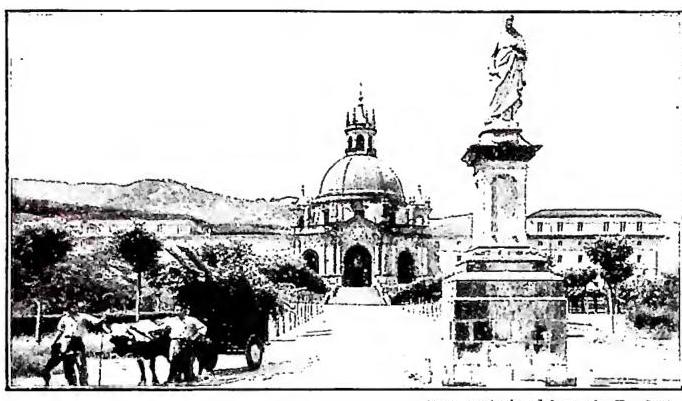
LOYOLA, SANTUARIO di — General view of the Sanctuary.
dists. Because of their insistence on certain truths of the Gospel, e.g., on sin and forgiveness, the members of L. C. were called « evangelicals ». Among them, especially during the period of the Hanoverian dynasty, the government chose many bishops, and from this arose the importance that L. C. once possessed. During the development of the Oxford movement, it opposed it because of its semi-Catholic attitude. When it then saw that some Anglican ministers were also adopting Catholic ceremonies in worship, L. C. presented itself as the defender of Anglican usages and customs and founded the « Church Association », which represented within Anglicanism the group most hostile to the Catholic Church and to the Anglo-Catholics. Its doctrines may be reduced to the following: it attaches little or no importance to the episcopate and to apostolic succession; it is Erastian (v. ERASTO), but more for political than religious reasons; it is opposed to the theory of the three branches. Even among the members of L. C., however, there are nuances, overlaps and incursions of the doctrines of the other Anglican groups.