
ITALO-ALBANIANS. – This is the name given to those Italian citizens who live in the municipalities (more than a hundred) whose Albanian origin can be documented, established in Italy (Abruzzi and Molise, Campania, Apulia, Lucania, Calabria, Sicily, Veneto, Istria, Dalmatia) by the substantial groups of Albanians who emigrated from the fifteenth to the seventeenth century, before and after the death (17 January 1468) of the national hero, Giorgio Castriota Skanderbeg, and the consequent fall of Albania under the Ottoman yoke.
Leaving aside the families who, in groups or singly,
at various times crossed over into Italy, there were several mass migrations, which headed for the Kingdom of Naples and Sicily. Three military columns under the leadership of Demetrio Reres and his two sons Giorgio and Basilio came in 1448 to help Alfonso I of Aragon suppress the rebellion in Calabria, of which Demetrio was subsequently appointed governor; his two sons were sent to Sicily as a garrison against the threats of the French and against the pirates.
A letter from King Alfonso in 1452 to the prince of Taranto, his great feudal lord, ordering him to receive the Albanians favourably if they should seek hospitality in his lands, suggests an emigration around that period, or at least testifies to that King’s benevolent disposition towards the Albanians. In 1461, led by Skanderbeg, who had been urged by Pio II to defend Ferdinando I against Giovanni D’Angiò and the rebellious barons, military units arrived which later, together with another 5,000 combatants and the many families who, after the fall of Constantinople (1453), were streaming into Italy, founded several towns and repopulated others in Apulia. Skanderbeg was appointed lieutenant general of the region, with the perpetual grant, for himself and his descendants, of certain fiefs of the Kingdom. But the most numerous and dramatic emigrations occurred after the hero’s death (1468, 1478, 1482, 1491, and others), and gave rise to the greatest number of the Italo-Albanian colonies. To the first of these undoubtedly refers what Pope Paul II (1464–71) wrote to Filippo, duke of Burgundy, concerning the horrors and massacres being perpetrated against the Albanian cities, «quae ante hac pro nobis Turcorum substituerunt impetus», and against those populations who, in the most tearful despair, poured disorderly onto the Italian shores. Many colonies arose from the arrival of the Coroneans (1534) on an imposing fleet of Carlo V, to whom the cities of the Morea (Corone, Modone, Nauplia, and others also recalled in the traditional Italo-Albanian popular songs) had sought protection. For approximately three centuries of Venetian rule, the Morea was predominantly inhabited by Albanians who had moved there between the thirteenth and fifteenth centuries in such numbers as to change «grandemente l'aspetto etnografico del paese» (Hertzberg).
Carlo V renewed for the exiles the privileges they had enjoyed in their homeland in return for their loyalty to the Empire. Groups of Coroneans also settled in the principal cities of the Kingdom (Naples, Palermo, Messina, Reggio) and in the largest centres on the Adriatic coast (Bari, Brindisi, Lecce, Otranto, Taranto, and Barletta, Trani, Bisceglie, Molfetta, and others), where parishes arose around which Albanian families gathered, crossing the sea at various periods. During the reign of Carlo III di Borbone, in 1744, a final considerable emigration settled at Villabadessa (Pescara), a fief personally owned by the Sovereign, who generously assigned it to the Albanian exiles. Between 1727 and 1733 Borgo Erizzo arose near Zara in Dalmatia, the only Ghega colony, that is, one originating from northern Albania.
Because of the ancient friendly relations between the Albanian princes and the kings of Naples, and the military cooperation between the two countries, although there were also manifestations of hostility by coastal populations terrified by the advances and savage reprisals of the Turks, the Albanian exiles, protected by the pontiffs as victims and almost martyrs of the faith and favoured by the sovereigns, came as to a second homeland to colonize and reclaim extensive areas depopulated by earthquakes, epidemics, and continual wars. Because of these indisputable demographic and economic advantages, the barons and bishops, too, were generous in granting concessions to the new colonists, who always enjoyed the rights of citizenship and practised their religion according to the Greek rite without disturbance in their churches and with their own clergy, and without any suspicion ever being raised regarding their Catholicism.
This is confirmed by the constant Catholic tradition of the I.-A., who, as one reads in the Constitutions of the Synod held at Monreale (Palermo) in 1652 by Cardinal Fr. Montalto Peretto, «erroribus orientalium schismaticorum nullo modo consentiunt». The surnames predominant in these colonies correspond, to a considerable extent, to the historical surnames of southern Albania and to the names of towns and districts still current in those regions; many of these place-names were applied by the exiles to places and districts in the Italo-Albanian territories. The dialect and the few historical and geographical allusions in the traditional Italo-Albanian songs confirm their origin from southern Albania and the Morea, as does the Greek rite professed, at least originally, in all the colonies.
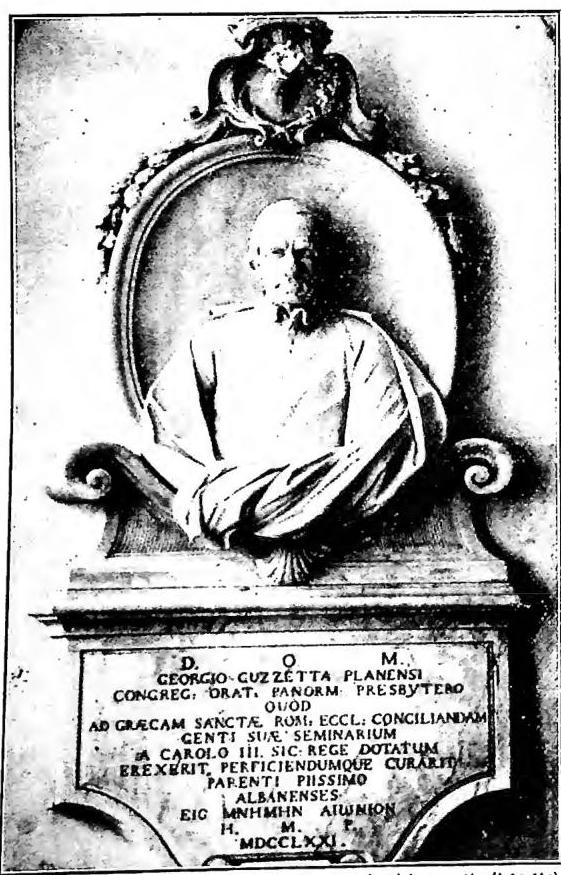
(courtesy of Rev. U. Petrotta) ITALO-ALBANESI - Monument to Fr. Giorgio Guzzetta erected in 1771 - Piana dei Greci (Palermo).
This bull, justified in the case of the Italo-Greeks who at that time, both faithful and clergy, came from centres separated from Rome, was not justified in the case of the I.-A., who, being distant from any communication with those centres, had a clergy who carried out their studies and philosophical and theological formation, as is still practised today, in the diocesan Latin seminaries, in the Pontifical Greek College, and in the pontifical universities of Rome. These restrictive provisions served as the pretext for an ill-considered and scandalous struggle against the Italo-Albanian Greek Catholic rite.
But Providence raised up men of holy life, extremely zealous for the Eastern rites, for Albania's return to Catholicism, and for its liberation from Islamic slavery: Fr. Stefano Rodotà of S. Benedetto Ulano (Cosenza) obtained from Pope Clement XII, in 1732, the establishment of the Greek-Albanian College for Calabria and, in 1735, the institution of the bishopric; Fr. GUZZETTA, GIORGIO (v.) was able to open the Greek-Albanian Seminary in Palermo for Sicily in 1734, and was able to initiate the process for the bishopric, which was obtained after his death, in 1784.
Two facts contributed to disappointing the hopes that the Albanians placed in these institutions: the lack of ordinary jurisdiction for the two bishops, and, even more, the publication of Benedict XIV's bull Etsi pastoralis in 1742, which caused great displeasure among the I.-A., because in it the Greek rite was called tolerated, because their Catholic faith was called into question, and because, with pontifical authority, all the abuses committed to their detriment were sanctioned (Nota di Segreteria, 1917). Hence new conflicts between the Latins and the Albanians, who, « concentrating all their energies on the defence of their own rite, became lost in internal complaints and no longer thought of the missions of Albania (Nota cit.) », which they had maintained for approximately two centuries (the seventeenth and eighteenth), with such zeal on the part of priests and Basilian monks from Megoïso (Palermo) and Grottaferrata, as well as distinguished prelates, keeping alight a feeble flame of Catholicism in the poor churches of Chimara (southern Albania).
Nevertheless, during two centuries of life the two Institutes (although the one in Calabria, later transferred [1794] to S. Adriano near S. Demetrio Corone, was transformed into a secular boarding institution) caused the Greek rite to flourish again and, through linguistic, literary, historical, and liturgical studies, raised the condition of the colonies that had escaped the storm. Having strengthened their tradition, these colonies made a valuable contribution to the Italian and Albanian Risorgimento and initiated a vigorous literary movement through the collection of popular songs, from which the distinctly Italo-Albanian literature drew its inspiration. With Girolamo De Rada (1814-93) of Macchia (Cosenza), and subsequently, down to our own day, with Giuseppe Schirò (1865-1927) of Piana degli Albanesi (Palermo), through a long succession of scholars and writers, priests and laymen, it represents a substantial part of Albanian culture and literature.
In recent decades, with the revival of the missionary spirit and as a result of the popes' concern for the separated East, the I.-A. have been prompt to respond to the call of the common Father by establishing (1931) in Palermo, under the guidance of Cardinal Luigi Lavitrano, the Italian Catholic Association for the Christian East (ACIOC). Through weeks of prayer and study in the principal Italian cities, this association has aroused zeal for the apostolate of Union in the light of the pontifical documents. The popes, especially from Leo XIII to the present day, have promoted the preservation and revival of the Greek rite in Italy for this apostolate. In 1919 Benedict XV established the eparchy, or Greek diocese, of Lungro for Calabria and the Pontifical Albanian Seminary in the monastery of Grottaferrata; in 1937 Pius XI declared it exarchal and established the eparchy of Piana degli Albanesi for Sicily.
For the Italo-Albanian rite,