
DONOSO CORTÉS, JUAN. — Marquis of Valdegamas, Spanish statesman and Christian philosopher of history, born at Valle de la Serena in Extremadura on 3 May 1809 and died in Paris on 3 May 1853. From 1820 to 1828 he studied at Salamanca, Cáceres, Seville, and Madrid. Professor of literature at Cáceres from 1829 to 1832, he married; but he immediately lost his wife.
(from V. Frand, Pantheon des illustrations françaises au XIXe siècle, Citeret, Paris, s. d.)
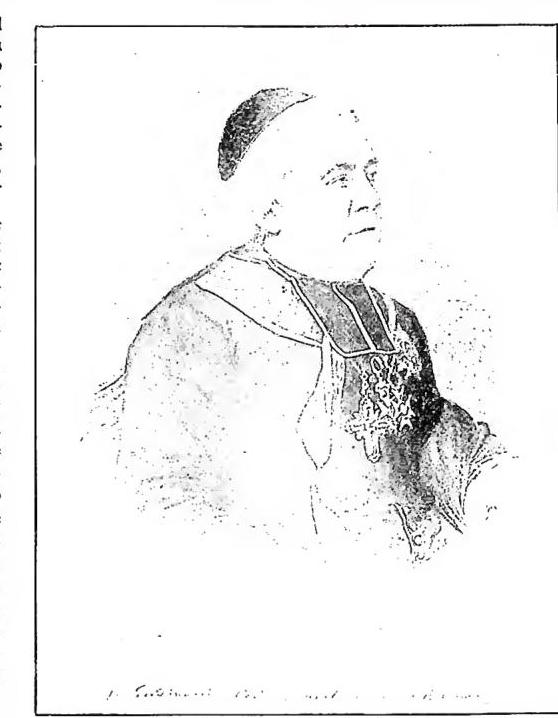
DONNET, FERDINAND-FRANÇOIS-AUGUSTE - Portrait with autograph signature. Lithograph from a drawing by Lemoine.
Parisian revolution of 1848 (he would say that “revolutions are the beacons of Providence and of history”), he abandoned liberalism in order to return to the practice of Catholicism, in a straightforward and open manner, as was characteristic of his nature. Re-elected deputy to the Cortes, he delivered speeches there that resonated throughout Europe, such as those on dictatorship (1849) and on the conditions of Europe (1850). His principal work, which summarizes his political, philosophical, and religious thought, is the Ensayo sobre el Catolicismo, el Liberalismo y el Socialismo (Madrid 1851), divided into three books: in the first he set forth the miracle of the Church in itself; in the second, the solutions offered by the Church to the problem of good and evil, of necessity and freedom, in opposition to the contradictions of liberalism and the absurdities of socialism; in the third, he examines according to the same criterion the Church’s attitude toward social questions, especially concerning familial, national, and human solidarity and the tragic experience of suffering and sacrifice in history. The work bears the influence of the ideas of the traditionalist school of De Maistre and De Bonald, which exerted such influence through the C.’s inner process at the time of his conversion. Regarding the bitter controversies that naturally arose, La Civilità Cattolica took stock of the matter in April 1853. In 1849 C. was also ambassador of Spain to Berlin, and from 1851 to 1853 to Paris.
BIRL.: Obras de don Juan D. C., edited by G. Tojado (with a biography of C.), 5 vols., Madrid 1854-56; 2nd ed., 4 vols., there 1903-1904; Oeuvres de D. C. with an introduction by L. Veuillot, 3 vols., Paris 1858-59, 2nd ed. 1862; Discursos parlamentarios, Madrid 1915; A. Valle, Cartas inéditas y semineñidas de D. C., in Razam y Fe, 1936, II, pp. 434-51. In Italian: Scritti vari di D. C., Rome 1861; I brani migliori di D. C., edited by B. Sanvisenti (I libri della Fede, 15), Florence 1924. Three complete and partial translations of the Saggio, Foligno 1852, Milan 1854, Rome 1861. E. Schramm, D. C., Leben und Werk eines spanischen Antiliberalen, Hamburg 1935 (contains all the preceding bibliography); A. Dempf, Christliche Staatsphilosophie in Spanien, Salzburg 1937; P. Leturia, L'ateismo comunista previsto e confutato negli ultimi scritti di D. C., in Civ. Catt., 1937, IV, pp. 302-16, expanded in Gregorianum, 18 (1937), pp. 481-517. Ireneo Daniele