Machine translation of the 1948–1954 Italian original. The original text is authoritative.
SERPOTTA, GIACOMO. — Sculptor, born in Palermo on 10 March 1656, died there on 27 February 1732.
His distant ancestor was a Guglielmo S. of the 16th century, followed by a line of artisans, down to Gaspare S., sculptor and stucco worker, Giacomo’s father. S. began working in stucco in the workshop of his brother Giuseppe; his journey to Rome is doubtful, although his art contains reflections and references to the Roman art of the period.
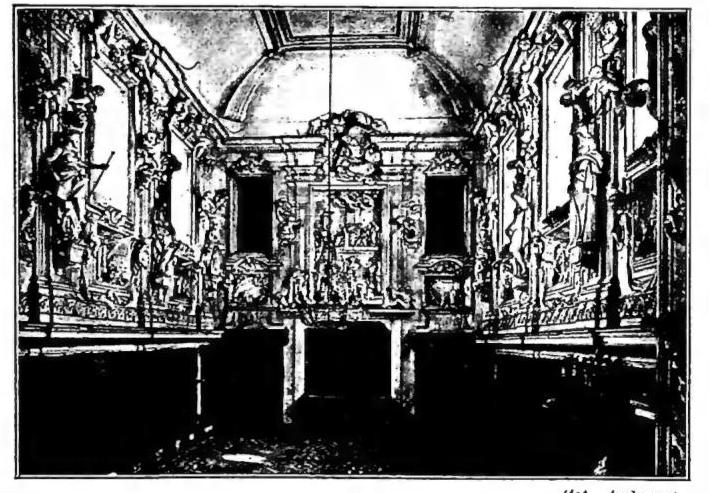
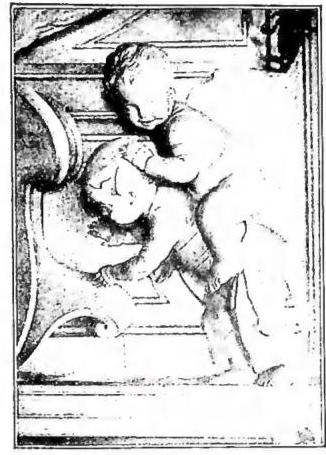
Most of his work is found in Palermo; the six statues of the church of the Giusino, originating from the Oratory of Charity, date from 1679. From these works arose the commission for the equestrian monument to Carlo II at Messina (1681), destroyed in 1848 (model in the Museo Sieri Pepoli in Trapani). In 1682 he executed the statues of SS. Pietro and Paolo in the church of S. Maria del Carmine Maggiore, and then, in 1685, began one of his most famous decorations: the stuccoes of the Oratory of S. Cita, completed over various periods. In 1690 he modelled the statue of the Virgin of the Jesuit College; in 1691, the stuccoes for the chapel of S. Stefano in S. Sebastiano alla Marina and that of the Annunciation at S. Onofrio. In 1694 he went to Agrigento to execute there the marvellous putti of the church of S. Spirito; later to Alcamo, where he left four of his finest Allegories, while it is uncertain whether he visited other centres of the Island that possess works attributed to Serpotta without secure documentation. In 1696 S. undertook the decoration of the church of S. Orsola, later restored by his son Procopio, also a stucco worker, and prepared the wax models for the mysteries of the Rosary of the convent of S. Cita, subsequently sculpted by Vitagliano. In 1698 he decorated the small chapel of the hospital of the priests and in 1699, framing Caravaggio’s paintings, began the stuccoes of the Oratory of S. Lorenzo, which, together with those of the Oratory of the Rosary of S. Domenico, executed shortly afterwards, rank among the master’s major works. In 1707 the Princess of Roccaflorita had herself portrayed by S. in a stucco medallion. In the following year S. decorated the church of the Pietà and in 1711 that of S. Agostino. Shortly afterwards the decoration of the church of S. Tommaso dei Greci was executed. From 1720 to ’28 the artist modelled the statues of the church of S. Agostino, where reminiscences of Bernini are evident, and completed the Oratory of S. Francesco ai Candelari, seat of the Confraternity of the Forensi, his final work.
S., one of the foremost sculptors of his time, possessed an exceptionally keen sense of environmental decoration, modulating in his lively representations an infinite series of motifs. These achieve unity also through the magical play of shadows, which both impart and receive value from the precious whiteness of the luminous material employed by the artist.
BIBL.: S. Bottari, Artisti siciliani, Messina 1931, pp. 47-66; F. Meli, Studi e conferenze per il 2° centenario serpottiam, Palermo 1934; id., G. S. (con bibl.), there 1934; N. Basile, Serpottiana, there 1935; S. Bottari, Il baldacchino del duomo di Messina
(fot. Anderson) SERPOTTA, GIACOMO — Stucco decoration, with scenes from the Life of s. Lorenzo and s. Francesco, symbolic statues, and putti, inside the Oratory of S. Lorenzo (1687–96) — Palermo.(courtesy of sierra Cosentino) SERPOTTA, GIACOMO - Putti in stucco. Oratorio del S. Rosario - Palermo.nando prepared himself for the missions among the Indians. From 1750 to 1758 he was a missionary among the Indians of Sierra Gorda, north of Querétaro. He translated the catechism into the language of the Pame Indians. Recalled to Mexico, he worked there (1758–67) with success as a popular missionary. When in 1767 the Jesuits were expelled from the Spanish possessions, the Franciscans took over the missions of Baja California, and S. asked to go there. Appointed superior, he landed with 15 companions at Loreto, the center of the Jesuit mission in Baja California. In those years the Spaniards began to concern themselves with possessing Alta California, until then completely neglected. With the expeditionary force sent in 1769 to occupy the land definitively, S. set sail with 4 Franciscans, to whom others were later added. Their task was to bring to the faith the Indians of the region, who were extremely uncultivated. Continuing the method followed by the Franciscans in Sierra Gorda, S. founded a series of missions: S. Diego (16 July 1769), S. Carlos (3 June 1770), S. Antonio (14 July 1771), S. Gabriel (8 September 1771); S. Luis Obispo (1 September 1772), S. Francisco de Asís (8 October 1776); San Juan Capistrano (1 November 1776); S. Clara (12 January 1777); S. Buenaventura (31 March 1782); the principal cities of California, such as Los Angeles, S. Francisco, S. Diego, Monterey, S. Barbara, and others, originated from his missions. S. was the father of the Indians, and for this reason California celebrates him as a national hero; his statue stands, as the representative of the State of California, in the Hall of Congress in Washington (1 March 1931). The process of beatification, initiated in the diocesan curia of Fresno, is already under consideration by the Sacred Congregation of Rites.
BIBL.: F. Palou, Relación hist. de la vida y apostol. tareas del ven. p. fray J. S., etc., Messico 1787 (fundamental work); id., Noticias de la Nueva California, ed. H. E. Bolton, 4 vols., Univ. Calif. Press 1926; C. E. Chapman, A hist. of Calif.: The Spanish Period, Nuova York 1928; Z. Engelhardt, The Missions and Missionaries of Calif., 4 vols., 2nd ed., S. Francisco 1930; Ch. Lummis, The spanish pioneers and the Calif. missions, Chicago 1930; Ch. Piette, Evocation de J. S. fondateur de la Californie, Bruxelles-Washington 1946. Nicola Kowalsky
Cite this article
“SERPOTTA, GIACOMO.” Enciclopedia Cattolica, vol. XI (1953), p. 252. Azione Romana digital edition, https://azioneromana.com/article/serpotta-giacomo.