
TREIA. — An ancient diocese in the province of Macerata. For its statistical data V. SAN SEVERO.
Of Picene origin is ancient Trea, perhaps a colony, certainly a Roman municipium, which Pliny places among the inland cities of the Fifth Region, and Ptolemy calls Τρῶλαν. It stood approximately 2 km from the present site, in a locality now called «Mura Saracena»; devastated by Alaric in 404, it subsequently suffered the ravages of the Lombards, the Hungarians, and the Saracens, who destroyed II. The inhabitants then gathered on the hill, where they reconstituted an inhabited centre, the present-day one, which was called Monticulum, Monticulum, and hence Montecchio («del Potenza» or «di Macerata»). By the 11th century it had already been constituted as a Guelph Commune, listed in the Constitutiones Aegidianae among the «civitates mediocres»; subsequently subject to the various rulers of the Marches, it finally passed to the Church. An ancient parish church, S. Maria, at the site of the destroyed Trea, is regarded by certain historians as the cathedral of a primitive diocese, on the assumption that T., by analogy with several other cities of Picenum, also had its bishops from the earliest centuries (although there is no documentation of this), and that the diocese ceased to exist with the end of the city itself and consequently came under the jurisdiction of the bishops of Camerino.
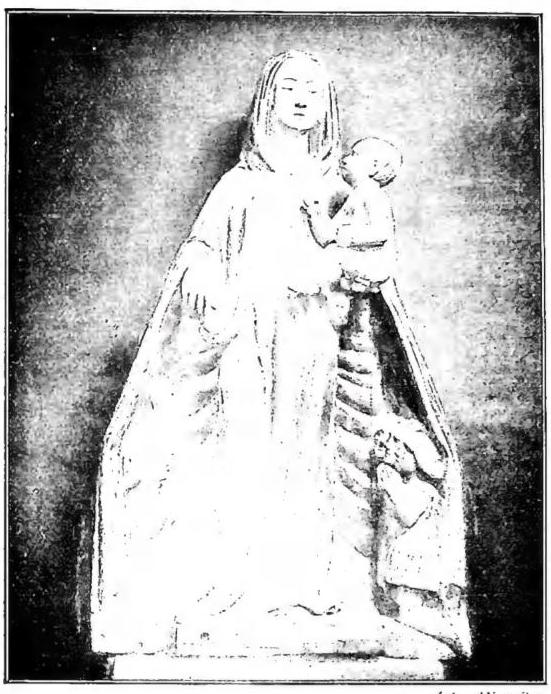
(phot. Alinari)
TREIA - Our Lady of Succour, a fifteenth-century wooden sculpture. Accademia Georgica dei Sollevati.
scopalem » with its Curia, seminary, and all the rights, honors, and prerogatives of episcopal cities; and, separating its territory from the see of Camerino, he gave the archbishop of the latter the perpetual administration of T., with the obligation of residing there for several months each year, maintaining a vicar general there, and signing himself in all documents with the joint title of archbishop of Camerino and perpetual administrator of T. But given the distance between Camerino and T., Pope Benedict XV, by the apostolic constitution Bani Pastoris of 20 February 1920, permanently united the diocese of T. with that of S. Severino, whose bishop became the perpetual administrator of T.
T. gave birth to the blessed Pietro, called of T., a celebrated preacher and promoter of peace in the Marche, which had been torn by internal discord; he died in Girolo (Ancona), where his tomb is venerated. Cardinal Nicola Grimaldi (1768–1845) was from T.; he was governor of Rome in the time of Gregory XVI, who made him a cardinal, and a benefactor of T., to which he sent the two marble statues of the apostles Peter and Paul, belonging to the tomb of the Emperor Otto II.
Notable in T. are the Cathedral, dedicated to the Most Holy Annunciation, and, in the surrounding area, the shrine of the Crucifix and the small shrine of Our Lady of the Bridge, in the hamlet of Passo di T. The Accademia letteraria dei Sollevati (fifteenth–sixteenth centuries) became renowned in T.; it was revived in 1776 under the name Società Georgica dei Sollevati, for agricultural studies and experiments, and is housed in a palace designed by Valadier.