
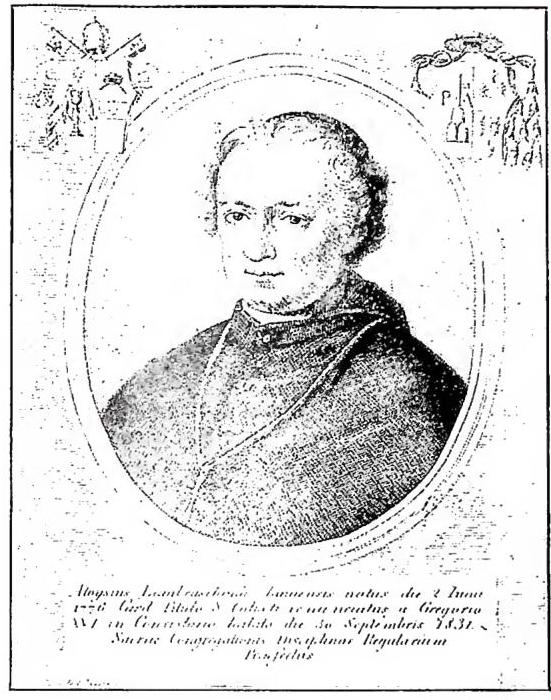
LAMBRUSCHINI, LUIGI. – Cardinal, Barnabite, born at Sestri Levante on 16 May 1776, died in Rome on 12 May 1854. He taught philosophy and theology at the Barnabite Colleges in Macerata and Rome. Pius VII, whom he had assisted during his imprisonment at Savona, appointed him examining theologian of bishops, consultor of the Inquisition, and finally secretary of the Congregation for Extraordinary Ecclesiastical Affairs. He was also a valuable collaborator of Cardinal Consalvi in the negotiations with the Neapolitan government. On 3 October 1819 he succeeded Cardinal G. Spina as archbishop of Genoa. In 1821 he persuaded the insurgents to spare Governor Des Geneys, who had fallen into their hands, and subsequently exerted himself on their behalf when the reaction set in.
In 1827 Leo XII sent him as nuncio to Charles X of France; there he was overtaken by the July Revolution. L., who was immediately opposed to this revolution, which also assumed anticlerical and anti-Catholic aspects, opposed it not only because of his attachment to the old dynasty, but above all because of his firm convictions against every idea of popular sovereignty and liberalism. The nuncio’s position was then highly delicate because of the numerous problems that arose following the establishment of the new dynasty and the new regime; among them were the recognition of Orléans by the Holy See, the validity of the concordats concluded by Napoleon and the Bourbons, the oath of allegiance to the new regime, and finally the French attitude toward the Revolution in the Legations and toward the Austrian intervention aimed at suppressing II. Although L. did nothing to make relations between France and the Holy See more difficult, although he had, on his own initiative, anticipated recognition of the new government, and although many of his positions were dictated more by the prudence of the Curia than by ill will, nevertheless his personal sentiments and the support he gave to the archbishop of Paris, regarded as a legitimist, induced the French government to request the nuncio’s removal, and he was in fact recalled in July 1831.
On 30 September of the same year he was created cardinal by Gregory XVI and was entrusted with the S. Congregation of Studies. As its prefect, concerned about the modern philosophical and political ideas spreading from the universities, he tightened the reins further and kept a closer watch on professors and students. In 1836, upon Bernetti’s resignation, he was chosen as Secretary of State. It was wrongly said that in this office he proved a submissive instrument of Austrian policy and that his accession signified a return from Bernetti’s broad and understanding policy to a more genuinely reactionary absolutism. In reality, he was able to defend pontifical independence even against Vienna (one may recall his attitude concerning the Austrian insurance companies in 1837) and, without compromising on religious questions, he was conciliatory toward France and Piedmont; he also knew how to yield on purely temporal matters, such as that concerning certain police measures directed against travelers disembarking at Civitavecchia. His greatest success in foreign policy came in 1838, when the Austrians and the French evacuated Ferrara and Ancona, respectively. In domestic policy, too, his attitude was not very different from Bernetti’s: uncompromising in theory, but tempered in practice. He nevertheless imposed many restrictions; among other things, recognizing political aims in scientific congresses, he prohibited participation in them.
At the Conclave of 1846 he obtained 15 votes in the first ballot, but a strong group of cardinals, led by Bernetti, opposed his election. He was created prefect of the S. Congregation of Rites, bishop of Porto and S. Rufina and of Civitavecchia, secretary of the Briefs, and librarian
Oltre a Notificazioni, Pastorali, Indulti, Regole, Statuti e Costituzioni per le diocesi e varie Congregazioni religiose, è da indicare come fonte importante: La mia nunziatura in Francia, a cura di P. Pirri (Bologna 1934).