
MASSAJA, GUGLIELMO. — Cardinal, Capuchin, born at Piovà (Asti) on 8 June 1809, died at S. Giorgio a Cremano (Naples) on 6 Aug. 1889 in a reputation for holiness. On 6 Sept. 1826 he entered the novitiate of Madonna di Campagna in Turin. He was lecturer in philosophy and theology (1836–46), confessor to Princes Emanuele and Ferdinando of Savoy, and definitor. Elected (12 May 1846) apostolic vicar of the Galla (southern Ethiopia), he departed from Rome for his mission (3 June 1846). The first Catholic bishop of modern times to set foot again in Ethiopia despite the penalty of death, he restored the hierarchy there, consecrating three bishops.
Exiled by Prince Ubiè, persecuted and excommunicated by the heretical bishop Salama, he became popular under the
name of Abuna Messias. During the five-year period 1846–50 he travelled along the coasts of East Africa in an attempt to find a route to the Galla, but in vain; he helped save the Lazarist mission; he ordained several dozen priests and consecrated as bishop the future Blessed G. De Jacobis (7 Jan. 1849). Driven back to sea once more, he returned to Europe in 1850 in order to draw the attention of the Holy See and France to the sad religious and political conditions of East Africa. His second journey (4 Apr. 1851), through Egypt and the Sudan, finally brought him to his mission (21 Nov. 1852), after six years of heroic attempts and romantic adventures.
During the Galla decade (1852–63) he founded missionary centres in Gudrù, Ghera, etc., and in Kaffa (1859–61); he took care of the formation of the indigenous clergy, creating “the itinerant seminary”; he laid down admirable principles of the apostolate for missionaries in the Magna Charta of Assandabo (16 March 1854); he was a pioneer of medicine as a weapon of the apostolate, and pacified princes and peoples, whom he subdued through the holiness of his life. During the twofold European interlude (1864–66, 1867), he wrote a catechism, founded the Galla College of Marseille (1866), and published the Lectiones grammaticales pro missionariis qui addicere volunt linguam amaricam seu vulgareem Abyssiniae nec non et linguam oromonicam (Paris 1877). His third journey (19 Apr. 1866) extended as far as Aden; it was followed by the fourth and final one (9 Sept. 1867), which opened the Shoan period (1868–79).
A friend and adviser of Menelik, king of the country, he carried out such religious and social activity that he was proposed as Abuna of Ethiopia. But he did not accept. Exiled (1879) by order of King Giovanni, he returned to Italy, where the masses’ veneration for the servant of God reached the point of cutting pieces from his clothing in order to have relics of him, as happened later on his deathbed. In Leo XIII he found his papal patron, who made him bishop of Stauropoli (1881) and cardinal (1884), despite the vigorous opposition of the candidate, who was often entertained in conversation by the Pope on the Church’s most secret affairs. At the announcement of his death, the Holy Father exclaimed: “A saint has died!” The Church has opened the processes for his beatification.
At the “command” of Leo XIII, M. consented to write—when more than seventy years old—his classic work I miei trentacinque anni di missione nell'alta Etiopia (Rome–Milan 1885–95, in twelve large volumes).
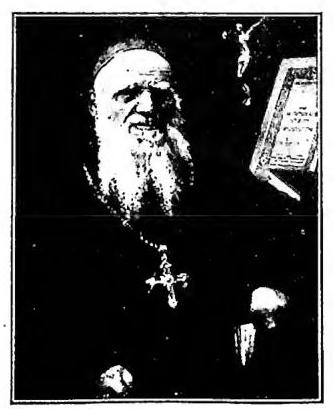
(courtesy of Fr. Carmelo da Sessano)
MASSAJA, GUGLIELMO - Portrait. One of the published volumes of his work I miei trentacinque anni di missione in alta Etiopia rests on the table.
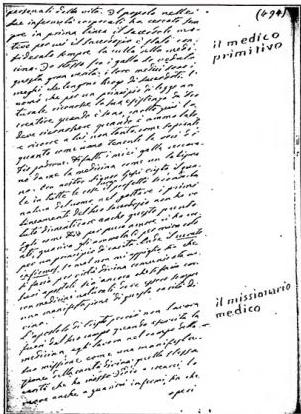
(courtesy of Fr. Carmelo da Sessano)
MASSAJA, GUGLIELMO — p. 404 of vol. IV of the original manuscript of the work I miei trentacinque anni di missione nell'alta Etiopia. The original, in 5 vols., is preserved in the Secret Vatican Archives, Pius IX section.
which would harmonize the aforementioned aims in a work of a narrative and popularizing nature. For this reason, the collaborators proceeded to make omissions, additions, and interpolations that ultimately altered the character of the original and consequently that of the author. Indeed, especially as regards omissions and additions, the disagreement between the two texts is strikingly evident: the former — extending to more than 400 pp. — have relegated to the background, because they are largely missionary in character, the extraordinary apostolic spirit of the «holy prelate»; the additions, especially with regard to terminology including vulgar epithets such as scoundrel, rascal, son of the devil, dog, vulture, etc. (which are not found in the Vatican original), have placed the supposed author in the false light of presumptuous infallibility and harshness, thereby attracting bitter criticism and unfavorable judgments. Finally, the absence from the published work of that religious and providential substratum that enlivens the entire original is another significant deficiency that diminishes the gigantic figure of the protagonist. From a literary point of view, it is true that the manuscript presents an M. less polished and refined than the published version, but certainly more personal and effective, better served by a spare and spontaneous, yet incisive and eloquent style than by a «novelistic» style such as that of I miei trentacinque anni.
In short, the manuscript contains and is dominated by the historical, apologetic, polemical, and missiological M., such as and as he himself wished to be.
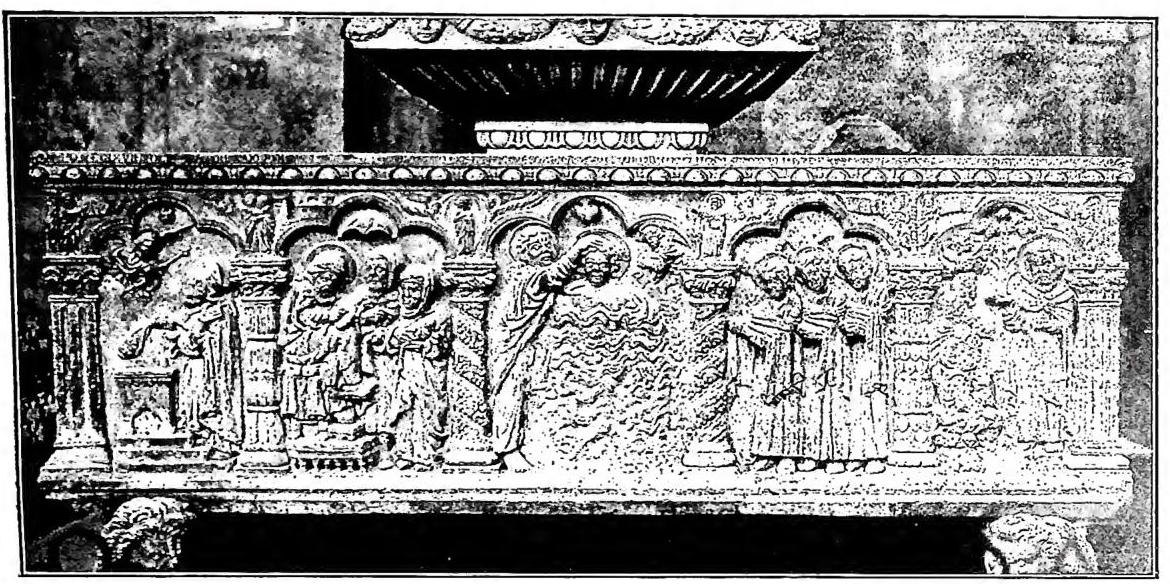
MASSA MARITTIMA, DIOCESI di — Baptismal font, work of Giroldo di Giacomo da Lugano (1267) — Massa Marittima, Cathedral.