
MERSENNE, MARIN. — French scientist and theologian, born at Oizé (Sarthe) on 8 September 1588, died in Paris on 1 September 1648. Having completed his studies at the College of La Flèche, he entered the Order of Minims. The renown of his name is still unjustly linked almost Descartes (v.). It should be noted in this connection that, when M. left the College of La Flèche, Descartes was thirteen years old, and that many of his principal works predate the Discours de la méthode (1637). M., «le secrétaire général de l'Europe savante» of his century, as Haureau writes, is much more than Descartes’s associate and occupies his own place in the great scientific and intellectual revolution of the seventeenth century. In contact with all the best-known scientists and philosophers of the period, he served as a link, a meeting point, and a means of understanding, often succeeding in overcoming the personal rivalries and disagreements, not always doctrinal in character, among his friends and correspondents. From a group of scientists whom he gathered around himself (E. Pascal, Mydorge, Hardy, Roberval, Abbé Chambon, Pailleur, Montholon) arose the Académie Parisienne, the first nucleus of what would become the Académie des Sciences. His ideal always remained the foundation of an international Academy (under the patronage of the pope and Christian princes), which would bring together theologians, philosophers, jurists, physicists, chemists, and others.
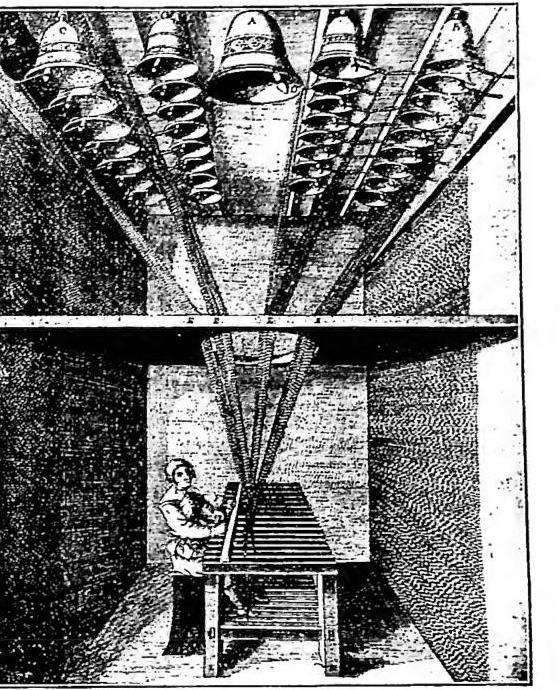
He dealt in fact with ancient and modern music in its various aspects: the nature of sound, the art of singing, harmony, and composition (Les préludes de l'harmonie universelle, Paris 1634; L'harmonie universelle, contenant la théorie et la pratique de la musique, 2 vols., there 1636–37, where, among other things, he adopts the theory of the subjectivity of sensible qualities). He conducted research on musical instruments, designing portable organs; and his experiments on vibrating strings and on sonorous pipes or tubes made it possible to discover and announce precise laws that for approximately three centuries went under his name.
(courtesy of Fr. G. Moretti)
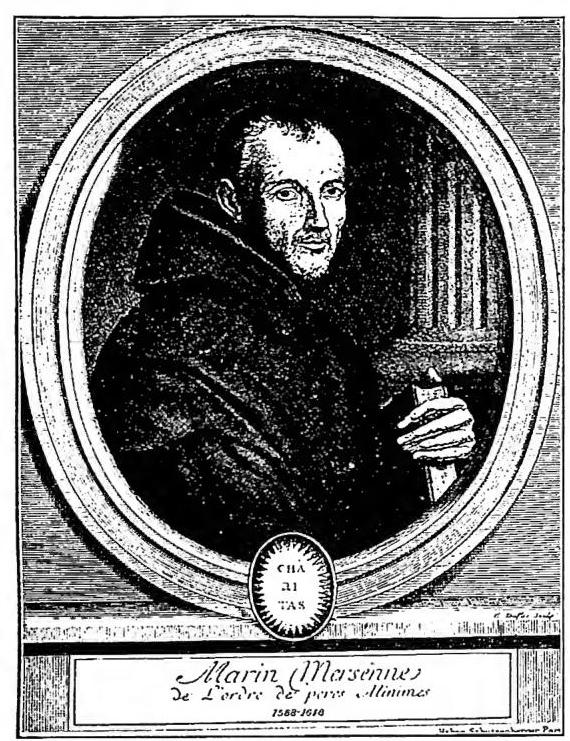
MERSENNE, MARIN – Portrait engraved by Duflos.
As has been demonstrated by recent studies (Lenoble), M.’s scientific-theological activity must be situated within the «naissance du mécanisme». Among the philosophies of the seventeenth century—Aristotelianism and Cartesianism—there is a third, the naturalism of the Renaissance (Pomponazzi, Bruno, Cardano, Paracelsus [v.]), which is still based on the old magical theme of the World Soul, to the serious detriment of religion and science. M., like Galileo and Roberval, combats magic and animism and establishes the new mechanism (different from that of Descartes), that is, he “reads nature according to the mathematical rule.” Indeed, in L'«impiété» (p. 374), M. writes, still in opposition to Bruno, that he preferred to say “that there are in the world only contingent effects, and that God is the universal principle acting in all things and maintaining individual natures united, rather than introducing a universal soul.” M., moreover, as a sincere believer, “grafts onto it the apologetic rationale justifying the ‘miracle,’ which, precisely because it is a derogation from the laws of nature, presupposes those laws, without which it would not exist; therefore, to save the natural law is to save the miracle.” He is convinced that the new mechanistic physics is a more secure guarantee of the law of nature than Aristotelian physics. Thus M. contributes to the birth of modern, or quantitative, physics, as a description of phenomenal nature according to the mathematical rule, without claims to an apodictic explanation and without constructing metaphysical systems upon II. It is, essentially, the scientific definition of “phenomenon,” for which M.’s doctrine has rightly been called a “critical empiricism.”