
SIMBIOSI. — From the Greek σύν (= together) and βλω (= life). This term, introduced by A. de Bary in 1879, denotes the intimate and constant association of two animal or plant organisms of different species, capable of creating reciprocal relationships between them that enable them to attain more favorable conditions of life.
When both components of a s. (symbionts) derive equal benefit from their association, one speaks more precisely of mutualism or mutualistic s. From this condition one passes gradually to others,
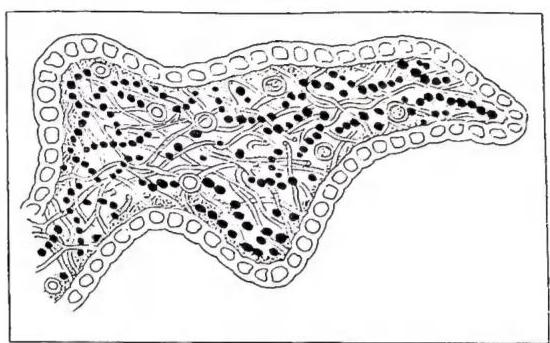
Phenomena of true s. occur between plants and plants, between animals and animals, or between plants and animals. From cases of ectosymbiosis, in which the associated species retain a certain autonomy, one arrives at cases of endosymbiosis, characterized by a considerable interpenetration of the symbionts into a single complex (Caullery).
One of the most interesting forms of s. among plants is that found in lichens, each species of which (as Schwendener discovered in 1867) results from the intimate association of a fungus with a unicellular alga. The advantage of this coexistence (lichen consortium) derives from the fact that the autotrophic alga synthesizes carbohydrates, while the heterotrophic fungus, capable of absorbing water and mineral substances from the environment, uses them to manufacture quaternary substances (fats, proteins). Another important form of plant s. is that which occurs between legumes and Bacterium radicicola. The latter, localized in the roots of the plant, where it produces characteristic nodules, has the power to assimilate nitrogen of atmospheric origin, generating nitrogenous compounds, which are then utilized by the legume. A third, very widespread example is that of mycorrhizae, or associations of fungi with herbaceous or woody plants (Kaminski, 1881; Frank, 1885). The mycelia of the fungi, enveloping or penetrating the roots of the plants and functioning almost like root hairs, draw water and mineral salts from the soil and supply them to the plant, while the plant supplies the fungus with carbohydrates, synthesized through chlorophyll activity by the green aerial organs. The partial digestion of fungal hyphae by the plant might also provide the latter with food rich in nitrogen.
In s. between animals, the advantages derived by the symbionts in general consist in protection against predatory organisms or in greater ease of procuring food. A well-known example is that of a group of crustaceans with soft abdomens (hermit crabs), which find protection by living inside the empty shells of gastropod mollusks and which often enter into s. with coelenterates (sea anemones) well supplied with stinging cells, attached to the mollusk’s shell. The stinging batteries of the sea anemones constitute a defensive weapon for the hermit crab; on the other hand, the sea anemones benefit from the hermit crab’s food remains and, above all, from the possibility of being passively transported during the wanderings of the latter, thus becoming vagile, whereas they would normally have been sedentary. Analogous s., with similar reciprocal advantages, are established in sponges of the genus Suberites, which grow on the exoskeleton of crabs of the genus Dromia; or also in certain small fish, which habitually live among the tentacles of sea anemones or jellyfish, thereby defending themselves from attacks by their predators and at the same time facilitating, through their movements, the arrival of food particles suspended in the water at the mouth opening of the coelenterate.
A separate mention must be made of s. between protozoa and metazoa. The case of termites is cited, whose intestine hosts a considerable number of flagellates, indispensable for the digestion of the wood on which these insects feed; and that of ruminants, whose stomach houses certain species of ciliates, necessary for the digestion of the cellulose in the membranes of plant cells.
Finally, the s. between animal and plant organisms are numerous and important (Buchner). The plant symbiont in these cases is generally a microscopic form belonging to the groups of fungi, algae, or bacteria. Among the most widespread examples, one may recall that of various protozoa or metazoa (sponges, coelenterates, annelids, mollusks, etc.), whose cells display a yellow or green coloration owing to the presence in the cytoplasm of unicellular algae (zooxanthellae, zoochlorellae), which benefit from the protection offered by the animal and use, for chlorophyll function, the carbon dioxide eliminated by it, while the animal, at least to a certain extent, can in turn exploit both the oxygen and the starch produced by the alga.
More complex are the cases designated by Pierantoni as hereditary physiological s. These are constant and indispensable mutualistic associations in which a lower plant (blastomycete or bacterium) lives in association with an animal that, through various mechanisms, transmits the symbiont to its descendants. In many insects such s. has nutritive functions. Thus the female of Icerya purchasi has, along the sides of the intestine, a special tissue (mycetome) filled with blastomycetes, which find their nourishment in the animal cells and digest, to the insect’s benefit, the carbohydrates on which it feeds. The transmission of the blastomycetes to successive generations is ensured by their passage from the mycetome to the oocytes contained in the ovaries. Analogous facts have been observed in aphids. In certain cases, the production of vitamins indispensable to the host by the symbiotic plant appears to have been demonstrated.
Other cases of physiological s. between animals and bacteria appear to be connected with phenomena of bioluminescence (Pierantoni, Buchner). Thus, in the luminous organs of various insects, the presence of bacteria has been noted; these participate more or less directly in the biochemical processes that produce light. Very numerous photogenic bacteria have likewise been found within the luminous organs of marine animals (cephalopods, tunicates, fish). Not all cases of bioluminescence, especially frequent in abyssal faunas, however, seem attributable to phenomena of s. with bacteria.