
REPRODUCTION. – Reproduction, or the faculty of generating new organisms similar to themselves, is the most characteristic and fundamental feature of living beings. It enables the perpetuation of the species, despite the mortality of individual organisms.
I. ANIMAL REPRODUCTION
In animals, a very great variety of modes of reproduction are known, but they can be reduced to two principal categories, profoundly different from each other: asexual (or agamic) reproduction and sexual reproduction. The former, less widespread but especially frequent among protozoa and in certain groups of invertebrates, consists essentially in the separation of one or more parts of the body from a pre-existing individual, followed by their completion, whereby they are transformed into an equal number of offspring. The latter, enormously more widespread, consists instead in the formation of the new organism from an initial cell (zygote), derived from the fusion of two special cells (gametes), one male (spermatozoon) and the other female (egg).An essential difference between the two types of reproductive activity lies in the fact that animals born by asexual reproduction retain a hereditary constitution entirely identical to that of the progenitor, whereas, conversely, organisms originating through sexual reproduction possess a hereditary constitution that is a mixture of traits derived from the father and the mother. This is of fundamental importance for the phenomena of individual variability and for the laws governing the transmission of traits.
1. Asexual reproduction
The phenomena of asexual reproduction occur in very different ways among the various groups of animals. In protozoa, the single cell constituting the entire organism frequently reproduces by simple fission, dividing into two cells identical to each other, which separate and grow until they reach their original dimensions. At other times there is multiple fission, in which the cell nucleus divides repeatedly, giving rise to many daughter nuclei, each of which becomes surrounded by a small quantity of cytoplasm, thus generating an equal number of independent individuals; generally, the process is preceded by the formation of a common protective envelope (cyst), which breaks open at the end of the reproductive activity. A third mode is budding, or the formation of one or more small cellular protuberances, each containing a nucleus derived by division of the pre-existing nucleus; each bud thus formed separates from its progenitor and then grows, leading an independent life. Similar phenomena of simple or multiple fission and budding are also found in many metazoans, especially among coelenterates, flatworms, annelids, and tunicates. A well-known case is that of the freshwater hydra (Hydra sp.), which, in addition to reproducing sexually, is capable of proliferating one or more offspring by budding along the sides of its body, the offspring being destined to separate from II. In other coelenterates, through a similar process of asexual reproduction, entire colonies of polyps originate from an individual born through sexual reproduction; these sometimes display morphological differences among themselves, associated with a complex division of labor serving the interests of collective colonial life (siphonophores). Among flatworms, certain strains of planarians have almost entirely lost the capacity for sexual reproduction and multiply almost exclusively by fission (Benazzi). Among annelids, cases are known of polychaetes and oligochaetes forming entire chains (stolons) of organisms destined to separate; sometimes, in polychaetes, only these individuals originating by fission (schizogomids) are capable of maturing the eggs and sperm indispensable for sexual reproduction (schizogamy, Malaquin).In various animal groups there is a regular alternation between generations reproducing by agamic means and by sexual means. The phenomenon, called metagenesis, has already been mentioned in connection with those coelenterates in which colonies of organisms multiplying asexually originate from an initial individual derived from a fertilized egg. In these cases, the animals of the egg- and sperm-producing generation generally have the appearance of medusae and arise by budding from those of the asexual generation, which have the form of polyps. Metagenesis was discovered by Chamisso (1818) in certain tunicates (salps), which may exist as isolated specimens (solitary salps) or in the form of chains consisting of several individuals joined together (aggregate salps). Solitary salps originate sexually, through fertilization between eggs and sperm produced by aggregate salps; the chains of the latter, in turn, form agamically from a reproductive stolon generated by the solitary salp, which is unable to mature male and female gametes.
A particular form of asexual reproduction is polyembryony, or the formation of two or more twin embryos from a single fertilized egg, which, during the early stages of ontogeny, divides into two or more distinct parts, each developing independently. The phenomenon, occasional in the human species, is habitual in certain insects and in some mammals (armadillo).
2. Sexual reproduction
The first indispensable act of sexual reproduction is the preparation of the gametes. In protozoa, the single cell constituting the entire organism may, at certain stages of the life cycle, acquire the status of a gamete. In metazoans, which are formed of several cells, the gametes instead derive from a particular lineage of elements (germ cells) which, in the gonads (ovaries and testes), undergo a complicated process of maturation, transforming into eggs or spermatozoa. The most important phenomenon in the preparation of the gametes consists in the reduction by half of the number of chromosomes characteristic of each species of organism. It is customary to say that the gametes possess a haploid number of chromosomes, in contrast to the other cells, which instead possess a diploid number. The encounter and fusion of two gametes of opposite sexes to form the zygote is called fertilization. This may be external, in numerous aquatic animals (sea urchins, annelids, fish, tailless amphibians, etc...) that release their gametes into the surrounding environment, or internal, when, conversely, the male gametes are introduced into the female genital passages, where they encounter the egg. The spermatozoon, small and mobile because it is generally provided with a tail in the form of a flagellum, reaches the egg and penetrates it; the surface of the egg then changes through the appearance of a fertilization membrane, which prevents the entry of other spermatozoa. The two haploid nuclei of the egg and spermatozoon (called the female and male pronuclei) then fuse together, forming a diploid nucleus (the nucleus of the zygote); and a process of mitosis of the latter marks the beginning of the develop-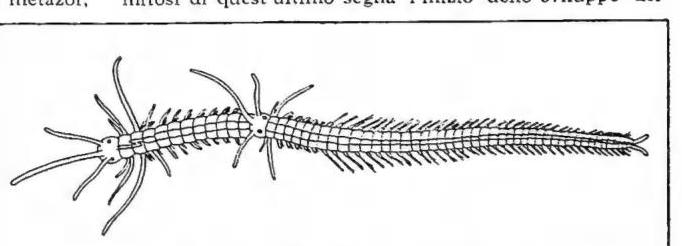
RIPRODUZIONE ANIMALE - Asexual reproduction by fission (schizogamy) in the polychaete Autolytus cornutus; the individual born by fission regenerated its head even before becoming detached from its progenitor.
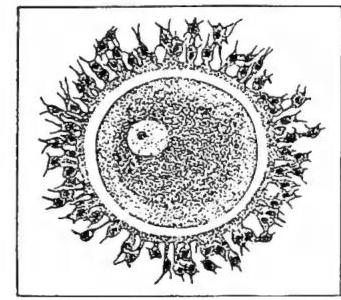
Considering the process of fertilization from a physiological point of view, it may be assumed that the mature, as yet unfertilized egg is a cell in a state of torpor, which the entry of the spermatozoon awakens to new life, as is frequently demonstrated by the resumption of respiratory activity and of exchanges of saline substances with the environment.
A form of sexual reproduction, called parthenogenesis or virgin generation, is that in which the egg is capable of generating an organism even in the absence of the activating action of the spermatozoon. The phenomenon, discovered in certain insects (aphids) by C. Bonnet in the eighteenth century, is now known, as a normal means of reproduction, also in many other invertebrates. Thus, in the bee and in the great majority of hymenopterans, females and males are born according to whether or not the egg is fertilized, whereas in many other cases (phylloxera, cladocerans, rotifers) there is a more or less regular alternation between one or more parthenogenetic generations and a generation born from the fertilized egg (heterogony).
By various experimental, physical or chemical means, parthenogenesis can also be induced in eggs that in nature are capable of developing only if fertilized. Thus, in the sea-urchin egg, the activating effect of the spermatozoon can be replaced by various chemical actions (Loeb), while in frog eggs the same effect is achieved by piercing the virgin egg with a thin needle dipped in blood (Bataillon). More recently, even in the rabbit, the experimental parthenogenetic development of eggs has been obtained (Pincus, Olivo).
3. Oviparous and viviparous animals
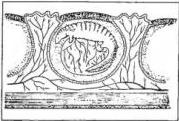
Oviparous are those animals that deposit their eggs in the external environment at a very early stage, when the development of the embryo has only just begun or before such development has begun. These eggs are generally surrounded by a gelatinous covering when they develop in water, but are protected by resistant shells when deposited in a more or less dry environment. Among oviparous animals, some have no care whatsoever for the eggs they have laid or for the young that hatch from them, whereas others lavish on the eggs and the young a series of attentions generically known as parental care. These consist in the construction of a nest, of highly varied form in the different animal groups, suitable for providing secure shelter for the eggs and offspring; or also in keeping their progeny close to them; at other times, even, in offering them shelter on their own bodies. Thus, the females of the anuran amphibian Pipa americana deposit the eggs on their backs, around each of which the skin forms a small cell, in which the development of the embryo takes place. In the seahorse (Hypocampus), on the other hand, it is the male that shelters the eggs deposited by the female, incubating them within a special abdominal cutaneous pouch. In addition to many invertebrates, the majority of fish and amphibians, many reptiles, all birds, and among mammals only the monotremes (echidna, platypus) are oviparous.In contrast to oviparous animals, viviparous are those
the embryo. Recent studies (Hartmann, Moewus) have shown that the attraction between gametes of opposite sexes, followed by a reaction of the fertilized egg, is essentially due to the production of substances called gamones. It has also been demonstrated (Rowlands and McClean) that spermatozoa often secrete special enzymes (jaluro-
animals whose eggs are not deposited early in the external environment, but remain for a certain period housed in a special cavity of the maternal genital system, where all or most of the development of the embryo takes place.
In many cases, the embryo, throughout the entire period during
(courtesy of E. Vannini)
ANIMAL REPRODUCTION — Embryo of the amphibian Pipa americana, housed within the skin of the maternal dorsum.
which is housed within the mother does not derive its nourishment from her, but obtains it exclusively from reserve substances that had been stored from the outset in the egg in the form of yolk globules. More precisely, these are referred to as ovoviviparous forms, examples of which are found, besides among invertebrates, in teleosts (gambusia), selachians, amphibians (Salamandra atra), and reptiles (viper). Among mammals, marsupials can perhaps be considered ovoviviparous, because the embryos do not establish close relations with the maternal organism and are born at a very early stage of development. At times, however, the embryos establish, very early on, close relations with the walls of the maternal cavity (uterus) within which they are contained, and for a long time they are nourished at the mother’s expense by means of a special organ (placenta) that connects with her. This is referred to as true viviparity, which is found in certain invertebrates, in some selachians, in a few reptiles, and in the great majority of mammals (the so-called placentals).
Ovoviviparous and viviparous forms, too, often provide parental care for their offspring after birth. It will suffice to recall the function of suckling, characteristic of all mammals and especially prolonged in forms whose young are helpless.
II. VEGETABLE REPRODUCTION
Reproduction in the plant kingdom is so important that it has been taken as the basis of systematic classification for a large number of plant groups (classes, subclasses, orders, suborders). Indeed, Linnaeus founded his “sexual system” on sexual reproduction, and it still holds its place today.In plants, reproduction may be sexual or asexual. Sexual, or gamic, reproduction is more complex than asexual, or agamic, reproduction, understood as vegetative multiplication, which may involve various parts of the same individual and may replace sexual reproduction when the latter is prevented for any reason. The fundamental characteristic of sexual reproduction is the formation and subsequent union of two gametes which, through a sexual act (amphimixis), contribute to the formation of the zygote, the first cell of a new organism derived from two parents or from two cells that have united for this purpose. In plants, asexual reproduction is already more or less uniform and provides for the reproduction of parts that already exist and which, by simply becoming detached from the producing individual, give rise to a new individual that differs in no constitutional respect from the one that produced II. Sexual reproduction, by contrast, tends to generate individuals that vary in their chromosome complement within the range of possible variations of the genome.
To obtain a complete picture of sexuality in botanical species, it is useful to review the variations among the lower and higher groups of the botanical scale. The lowest groups (bacteria or schizomycetes) lack sexuality, or it is unknown in them. There exists only the so-called “sporulation,” that is, the formation of endogenous spores within a cell, which are released when the membrane ruptures. In the myxomycetes there are equal gametes (isogametes, isogamy). In algae, sexuality is very evident, particularly because a sexual generation alternates with an asexual generation; these two phases culminate in the formation of the zygote, that is, the union of two haploid cells (gametes) into a single diploid one (the zygote), and in chromosome reduction (meiosis), which restores the haploid chromosome complement in the sexual cells. In some groups, the two processes are separated in the sense that a soma (haploid or diploid) intervenes between them; at times, however, as soon as the zygote is formed, the first division it undergoes may be reductional, so that the zygote itself is the sole representative of the diploid plant. Such groups are called haplobionts. If, instead, as in the case of higher plants and animals, chromosome reduction immediately precedes the formation of the gametes and therefore that of the zygote, there is a diplobiont, since the diploid plant has absolute predominance over the haploid plant, which is represented only by meiosis. In the intermediate case, when, in the biological cycle of an organism, the haploid plant undergoes a long series of divisions at the end of which the gametes are formed, and the zygote likewise undergoes a long series of divisions, giving rise to a soma, the organism is said to be an haplodiplobiont. In general, green algae are haplobionts, since in them the gametophytic phase, bearing gametes, predominates; nevertheless, asexual reproduction by zoospores (free cells that reproduce the algal filaments vegetatively) is not absent (Ulotrix), while the sporophytic phase is reduced to the zygote alone, which undergoes meiosis (chromosome reduction) immediately after its formation. Some brown algae are haplodiplobionts (Laminaria), with the sporophytic phase predominating and the gametophytic phase reduced to a few divisions; others (Fucus) are diplobionts because the sporophytic phase predominates over the gametophytic phase, reduced to the two reductional divisions. Red algae are likewise haplodiplobionts because the gametophytic phase extends beyond the two reductional divisions, while the sporophyte is represented by the sporogenous filaments. The reproduction of agamic spores (zoospores) is very frequent in algae and, alongside sexual reproduction, represents a form of purely vegetative multiplication. The alternation of generations in fungi is based on the production of spores that give rise to haploid fungal forms. In some cases (lower ascomycetes), the zygote is the sole representative of the sporophytic generation. In higher ascomycetes, fusion of the cytoplasm (plasmogamy) precedes the fusion of the two nuclei (karyogamy). The dikaryotic ascogenous filament is considered part of the sporophyte.
Basidiomycetes display the two phases in equilibrium and are therefore considered haplodiplobionts. Reproduction in lichens, biological forms resulting from mutualistic parasitism between green algae and fungi, is for the most part vegetative; sexuality, as well as classification (ascolichens and basidiolichens), is entrusted to the fungus, which displays the same reproductive organs as fungi.
Bryophytes entrust the organs, as well as vegetative parts, with the capacity for reproduction and multiplication. In their biological cycle, the gametophytic phase predominates. A spore produces the protonema, on which a young plant arises; at its vegetative apex it bears archegonia (female organs bearing the oosphere) and antheridia (male organs bearing antherozoids). The mobile antherozoid fertilizes the immobile oosphere, which there forms the zygote, producing the sporophyte. The soma is therefore represented by the gametophyte.
In pteridophytes, the sporophyte predominates over the gametophyte, which is reduced to the prothallus. The fertilized oosphere develops in situ (as the zygote) and produces the sporophyte, which represents the soma. In higher ferns, the prothalli, undifferentiated in lower ferns, bear either only archegonia (female prothalli) or only antheridia (male prothalli), producing macrospores and microspores respectively. Such ferns are called heterosporous.
Phanerogams likewise exhibit an alternation of generations, but the gametophytic phase is borne by the sporophyte and is sheltered within the ovule, which in gymnosperms is borne by the open carpel and in angiosperms by the closed carpel, or ovary. In gymnosperms, the spore resulting from meiosis in a cell of the nucellus produces a prothallus (endosperm), on which a rudimentary archegonium bears the oosphere; this is fertilized by the sperm nucleus carried by the pollen (the mobile male gametophyte). The zygote produces the embryo, which develops in situ and at the expense of the endosperm, transforming the ovule into a seed.
In the nucellus of the angiosperm ovule, three megaspores of a tetrad degenerate, and only one megaspore germinates, giving rise to the gametophyte that bears the oosphere. At the same time, the pollen produced in the stamens bears the sperm nucleus that fertilizes the oosphere. The flower is the site of gamia, but the flower may have the two sexes united (a hermaphroditic or monoecious, monoclinous flower), or two distinct flowers may bear, one, the gynoecium and the other, the androecium (a monoecious, diclinous plant), or two distinct individuals may bear separate male and female flowers (a dioecious species).
Dioecism and monoecism in no way disturb sexuality, which is promoted by external factors such as wind, animals, water, etc. (anemophilous, entomophilous, hydrophilous pollination, etc.). Nature seeks to avoid self-fertilization, that is, the fertilization of the ovule by pollen from the same flower.
In addition to sexual reproduction, vegetative multiplication also exists, whereby a part of the soma, becoming detached from an individual, generates another individual entirely similar to the one that produced II. Thus, an olive branch can once again produce a plant entirely similar to the one from which it came.
In botanical species, besides the forms of sexual reproduction and vegetative reproduction, there are other forms: parthenogenesis, which consists in the development of the oosphere in the absence of the male gamete; apospory (suppression of spore formation), in the case where a cell of the nucellus (diploid) develops and, invading the space intended for the gametophyte, which aborts, produces a diploid embryo sac that degenerates; apogamy, that is, the development of a cell of the gametophyte other than the oosphere and therefore haploid, etc.
Sexual reproduction permits the exchange of genes and thus variability, within the limits of the species, among the individuals belonging to it; it also permits the formation of interspecific and sometimes even intergeneric hybrids, which are for the most part sterile. Vegetative reproduction, on the other hand, permits only the vegetative development of the soma.