
CICLI BIOLOGICI. – There is no fundamental difference from the concept of rhythm. Life manifests itself rhythmically (v. BIORITMI): such are the physiological processes, such as respiration, cardiac pulsation, circulation, secretion, etc. But in the phenomena of life, more complex rhythms manifest themselves, with a longer period, which are better defined as b. c. The life of an organism from birth to death unfolds through a more or less complex b. c. It presents various phases or periods. The animal organism, for example, which originates from the egg cell, presents a first phase called segmentation, during which the egg divides into a large number of cells without increasing in size. This period is followed by the embryonic period, during which organogenesis and an initial phase of growth take place; there follows a more or less lengthy postembryonic growth period which, upon its cessation, leads to the adult condition. During the postembryonic growth phase, there may occur an ac-
The environments in which the organism passes through the various phases of its life cycle may also be considered. These conditions are particularly interesting in animals in which there is a larval life and metamorphosis of the larva: in anuran amphibians, for example, the larva’s aquatic mode of life is followed by the adult’s terrestrial mode of life. In some animals, such as mollusks, crustaceans, worms, etc., there may be different larval conditions succeeding one another in different habitats. This phenomenon is particularly complex in those parasites whose biological cycle is completed through several hosts (intermediate hosts: those in which the parasite is not in the adult condition; definitive host: in which the parasite matures its germinal elements: V. PARASSITISMO).
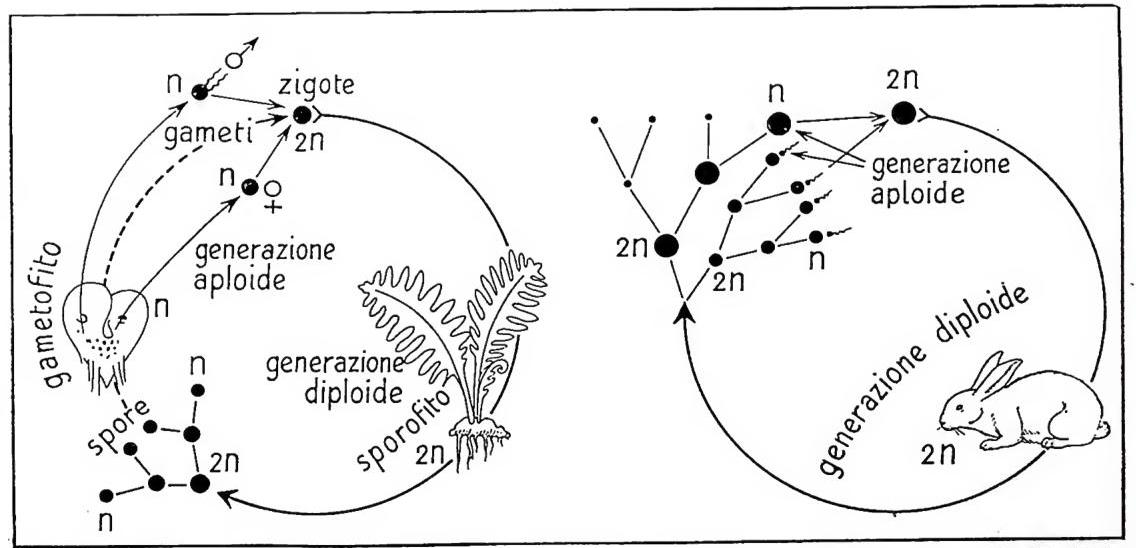
Another important condition in the life cycle is the alternation of generations, referring to the condition of a single set (haploid condition: n) and of two sets (diploid condition: 2n) of chromosomes in the cells of the body. In plants, one speaks of a diploid sporophyte; it matures haploid spores from which haploid gametophytes germinate and produce the male and female germinal cells (gametes). From the union of the two gametes comes the diploid zygote, from which the sporophyte germinates. In plants, the sporophyte and gametophyte may be represented by two plants with a very different morphological appearance, as, for example, in ferns (fig. 1), although the gametophyte (prothallus) is far less conspicuous than the sporophyte. The mechanism by which haploid spores are formed in plants from the diploid cells of the sporophyte is meiosis (v. GAMETI). In higher plants, the greatly reduced prothallus develops on the sporophyte itself, without an independent life, in the flowers.
In animals, the diploid generation is represented by the individual itself. In its gonads, meiosis produces haploid gametes (eggs and spermatozoa), which are the sole representatives of the haploid generation. From their union, through the processes of fertilization, comes the diploid zygote, or fertilized egg, from which the diploid animal develops (fig. 2).
Connected with biological cycles are the cyclic combinations undergone by the elements composing living matter, or biogenetic elements, which pass from the mineral world into the organic and living world. Particularly important are the cycles of carbon, nitrogen, phosphorus, and sulfur (v. ORGANICAZIONE). In these cycles, organic matter is constructed by autotrophic organisms (green plants), which utilize the elements of the mineral world through an endothermic synthetic reaction, making use of the sun’s energy (v. BOTANICA). Heterotrophic organisms break down the organic substances thus formed, releasing the energy accumulated in them (exothermic reaction) and returning to the mineral world the elements that had become organic. This process of breakdown takes place chiefly through oxidation (respiration; fig. 3).