
CELLULA. — In biology this is the name given to the smallest vital unit, capable of autonomous life and of reproducing the metazoans and metaphytes, multicellular animals and plants. Many microscopic organisms consisting of an undivided mass of living matter, the Protists (Protozoa and Protophytes), are considered unicellular, but in reality such organisms have an organization much more complex than that of a c. The c. are masses of protoplasm (v.) generally of microscopic size (from a few microns, or thousandths of a millimetre, to about one hundred) and of elementary spherical, subspherical, or polyhedral form, provided with an outer limiting membrane (primary membrane), which may be more or less thick and distinct, even being reduced to a film of surface tension, with a generally spherical nucleus inside, and with organelles. At times (plant c., egg c.), the c. is enclosed by a shell or secondary membrane (cellulose of plant c. and zona pellucida of the egg). The protoplasm surrounding the nucleus is called cytoplasm, and that of the nucleus karyoplasm.
The c. was discovered in 1665 by Hooke in cork and observed in animals and plants by Leeuwenock (1632–1723); in 1675 Malpighi considered the c., which he called utricles, to be the fundamental constituents of plants.
In 1831 Brown considered the nucleus a fundamental constituent of the c.; in 1850 Mohl observed cell division.
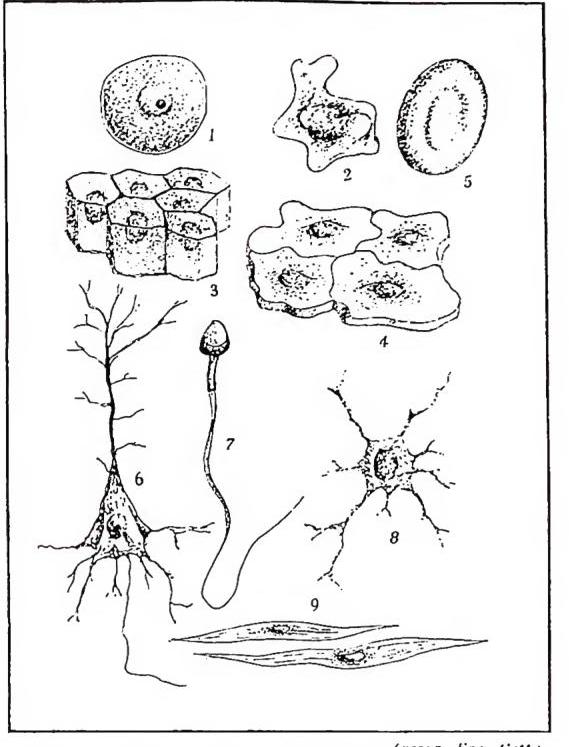
(propr. Enc. Catt.)
CELLULA. - Some types of differentiated cells: 1. oocyte (egg cell); 2. amoebocyte (leukocyte); 3. cuboidal epithelium; 4. squamous epithelium; 5. erythrocyte; 6. nerve cell; 7. spermatozoon; 8. connective-tissue cell; 9. muscle cells.
at rest, although some wish to regard the axial filament or chromonema as present, since this is considered by certain scholars to be a very important condition for explaining the transmission of hereditary traits. The number of chromosomes is constant in all the cells of the individuals of a given animal or plant species, in a simple (haploid) or doubled (diploid) complement.
From a purely structural point of view, in the resting nucleus one can see clumps of chromatin immersed in the nuclear sap. Chemically, chromatin is composed of nucleoproteins and ribo- and deoxyribonucleic acid (or thymonucleic acid). Other organelles and structures are found in the cytoplasm: the chondriome, formed of granules or filaments consisting of phospholipoproteins, which is of great importance in many cellular manifestations, including the elaboration of secretions and the formation of differentiating structures; the ergastoplasm, the densest part of the cytoplasm, regarded by some authors as the superior cytoplasm (Garnier); the sphere apparatus, radiate in form, which during cell division separates into two parts that move toward the poles. The reticulum or Golgi apparatus, the lacunome, the paranuclei, etc., represent other formations of great importance for the expression of the vital phenomena of the cell. The structure of the primary cell membrane is particularly important because, although it possesses the physical attributes of physical membranes, it has special properties that can only be defined as vital, such as the power of selection, which no physical membrane possesses.
From a chemical point of view, the fundamental cytoplasm is a complex of proteins and lipids (lecithins and sterols) imbibed with water and containing mineral salts.
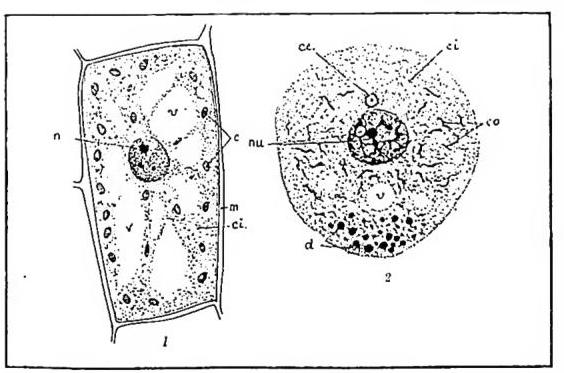
(propr. Enc. Catt.)
CELLULA. – Undifferentiated plant (1) and animal (2) cell, m. cellulose membrane; c. chloroplasts; e. vacuoles; n. nucleus; d. deutoplasm (reserve substance of the egg); ci. cytoplasm; co. chondriome; ce. centrosome (in relation to the sphere apparatus); nu. nucleoli.
that is, to manufacture new living substance of its own; dissimilation, that is, the property of splitting the synthesized organic compounds and releasing energy; reproduction, that is, the ability to divide into two daughter cells after a period of growth; excitability, that is, the capacity to perceive stimuli from the external world (sensitivity) and to react in various ways (reactivity) through movements, secretions, the production of light, color, etc. Through the division of labor, the individual functions become intensified in various groups of cells, which are modified in a specific manner, that is, they differentiate; the various tissues are thus formed. The study of tissues is the task of histology. Through histological differentiation, the c. come to assume the form and structure best suited to their specific work, losing the sub-spherical and polygonal appearance of undifferentiated embryonic elements.
Among differentiated c., the following deserve mention: red blood cells, of hydrodynamic form, suited to moving through the bloodstream, which, in mammals, in order to increase the surface available for gaseous exchange, assume the form of biconcave discs and lose the nucleus so as to contain a greater quantity of respiratory pigment, hemoglobin; nerve cells, which produce processes, sometimes extremely long, capable of reaching, through the various tissues, the peripheral sensory organs or receptors, or the reactive organs or effectors, such as muscles and glands; smooth muscle fibers, greatly elongated in the direction of contraction, in whose cytoplasm contractile myofibrils differentiate. Often, in order to achieve functional units, the individuality of the c. is lost through the fusion of various c. into multinucleated syncytia: such are, for example, the striated muscle fibers of the skeletal muscles and heart, many connective-tissue elements, etc. With the acquisition of specific differentiation, the c. lose the ability to reproduce and are therefore destined, sooner or later, to be worn out by work and destroyed, as in the case of epidermal c. (desquamation) and blood cells. It is therefore necessary that young reserves remain in these tissues, so as to replace the cells that gradually die: such is the germinal layer for the epidermis and the bone marrow for the c. of the blood. These tissues have the same significance as the cambial tissues of plants.
But not all the tissues of the organism undergo such intense physiological wear. These labile tissues (according to Bizzozero’s classification) correspond to tissues with stable elements and tissues with permanent elements. In the former, reproduction continues until the end of bodily growth and then ceases (e.g., in the liver); in the latter, reproductive capacity ceases during the first stages of embryonic development, and the same c. accompany the organism throughout life. A typical tissue with permanent elements is nervous tissue, the tissue in which differentiation is expressed to the greatest degree, so that individual nerve c. with a specific structure assume a specific function of characteristic physiological significance. The nerve c. of the higher forms and, above all, of human beings are the repositories of the highest psychic manifestations, and it is readily understood how the conditions of education and memory can be reconciled only with the permanent condition of these c. On the other hand, it is well known that the destruction of particular areas of the nervous system abolishes certain particular activities, while the other nervous functions remain unimpaired; and if the nerve c. are destroyed, the functions connected with them can no longer be restored.