
COLLOIDS. – The colloidal state of matter is of particular interest both because it is the condition of many industrial products of the greatest practical value (rubber, yarns, plastic products of various kinds) and, above all, because it is the condition of many organic substances and of living matter (v. PROTO-PLASMA).
It was the merit of Francesco Selmi (1864) to be the first to highlight certain properties of solutions which he distinguished as pseudo-solutions from true solutions. Only 15 years later, Grahm gave the former the name of c. and the latter that of crystalloids, defining by these terms the colloidal, generally viscous state of the former and the capacity of the latter to crystallize. This distinction is no longer universally valid today, since many c. that crystallize and others that are not viscous are known.
A property distinguishing c. from crystalloids is that the former cannot be filtered through porous partitions, that is, they do not undergo dialysis. This reveals the corpuscular nature of the colloidal state, whereby the particles do not pass through the pores of the membrane. It is clear, however, that this possibility depends on the size of the pores. By means of filters with pores of different and known sizes, the dimensions of the particles can thus be measured. Ultrafiltration shortens the time required for such an operation.
Colloidal particles have been regarded as aggregates of several molecules, approximately spherical in shape, and therefore the colloidal state is nothing more than a degree of subdivision of matter between that of free molecules and that of a coarse disintegration representing a condition of the solid state. According to Ostwald, matter exhibits colloidal properties when it is subdivided into particles with diameters on the order of 0.1–0.001 μ. (μ = 1 thousandth of a millimetre); larger fragments belong among the coarse dispersions of the solid state, while smaller ones are on the order of free molecules, ions, or atoms of the liquid and gaseous states.
Colloidal particles are suspended, dispersed, in a dispersive medium which may be gaseous or liquid. Mists and smokes are gaseous c., but far more important are those with a liquid dispersive medium. The liquid may be of the most varied kinds and may either be pure or constitute a solution; from a biological point of view, c. in which the dispersive medium is water, or rather an aqueous solution of salts, are of particular interest.
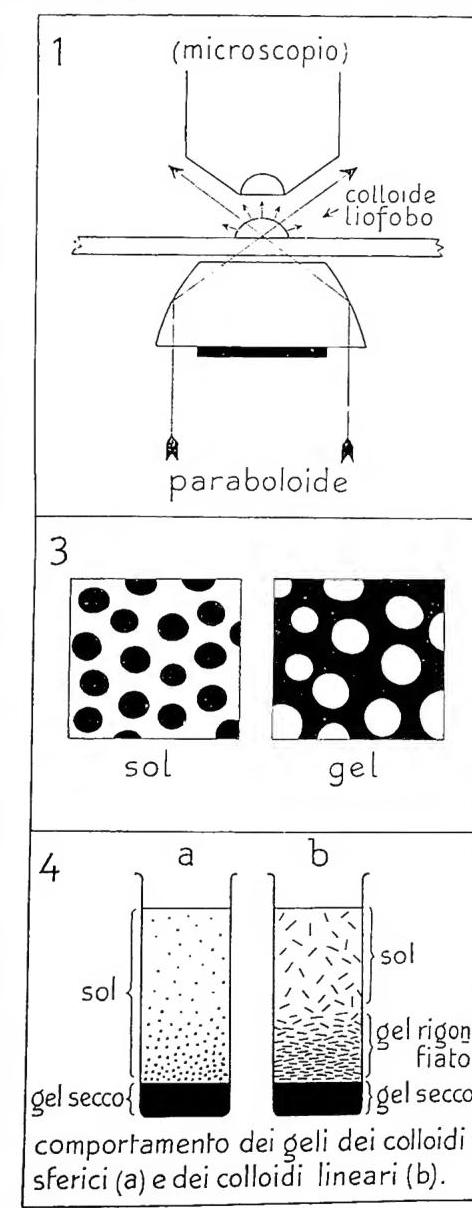
The colloidal condition described thus far is that known as a sol. In a sol, the particles are subject to incessant movement in the most varied directions, a kind of trembling known as Brownian movement. This movement is due to the impacts received by the particles from the molecules of the dispersing medium, which are in kinetic motion. As the temperature increases, this motion increases, and the Brownian movement of the micelles likewise becomes more vigorous. The observation of colloidal particles is possible for certain colloids by means of the ultramicroscope (Siedentopf and Zsigmondy), based on diagonal illumination of the object observed under the microscope, so that it is illuminated but the rays do not enter the microscope tube (fig. 1); it consists of an optical system applied in place of the microscope condenser (paraboloid, cardioid, etc.).
The particles of a sol tend to sediment, and this tendency increases when the particles lose their electric charge—that is, when the colloid is in the isoelectric state. The size of the particles can be calculated from the rate of sedimentation. The sedimentation time can be shortened if the colloid is subjected to a gravitational force greater than that of the earth, as, for example, with Swedberg’s ultracentrifuge, which produces a gravitational force 750,000 times that of the earth.
When the particles have sedimented to the bottom, or have precipitated, the colloid comes to be in the condition of a gel.
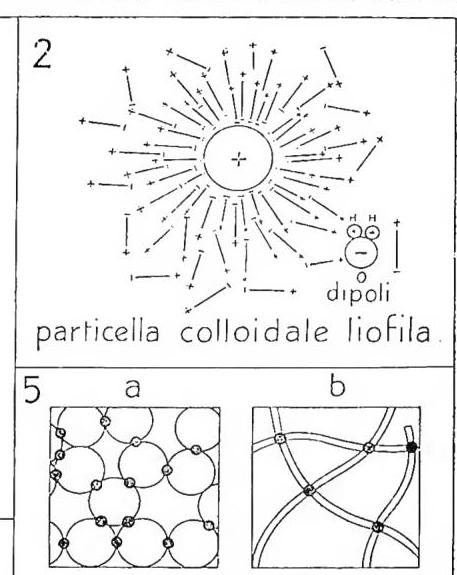
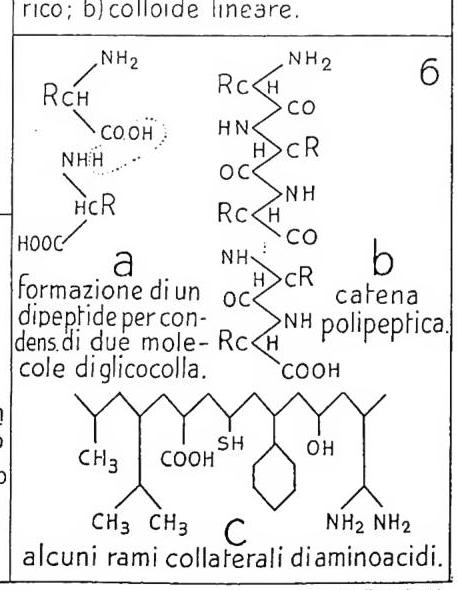
There are colloids whose particles have an affinity for water; that is, they can attract and retain at their surface shells of water dipoles attracted by the end bearing a charge opposite to that of the particle (fig. 2). Such colloids are called hydrophilic, and the uptake of water by the particles is called solvation. Hydrophilic colloids, too, pass into the gel state through loss of water, a state characterized by the union of the particles into a continuous phase, while the liquid remains trapped and dispersed among the compacted micelles (fig. 3). Whereas in hydrophobic or lyophobic colloids the gel returns to the sol state only through a new mechanical action of disintegration, the hydrophilic colloid returns to the sol condition by taking up water. This is referred to as the reversibility of colloids, or thixotropy. During gelation, contraction of the mass and expulsion of liquid may occur (coacervation), with the formation of a coacervate.
Many properties of lyophilic colloids, such as the high viscosity of the sol, the considerable uptake of water by gels, their swelling, and their easy thixotropy, have been explained by the recognition that the dispersed particles are linear or filamentous.
In many colloids, these colloidal particles consist of a single gigantic molecule (macromolecule) obtained through the polymerization of a simple molecule.
Among the substances constituting living matter, carbohydrates, lipids, and protides consist of macromolecular colloids. These substances are therefore at once true solutions, insofar as they are dispersed as individual molecules, and colloids, insofar as the molecules, by virtue of their size, behave as micelles.
Consequently, with the introduction of the concept of filamentous colloids, Ostwald’s classification, based on the diameters of the particles, could no longer be maintained: Staudinger introduced a new criterion for delimiting the sizes of material particles in the colloidal state, based not on the diameter of the particles but on the number of their atoms. Thus, according to this author, particles are in the colloidal state if the atoms composing them number between 10² and 10³.
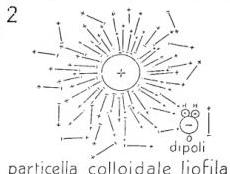
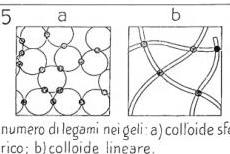
The reason for the considerable swelling of filamentous colloids is illustrated in fig. 4. Whereas in a gel of a spherocolloid a mixture, once solvated, separates from the mass and passes into the sol state, in a filamentous gel, which may be imagined as a compressed felt, a considerable amount of liquid must penetrate between the filaments to permit their free movement. This explains why the passage to the sol state is easier for a swollen filamentous gel than for a spherical gel: the points of cohesion between the particles are far more numerous in a spherocolloid gel than in a linear colloid gel (fig. 5).
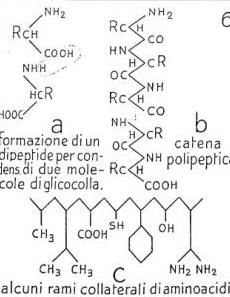
Depending on the degree of polymerization, colloids are obtained with fibers of greater or lesser length. Consider, for example, the polymerization of amino acids to form a dipeptide and then a polypeptide (fig. 6): the longer the fibers—that is, the greater the degree of polymerization—the more the characteristic properties of linear colloids become manifest. One distinguishes hemicolloids, with filaments formed of 50–500 units, of low viscosity and little capacity for swelling; mesocolloids (500–5,000 units), more viscous and forming gels, with greater capacity for swelling; and eucolloids (more than 5,000 units), highly viscous, spinnable, and forming gels that swell considerably.
The linear condition of colloidal particles has made it possible to explain many states of anisotropy on examination with polarized light—anisotropy indicating an orientation of the particles, an orientation that is difficult to conceive in spherocolloids. Indeed, simple phenomena of movement and flow orient the particles, as a result of the internal friction that occurs, with their major axis parallel to the direction of flow. Thus, in addition to the isotropic condition, which in linear colloids indicates complete disorder of the particles, there is an anisotropic condition due to particle orientation. It may occur in moving sols and may become established in gels. Conditions of stretching or contraction may increase the orientation. The conditions of orientation are as follows: the nematic, in which the particles are all oriented parallel to one another but arranged at various heights, as may be modeled, for example, by a wool thread, considering the hairs composing it as the particles; the smectic, in which parallel orientation is accompanied by regular stratification, as occurs in many colloidal membranes; and the cubotactic, in which the particles assume defined positions according to a three-dimensional lattice, thereby acquiring the true character of a crystal lattice. In this case, these are pseudocrystalline gels; cellulose provides an example. X-ray examination of this substance in fact reveals a typical Lane lattice indicating the crystalline orientation of the particles.
A classification of colloids may be made as follows:
A) Inorganic colloids (by dispersion, lyophobic, irreversible gels): a) spherocolloids (metallic, crystalline micelles); b) linear colloids (colloidal silica).
B) Organic colloids. - I. Lyophobic (by dispersion, spherocolloids, irreversible gels): a) micellar (e.g., oil in water); b) molecular (e.g., latexes); II. Lyophilic: A) by dissolution or micellar (reversible): a) spherocolloids (low-viscosity sols); b) linear (viscous sols, swellable gels), homopolar, heteropolar (e.g., soaps). B) by solution or macromolecular: a) spherocolloids (low-viscosity sols, slightly swelling gels), homopolar (e.g., glycogen acetate), heteropolar (e.g., ovalbumin, hemoglobin); b) linear (highly viscous sols, highly swellable gels). 1) hemicolloids (macromolecules of 50–500 units: e.g., hemicelluloses); 2) mesocolloids (chains of 500–5,000 units: e.g., lichenin); 3) eucolloids (chains with more than 5,000 units: e.g., celluloses).