
CIRCULATION. – By c. is meant that ensemble of structures and functions capable of causing a current of liquid to circulate incessantly from the surfaces of absorption of nutrients (respiratory surfaces, intestine) to the site of their utilization in the tissues, and from there to the surfaces where waste substances are eliminated (respiratory surfaces, kidneys), with the aim of rapidly transporting these substances and thus enabling an intense material and energetic exchange in the organism.
In vertebrates, this current flows entirely through closed vessels with elastic walls and is maintained by a suction-and-pressure pump, the heart. The current has a single direction, and, in the lower vertebrates (selachians), the blood leaves the heart and reaches the gills through arterial vessels, where the gaseous exchange of oxygen and carbon dioxide takes place (v. RESPIRAZIONE); from the gills it is distributed to the various organs, including the digestive tract and the kidney, and from these it returns to the heart through venous vessels. In the higher vertebrates (birds, mammals), on the other hand, there are two separate circuits, the lesser circulation, or pulmonary circulation, and the greater circulation, or systemic circulation, and two pumps, the right heart and the left heart. The blood leaves the right heart and reaches the lungs through the pulmonary artery, where gaseous exchanges take place, and from them
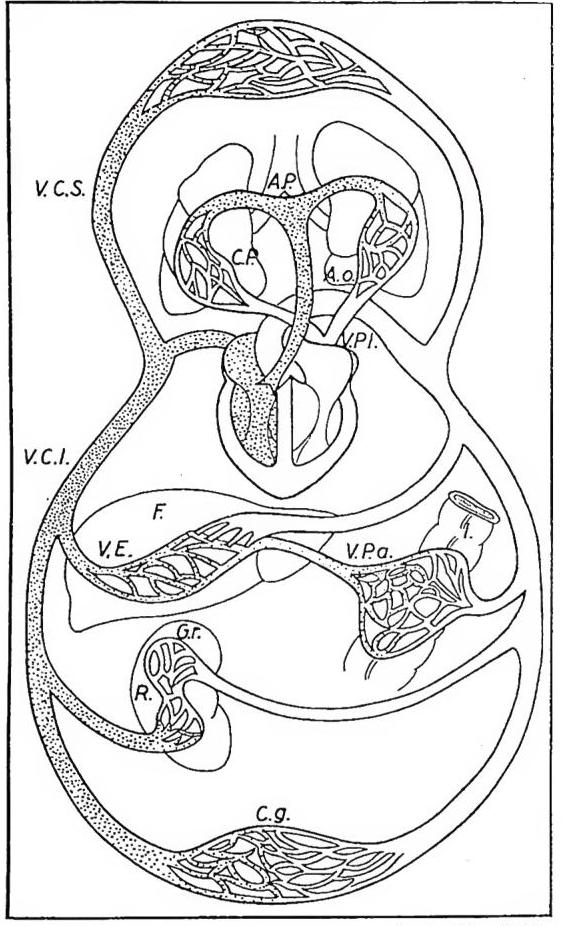
CIRCULATION OF THE BLOOD — Diagram of the c. Vessels containing arterial blood are white, those containing venous blood are stippled: A.P., pulmonary artery; V.P.I., pulmonary veins; A.o., aorta; I., intestine; F., liver; R., kidney; C.P., pulmonary capillaries; C.g., capillaries of the systemic circulation; V.C.S., superior vena cava; V.C.I., inferior vena cava; V.P.a., portal vein; Gr., renal glomerulus; V.E., hepatic veins.
it returns through the pulmonary veins to the left heart; from here the blood is propelled into the systemic circulation and reaches the various organs, including the intestine and the kidney, through the aorta and its branches, and returns to the right heart through the venae cavae.
During the fetal stage, in mammals, oxygenation of the blood does not take place in the lungs but at the level of the placenta. The placental circulation, with the umbilical artery and umbilical vein, consists of branches of the systemic circulation. The oxygenated blood coming from the umbilical vein reaches the right heart and from there passes, in part, directly into the left heart through the foramen ovale. The pulmonary circulation is considerably reduced, not only because of the presence of the foramen ovale but also because part of the blood expelled through the pulmonary artery reaches the aorta through the ductus arteriosus, thereby avoiding passage through the lungs.
The exchanges between the blood and the external environment (gills, lungs, intestine, kidney), and between the blood and the tissues, take place at the level of the terminal branches of the circulatory tree, the capillary vessels, surrounded by a simple endothelial wall permeable to water, gases, and crystalloids.
The circulation is able to adapt to the changing requirements of the organism. In the case of intense muscular work, since a greater quantity of oxygen and nutrients is required by the contracting muscles, the blood flow is increased; this is achieved through an increase in the velocity of the blood in the vascular bed, as a result of intensified cardiac activity, and through an increase in the lumen of the muscular vascular bed, as a result of dilation of vessels that are already open and the opening of previously impervious capillaries. At the same time, the visceral and cutaneous vascular beds constrict, so that the large mass of blood can be diverted entirely to the muscles. In the case of increased intestinal activity (digestion), on the other hand, there is dilation of the visceral vascular bed and constriction of other vascular districts, whereby a certain quantity of blood is diverted toward the digestive system.
These adaptations are the work of reflexes (v. FISIOLOGIA) whose point of departure is excitation arising within the organism and whose effectors are the heart and the vessels themselves.