
CLASSIFICATION.—It is the operation by which a multitude of related objects is organized within a hierarchical system of groupings, with the aim of facilitating their study. As a factor of knowledge, classification lies at the basis of the gnoseological problem and concerns all collective entities whose components display peculiarities—that is, common and differentiating characteristics—capable of being graded in such a way as to justify their ordering within a system. The study of characteristics is therefore a necessary prerequisite for establishing groups (categories or complexes) of different order or hierarchical level. Thus there is a classification of ideas, germinated with Socrates and developed by Plato, Aristotle, and later philosophers; a classification of the sciences, outlined by Auguste Comte; and, finally, classifications relating to the objects proper to individual disciplines.
Classification is essentially a problem of method, that is, of the criteria used to evaluate characteristics and of the procedure followed in constituting groups. The criteria vary according to the material to be classified, the aims to be pursued, and the classifier’s point of view; the procedure is divisive when it proceeds from the general to the particular on the basis of differentiating characteristics, and grouping when it rises from the particular to the general on the basis of affinities. The choice of method is important when considering objects of nature which there are sound reasons for believing to be already naturally ordered within a system. In that case, classification is natural if it faithfully reflects that system and, given its cognitive value, does not admit arbitrary solutions; it is artificial in the opposite case and, given its purely conventional purpose, may be arbitrary provided that it is rational and convenient. Natural classification is opposed by gaps in knowledge of the objects to be classified; the impossibility of clearly delimiting groups linked to one another by common characteristics; the ease with which subjectivism enters into the assessment of the discriminating and hierarchical value of the characteristics adopted to identify the groups; and, finally, uncertainty in choosing between the divisive and grouping procedures. The former, which goes back to the Platonic dichotomy
(διαίρεσις) and refers to the principle of definitions «per genus proximum et differentiam specificam», often appears easier and also more spontaneous as a mode of thought when faced with the task of sorting a multitude of objects; the latter may be recommended by the greater intuitive graspability of restricted groupings in comparison with broader ones, and hence by the advisability of proceeding from the better known to the less known.
In biology, classification has two aims: to permit determination, that is, the identification of an animal or plant to which a given name has been assigned by nomenclature, and to establish its position within the proposed system; and to accommodate them as easily as possible to natural systematics, that is, to the natural distribution of living beings into hierarchically subordinate taxonomic groups or complexes, resulting from the totality of affinities of different orders existing among their components. The first aim can be served by any classification, but only natural classification can meet the second.
The attempts to identify the natural system, which comprise a large part of the history of zoology and botany, were often influenced by a secondary aim. This was useful as a stimulus to investigation but became harmful when adopted as an orienting a priori assumption: namely, the search for the plan of organization, or even of creation, of living beings, which, evolution (v.), was replaced by the search for phylogeny. In both pursuits, disputes arose between supporters of the fundamental and original unity of organisms and supporters of their multiplicity. The possibility of natural classification was initially prejudiced by the conception that living beings were distributed in a continuous series of increasing complexity and, later, by the doctrine of evolution. The former, already suggested by Aristotle and subsequently dominant among many systematists of the eighteenth century, sanctioned a priori the artificiality of the “watertight compartments” of any classification; the latter declared every classification fallacious, since its necessarily static frameworks cannot reflect the dynamism of the evolutionary processes acting upon individuals, so that the reality of the various taxonomic complexes would be not a reality but a transient appearance. Hence arose the pernicious dualism between so-called static systematics and dynamic systematics: the former the object of the classifier, relegated to the rank of a librarian or nearly so, and the latter the object of the evolutionist and the general biologist. Attempts are now being made to remedy this situation, on the one hand by considering the slowness of the evolutionary processes affecting the great systematic groups (macroevolution), and therefore the theoretical possibility of depicting the present system; on the other, by studying methods capable of objectively detecting and adopting as practical limits the natural discontinuities observable among the various taxonomic complexes. That the definition of not a few groups of animals and plants may by now be considered satisfactory is attested by the overall stability they have achieved over time, often by different paths.
The laborious emergence of natural classification was aided by the increase in study material resulting from geographical and paleontological discoveries and from microscopy; by the deepening of knowledge of characteristics, brought about by the progress of all biological disciplines; and, finally, by the expansion of comparisons among the various organisms. Thus the classifications in use were modified as new criteria were added to, or replaced, the earlier ones: the various groups underwent grouping revisions or, more often, splitting revisions, and increased in the number of their constituent units; moreover, new intermediate levels were introduced between those already established. The meaning and designation of these levels were clarified, while the descriptions of the individual complexes were brought into conformity with uniform models. The first task was served by the adoption—largely traceable to Linnaeus—of terms of progressively narrower scope: type, class, order, family, genus, species, and race, to which various intermediate grades were added (subtype, subgenus, or superfamily, etc.) and, at times, other categories of variable rank as well (tribe, cohort, legion, phalanx, etc.). The second task, likewise initiated by Linnaeus, was pursued through the adoption of the Latin language in concise descriptive diagnoses and in the designation of individual groups, and through the introduction of binomial nomenclature (which sometimes became trinomial and polynomial when determinations descended to subspecific levels). According to this system, the name of every species must be preceded by the name of the genus and followed by the abbreviation of the first describer. International rules of nomenclature sought to remedy the inconveniences of homonyms and synonyms arising from the multiplication of determinations. Nevertheless, it still frequently happens that identical species and genera are designated by different authors under different names; this confused instability in terminological formalism is added to the instability affecting the very substance of classifications, contributing to a certain persistent unease in systematic studies.
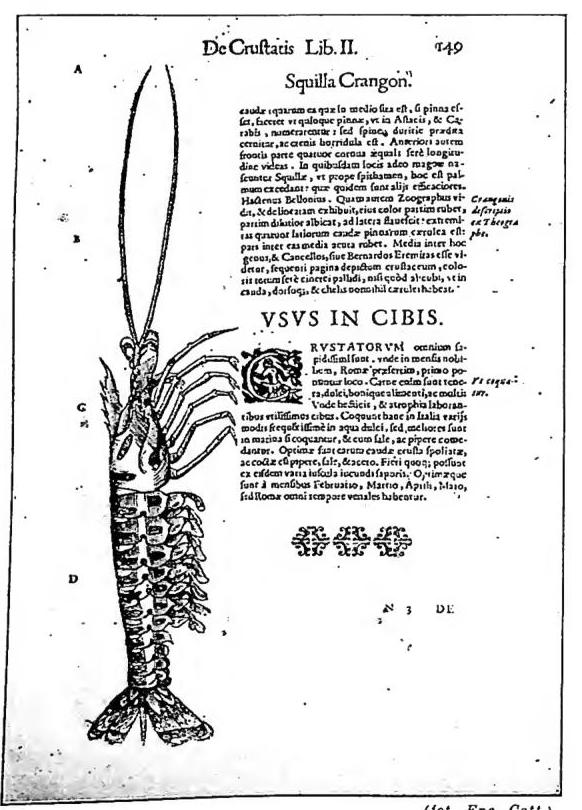
(Ist. Enc. Catt.)
CLASSIFICAZIONE — A page from Ulisse Aldrovandi’s work, De reliquis animalibus exanguibus, Bologna 1642.
History, traditions (see, among other things, the second chapter of Genesis), and ethnological and linguistic studies attest that from the earliest beginnings humanity had to become accustomed to recognizing and designating with specific names the animals and plants most familiar to II. The first reliable documents of systematic biology date back to the fifth century B.C.: in botany Empedocles of Agrigentum is remembered, while in zoology there are the classification of the school of Cos attributed to Erodicus of Selimbria and that contained in Plato’s Timaeus. But the first true systematist was Aristotle, who deserves credit for defining Plato’s concepts of species (εἶδος) and genus (γένος) in a naturalistic sense, subordinating the former to the latter, and for basing the classification of animals on characteristics intrinsic to organisms, not merely morphological but also anatomophysiological. He divided species into eight great genera (γένη μέγιστα), four of animals “with blood” (αἴματα), namely mammals (ζωοτοκούντα ἐν αὐτοῖς = viviparous animals), birds (ὄρνιθες), reptiles and amphibians (τετραποδα καὶ ἀποδα ὠοτοκούντα = quadrupeds and oviparous apods), and fish (ἰχθύες), and four of animals “without blood” (ἐνάμματα), namely mollusks (μαλάκια), crustaceans (μαλακώστρακα), insects (ἔντομα), and testaceans (ὄστρακοβέρματα). Much more artificial is the classification of plants carried out by Aristotle’s two disciples, Theophrastus and Phanias:
they divided plants into trees (δένδρα), shrubs (θάμνοι), undershrubs (σρύγανα), and herbs (πόα), and distinguished flowering plants (= phanerogams) from those without flowers (= cryptogams). For many centuries Aristotle’s work remained conceptually unsurpassed, even as the number of species increased. Indeed, many Roman classifications (such as those of Dioscorides and Pliny in the first century A.D.) and medieval ones (such as those contained in bestiaries and herbals) represent a regression, both because they were merely alphabetical lists or were based on characteristics extrinsic to organisms and often anthropocentric (such as habitat, poisonousness, usefulness, etc.), and because they lacked all critical spirit and were often stuffed with fabulous animals and plants. Apart from the isolated contributions of Albertus Magnus, Leonardo da Vinci, and a few other pioneers, one must reach the middle of the sixteenth century to find the germs of that renewal in naturalistic studies which later received powerful impetus from Galileo’s experimental method. Among botanists, the following should be noted: Andrea Cesalpino of Arezzo, who in the treatise De plantis (1583) outlined an admittedly artificial classification, since it was almost entirely founded on the characteristics of fructification, but one so rational that it served as a model for Linnaeus; J. Pitton de Tournefort and John Ray, who in the Historia plantarum (1686) distinguished monocotyledons from dicotyledons. More faithful to Aristotelian models are the contemporary works of zoology, among which those of the Bolognese Ulisse Aldrovandi (1522–1605) stand out: he was the author of a Historia naturalis, also celebrated by Buffon and Cuvier, and of a Syntaxis animalium, in which the dichotomous method is precisely formulated and applied; this method was likewise adopted by Ray in the Synopsis methodica animalium (1693), whereas Corrado Gesner’s Historiae animalium (1551–87) are minutely descriptive. In the seventeenth century a new field opened to systematic investigation with the invention of the microscope, through which Leeuwenhoek discovered the infusoria (1673) and Marcello Malpighi advanced the study of anatomy (1671).
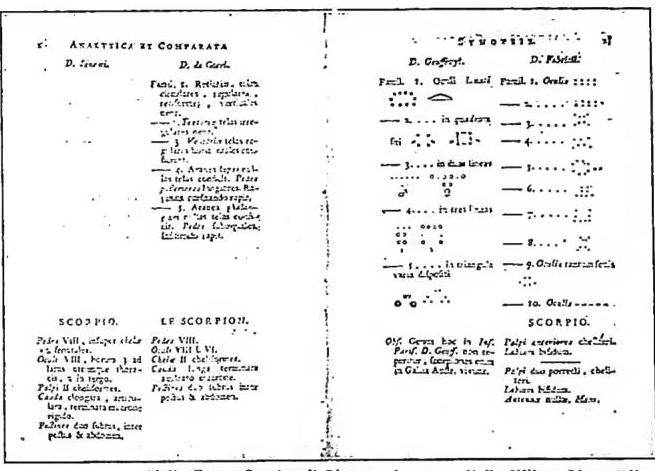
(from Linnaeus’s Fauna Suecica, edition edited by De Villers, Linne 1.15)
CLASSIFICATION — Example of a comparative synoptic table on the c. of arthropods according to Linnaeus, de Geer, Geoffroy, and Fabricius.
Yet the same author had become aware of its artificiality, as is shown by the fact that in other works (Classes plantarum, Genera plantarum, Philosophia botanica) he adopted the natural method, based on the recognition of the manifold affinities among organisms, in order faithfully to portray the groups that could be identified most readily. A. L. De Jussieu (1748–1836) devoted himself exclusively to this purpose: in Genera plantarum (1789), in proposing a new c., he observed that, in order to reveal natural groups, it is not enough to enumerate characters; attention must also be paid to their correlations and they must be “weighed,” graded, and subordinated according to their constancy, which is an indication of their meaning and value. Lamarck also adhered to the natural method, although in the Flore française (1778) he deliberately intended to provide an example of artificial c. purely for purposes of identification, and introduced into botany the dichotomous method with analytical keys, still widely used today. Other notable botanical c. are due to A. P. de Candolle, J. Lindley, and S. L. Endlicher.
G. L. Leclerc de Buffon (1707–88) declared himself an enemy of the arid and artificial “systems” of the Linnaean school: he based his Histoire naturelle (1749–88) on the principle that the only reliable criterion for distinguishing species is that of intraspecific fertility and the sterility of hybrids, a criterion that is still among the most widely accepted today; his c., imprecise and incomplete, refers to the evolutionary doctrine and to the idea of the unity of the living world. Stefano Geoffroy Saint-Hilaire (1772–1844) likewise agreed with this idea; in the Philosophie anatomique (1818–22) and in the Principes de philosophie zoologique (1830) he introduced the concept of homology, put forward the principle of the “balancing” of organs, and gave maximum prominence to topographical anatomy as a means of revealing the relationships among organs and their variations in the animal scale. A follower of Carlo Bonnet, G. B. De Monet de Lamarck (1744–1829) upheld the conception of the linear continuity of living beings, divided into the two kingdoms of plants and animals, and strove to base his c. upon it, thereby bringing about the clarification of many groups, especially among invertebrates. In his numerous works, among which Philosophie zoologique, Histoire naturelle des animaux sans vertèbres, and Système analytique des connaissances positives de l'homme stand out, Lamarck related animal organizations to the human organization, considering each of them as a more or less pronounced “degradation” of the latter and, conversely, the latter as a “progress” beyond them. And, from considering this progress as an indication of the “march of nature” toward increasing perfection, he was led to formulate his evolutionary theory (v. LAMARCKISMO) as a logical interpretation of the affinities among living beings and of the ascent in their organization: hence the outline of those phylogenetic trees later developed extensively by the evolutionists and culminating in E. Haeckel.
In agreement with Lamarck and Geoffroy on the systematic importance of comparisons and on the concept of degradation, but a determined opponent of evolutionary and unitarian ideas, was Giorgio Cuvier (1760–1832). The principal merits found in his many works, and particularly in the Règne animal (1817), are: the introduction of comparative anatomophysiology and paleontology among taxonomic criteria; the enunciation and application of the principles of coexistence and correlation among organs and of the subordination of characters; and, finally, the establishment of four embranchements (later called types by De Blainville), representing four irreducible and distinct fundamental patterns of organization. These types are those of the vertebrates (with the classes of mammals, birds, reptiles, and fishes), the mollusks, the articulates (with the classes of worms, crustaceans, and insects), and the radiates. Cuvier’s c., in its basic structure, is still followed today, with the modifications introduced chiefly by T. Von Siebold and R. Leuckart.
With Cuvier’s death, the period in which the term naturalist was equivalent to systematist came to an end. After him, research continued, but became fragmented among the works of specialists in individual groups; within their respective fields, and therefore unequally, they revised and enriched the middle and lower levels of the systematic hierarchy, while general zoologists and botanists adjusted the higher levels. Naturalists’ interest turned toward the other biological disciplines that developed rapidly in the nineteenth and twentieth centuries, and from which important contributions modifying systematic criteria and methods flowed into systematics: thus, to the Linnaean morphological criterion and to Cuvier’s anatomophysiological and paleontological criteria were added, with Von Baer, the embryological criterion; with Darwin and the evolutionists, the phyletic criterion; with Wallace, Wagner, and Turesson, the ecogeographical criterion; with Mendel, De Vries, and modern geneticists, the genetic criterion; and with Le Dantec, Nilow, and Souèges, the biochemical criterion. With the adoption of statistical-biometric methodology, inaugurated by Quetelet, applied by Heincke, and incorporated by Johannsen into genetics, and with the performance of experiments intended to establish the capacities of species for variation and to distinguish their genetic elements from those attributable to the environment, systematics moved along the experimental path, particularly fruitful at the subspecific levels, while individual analysis was replaced by population analysis and the supposedly exact determination tended to be replaced by probabilistic determination.
Although, in the practice of c., the Linnaean schematism still has many followers, and although evident defects persist in the evaluation of characters—such as their isolated and one-sided analysis, the precedence attributed to certain categories, and the preconceived introduction of phyletic hypotheses—it is certain that the present orientation tends toward natural c., a goal perhaps not unattainable once there is an awareness of the artifices employed and suitable methods are available for removing them.
Among the most widely followed c. are the botanical classification of Engler–Diels contained in the Syllabus der Pflanzenfamilien (1936), and the zoological classification of Leuckart–Von Siebold, with the modifications of Emery–Ghigi. In the former, the principal divisions are 15: Schizophyta; Myxomicetes; Flagellatae; Dinoflagellatae; Silicoflagellatae; Heterocontae; Bacillariophyta; Coniugatae; Chlorophyceae; Charophyta; Phaeophyceae; Rhodophyceae; Eunycetes et Lichenes; Archegoniatae, divided into Bryophyta and Pteridophyta; Embryophyta siphonogama, divided into Gymnospermae and Angiospermae, the latter being divided into Monocotiledonae and Dicotiledonae.
The latter includes 18 types (1 of protozoans and 17 of metazoans, of which 16 are invertebrates), namely: Protozoa, Porifera, Coelenterata, Ctenophora, Platyhelminths, Nemerteans, Nemathelminths, Chaetognaths, Acanthocephalans, Rotifers, Gephyreans, Annelids, Bryozoans, Brachiopods, Arthropods, Mollusks, Echinoderms, and Chordates, with the subtypes Hemichordata, Urochordata, Cephalochordata, and Craniata.
J. Spix, Geschichte und Beurtheilung aller Systeme in der Zoologie nach ihrer Entwicklungsfolge von Aristoteles bis auf die gegenwärtige Zeit, Norimberga 1811; G. Cuvier-Magdeleine de Saint-Agy, Histoire des sciences naturelles depuis leur origine jusqu'à nos jours chez tous les peuples connus, 5 voll., Parigi 1841-1845; J. Meyer, Aristoteles Thierkand., Berlino 1855; F. A. Pouchet, La biologie aristotélique, Parigi 1855; L. Agassiz, De l'espèce et de la classification en zoologie, trad. F. Vogeli, ivi 1869; J. V. Carus, Geschichte der Zoologie bis auf Joh. Müller und Charl. Darwin, Monaco 1872; T. H. Huxley, On the Classification of the Animal Kingdom, in Nature, 11 (1875), p. 101; J. Sachs, Histoire de la botanique du XVIe siècle à 1860, trad. H. de Vargent, Parigi 1892; E. Durkheim e M. Mauss, De quelques formes primitives de classification, in Année sociologique, 6 (1903), pp. 1-72; R. Burckhardt, Zur Geschichte der biologischen Systematik, in Verhandlungen der Naturforschenden Gesellschaft in Basel, 16 (1903), pp. 388-440; id., Das hoische Tiersystem, eine Vorstufe der zoologischen Systematik des Aristoteles, ibid., 15 (1904), pp. 377-414; id., Das 1er Buch der aristotelischen Tiergeschichte, in Zoologische Annalen, 1 (1905), pp. 1-28; id., Zur Geschichte und Kritik der biologic-historischen Literatur, ibid., pp. 355-375, e 2 (1908), pp. 31-46; id., Aristoteles und Cuvier, ibid., 3 (1908), pp. 69-77; J. Briquet, Règles internationales de la nomenclature adoptées par le Congrès international de botanique de Vienne 1905, Iena 1906; A. Semenov-Tian-Shanski, Die taxonomischen Grenzen der Art und ihrer Unterabteilungen, Berlino 1910; H. De Vries, Gruppenweise Artbildung, ivi 1913; J. P. Lotsy, Que est-ce qu'une espèce?, in Arch. Néerl. des Sciences exactes et naturelles, 3e série, b. 3 (1918), pp. 57-110; O. Hamelin, Le système d'Aristote, Parigi 1920; R. Burckhardt e H. Erhard, Geschichte der Zoologie und ihrer wissenschaftlichen Probleme, 2 voll., Berlino 1921; G. Turesson, The genotypical response of the plant-species to the habitat, in Hereditas, 3 (1922), pp. 211-350; H. Daudin, I: De Linné à Jussieu, Méthodes de la classification et idée de série en botanique et en zoologie; II: Cuvier et Lamarck, Les classes zoologiques et l'idée de série animale, 3 voll., Parigi 1926 (ampia bibl.); O. Kleinschmidt, Die Formenbetriebslehre und das Weltwerden des Lebens, Halle 1926; G. C. Robson, The species problem, Londra 1928 (con bibl.); B. Hayata, The natural classification of plants according to the dynamic system, in Icon Formos, 10 (1929), pp. 97-234; B. Rensch, Das Prinzip geographischer Rassenkreise und das Problem der Artbildung, Berlino 1929 (con bibl.); B. Rensch, Kurze Anweisung für zoologisch-systematische Studien, Lipsia 1934; R. Wettstein, Handbuch der systematischen Botanik, 4e ed., Lipsia 1935; L. Cuénot, L'espèce, Parigi 1936; E. T. Schenk e J. H. MacMasters, Procedure in Taxonomy, Stanford 1936; J. Clausen, D. D. Keck, e W. M. Hiescy, Experimental Taxonomy, in Carnegie Instit. of Washington. Annual Rep. Div. Plant Biology, Years 1935-37; T. Dobzhansky, What is a species?, in Scientia, 31 (1937), pp. 280-286; B. P. G. Hochreutiner, La valeur relative des groupes systématiques, in Boissiera, 2 (1937), pp. 1-7; J. Ramsbottom, Linnaens and the species concept, in Proceeding of the Linnean Society of London, 150 (1938), pp. 192-219; R. Souèges, L'espèce et les classifications actuelles, Parigi 1938 (con bibl.); J. Huxley (redattore), The New Systematics, Oxford 1940 (raccolta di scritti critici, ciascuno con bibl.), di H. H. Allan, W. J. Arkell, W. T. Calman, M. B. Crane, C. D. Darlinton, G. R. de Boer, C. Diver, E. B. Ford, J. S. L. Gilmour, J. Huxley, L. Hogben, J. A. Moy-Thomas, H. J. Müller, J. Ramsbottom, E. J. Salisbury, J. Smart, T. A. Sprague, W. H. Thorpe, N. V. Timofeef-Ressovsky, W. B. Turrill, N. J. Vavilos, E. B. Worthington, S. Wright); E. Mayr, Systematics and the origin of species, Nuova York 1942 (con ampia bibl.); R. Ciferri, La sistematica delle piante, in T. Ferraris, Botanica agraria, III, 1, Milano 1946 (con ampia bibl.); A. Sacchetti, Alcuni problemi di sistematica biologica, in Rivista di biologia coloniale, 8 (1947), pp. 79-110; S. Beer, Sistematica e c., in Responsabilità del sapere, 3 (1948), pp. 35-63; A. Ghigi, La specie, in Scientia, 42 (1948), pp. 175-81; V. inoltre International Rules of Zoological Nomenclature, in ogni volume di C. R. Congr. Intern. Zool. Sergio Beer