
BOTANY. - Botany, or phytology, is the science of plants. Plants are studied under three principal aspects: morphological, physiological, and systematic.
The morphology or study of form comprises several chapters: cytology, which concerns the structure of individual cells; histology, or the study of tissues; anatomy, which, by recognizing the distribution of different tissue types in the plant, establishes the internal structure of individual organs; organography, which describes the external form of plants and their organs; and finally, the chapters dealing with the cytology of reproduction, embryology, and others.
Even more numerous are the chapters of physiology, or the study of functions.
The life of plants unfolds through the continuous intake of materials, largely serving as nutrients. Unlike animals, which cannot nourish themselves except with organic substances, plants typically possess the ability to feed on mineral substances. Once introduced into the plant body, these substances are first transformed, through a series of chemical reactions, into organic or inorganic compounds; subsequently, and through further modifications, they are, to a greater or lesser extent, organized—that is, transformed into the very living substance or protoplasm.
The series of transformations imposed on the materials introduced into the plant does not stop at this point, since the various phenomena accompanying life determine a continuous wear of the living substance and, consequently, a continuous breakdown of its constituents, which undergo further transformations tending to return to the inorganic state. Nevertheless, numerous compounds appear in living cells—some still organic, others mineral—which, as waste substances, are eliminated. A similar fate befalls other materials that, having reached the organic form and before being organized, are either eliminated after more or less advanced breakdown or even in their original state, either permanently or only temporarily.
The same mineral substances introduced by plants may not be utilized and are eliminated without even undergoing the processes of organization. Thus, an unceasing and highly complex exchange of substances with the external environment occurs during the life of plants, constituting the subject of study of a major branch of physiology dedicated precisely to material exchange or metabolism (v.). Within it, we distinguish an ascending or synthetic phase (anabolism), which, through the processes of organization, leads to the formation of compounds with more or less complex molecules, such as those participating in the constitution of living matter; and a descending or analytic phase (catabolism), which, through inverse processes, leads to the appearance of waste substances, sometimes with extremely simple molecules.
Among the processes studied in distinct chapters of the physiology of material exchange are those concerning the physiology of water uptake, its dispersal, and transport; the physiology of mineral nutrition; the organization of carbon through photosynthetic and chemosynthetic pathways; the organization of nitrogen; the processes of organization; the study of assimilation products; the modalities of elimination and the nature of eliminated substances, and so on.
Parallel to material exchange, an energy exchange takes place in plants.
The organization of carbon in green plants is made possible by their ability to utilize the radiant energy of sunlight, and a substantial portion of the products of this process constitutes an energy reserve in plants. Indeed, with the breakdown of these compounds, the same amount of energy that was subtracted from light for their synthesis is released and used in the course of numerous other reactions. These breakdown processes, or dissimilation, proceed with different modalities and with or without the intervention of molecular oxygen from the outside; thus arise those groups of phenomena known as aerobic respiration, intramolecular respiration, and fermentations.
Other branches of physiology include those concerning growth (seed germination, the modalities by which internal and external factors influence growth, growth movements and plant orientation, plant conformation, and the factors determining it; teratology, or the study of abnormal forms, etc.); development, that is, the modalities by which, in the course of its life, the plant acquires new properties leading to reproduction and death; the physiology of sexuality and reproduction; the mechanism of hereditary character transmission, both from a cytological and functional standpoint; movements of plants; and ecology, that is, the study of the relationships between plants and the external environment and the structural and physiological modifications induced by environmental characteristics, and so forth.
Of special botany, the branch perhaps most familiar to laypersons is systematics or taxonomy, which, alone or nearly so, represented the entirety of botany in antiquity and the Middle Ages. The aim of systematics is the knowledge of all plants and their arrangement in a scheme that, while allowing their practical identification (classification), corresponds to specific scientific requirements.
The first task of systematics is to establish the categories into which different plants are distributed or grouped; the most fundamental of these categories is the species, an entity that, although among the first recognized by scientists, has become increasingly difficult to define and circumscribe within natural limits as science has progressed, so much so that countless discussions have arisen—and continue to arise—regarding the value of this systematic category and its real existence. Without entering into details here, it is impossible to overlook that the importance of these discussions is all the greater since their outcome determines whether to accept the principle of the fixity or mutability of living forms, whether to embrace the creationist connection of individual species or the evolutionary theory, and the very orientation of science toward a host of problems concerning the origin of life on Earth, which extend into the philosophical and transcendental domains.
Other systematic categories, of increasingly general type, are the genus, family, order, class, and division.
The result of this work of approximation and grouping into categories with ever more generic similarities is the creation of a general scheme in which a determined position is reserved for each form. Naturally, depending on the characteristics chosen for their construction, the value of such schemes will differ greatly, and the progress of systematics, from antiquity to the present, has consisted precisely in the progressive search for guiding characteristics that allow the construction of a natural scheme, or system, in which plants are distributed based on their natural affinities.
Scientific and philosophical problems once again intersect here, as it is a matter of establishing whether the affinity of different plant forms is such as to admit a monophyletic origin from a single ancestral archetype or a polyphyletic origin.
The principal characteristics on which modern systematics is based are derived from the comparative study of the mechanism of reproduction, the structure and function of sexual organs, the embryology of various forms, and their ontogenetic cycle.
Auxiliary disciplines of systematics, and likewise part of special botany, are phytopaleontology and phytogeography.
The task of the former is the knowledge of plant forms that lived in other geological eras and are now extinct; the latter, based on ecological and caryological foundations and utilizing geological and climatological data, aims to account for the floristic composition of the Earth's various regions and their individual territories.
Another major branch of special botany is, finally, applied botany, whose principal chapters are agricultural botany, forest botany, horticultural botany, phytopathology, pharmacognosy, etc.
The interest of such a vast and complex discipline as botany is evident; like the study of animals, the study of plants surpasses the human aspiration for knowledge as an end in itself, since here we are dealing with the study of life, its origin, its manifestations, and its essence. From a certain point of view, moreover, the interest in the study of plant organisms prevails over that of animals themselves, and the reason is that plants alone are autotrophic organisms, whereas animals are heterotrophic. Plants alone, in other words, are capable of nourishing themselves with substances in a mineral state, while animals, lacking this capacity, are obliged to make use of materials already rendered organic by plants.
Thus, all animal life appears dependent on plant life, and the existence of animal organisms on Earth, as they are, is made possible—and, so to speak, prepared—by the necessarily more ancient existence of plants.
Consequently, knowledge of the processes by which plants organize carbon, nitrogen, sulfur, and phosphorus acquires an interest that transcends the purely botanical—and even, more generally, biological—perspective, gaining value also from a speculative standpoint on the organization and general economy of living beings on Earth.
The classic example of this dependence of animals on plants is that of organic substances of every type—carbohydrates, fats, proteins, etc.—which, elaborated by plants, ensure animal nutrition. However, it should not be believed that animals find only food in plants, but very often also stimulating and regulating substances; consider, for instance, vitamins of every type, which, though so necessary for the normal course of animal life, are nevertheless synthesized by plants alone. It is also worth asking whether a number of substances that appear in large quantities and significant amounts in plant metabolism, and whose significance for the plant organism is very often entirely obscure, might not be properly appreciated only when considered within a general plan of the economy of living beings on Earth. We refer to essences, terpenes, camphors, and, above all, alkaloids and glycosides, typical products of plant organisms that hold such importance in the therapy of animal organisms.
As regards humans in particular, the interest in plants is even greater when one considers that not only do they find food and medicine in plants, but that most of their activities and industries rely on the activity of plants.
The very thermal, mechanical, electrical, etc., energy that humans utilize in the functioning of so many of their activities is nothing but radiant energy from the sun, which plants have captured in large quantities during the photosynthetic process and of which they have determined the formation of immense deposits in the form of various types of fossil fuels.
It should also be added that the same energy that humans are able to harness by exploiting waterfalls or, in any case, the movement of liquid masses, is largely conditioned by plants, as meteorology is profoundly influenced by them through the imposing intensity of their absorption and transpiration processes.
Green plants are incapable of utilizing the enormous masses of carbon found on Earth.
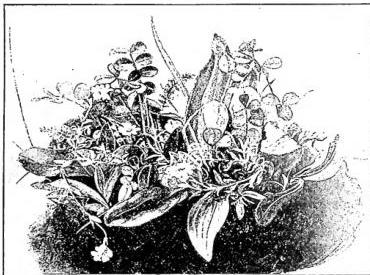
BOTANICA - Study of wildflowers. Watercolor by A. Dürer - Vienna, Albertina.
only in the form of carbonates, and utilize for their nutrition solely the carbon dioxide present in the air in the very modest proportion of 0.03%.
It has been calculated that organic chlorophyll photosynthesis annually removes approximately 60 trillion kilograms of carbon dioxide from the atmosphere, which means that if carbon dioxide were not continuously replenished in the air, its supply would be entirely consumed in 35 years; at the end of which, the possibility of plant life, and consequently animal life as well, would cease.
A certain replenishment of carbon dioxide is ensured to the atmosphere through respiratory processes that continuously occur in animals as well as in plants, but by far the greatest importance in this regard is assumed by fermentation processes that take place in the soil through the action of plant microorganisms. These microorganisms incessantly decompose enormous quantities of organic residues that continuously reach the ground, returning to the atmosphere, in the form of carbon dioxide, the carbon contained within them and thus closing its cycle. These fermentation processes occur in two stages: first, anaerobic microorganisms intervene, which, although living in the surface layers of the soil, are only active outside contact with atmospheric oxygen. In addition to a certain amount of carbon dioxide, which is returned to the atmosphere, the products of their activity include other organic substances such as alcohol, lactic acid, butyric acid, methane, etc. These compounds still contain carbon in varying proportions, so the complete return of this element to the air can only occur after further and complete decomposition of the products of anaerobic organisms' activity. This is carried out by other aerobic plant microorganisms, which take up the products of anaerobic fermentations and, through oxidation processes, further decompose them into water and carbon dioxide. Anaerobic and aerobic microorganisms thus perform an activity that is not only mutually beneficial but indeed necessary. They live in close association, and while anaerobic organisms provide aerobic ones with the fermentation products necessary for their life, the aerobes, which are highly avid for oxygen needed to completely oxidize the organic substances they live on, remove this gas from the environment, thus making it suitable for the life of anaerobic organisms.
The life of plant microorganisms (bacteria and fungi) that teem in the soil thus reveals one of the many aspects of its extreme importance; an importance that depends not only on the fact that, by decomposing the enormous quantity of organic residues that continuously reach the soil and which, like cellulose, for example, are often unusable by higher plants and animals, they prevent the immense energy reserve contained in such residues from being lost, but also on the fact that certain bacteria use the energy they obtain during these fermentation processes to fix atmospheric nitrogen, thereby also conditioning the life of all other plant and animal beings.
While, in fact, the air is composed of four-fifths nitrogen, plants are generally unable to utilize it and use for their nutrition only the few nitrogenous compounds they can find in the soil.
In this case as well, their supply would quickly be exhausted if there were no bacteria in the soil that, by decomposing organic substances such as carbohydrates, which reach the soil in enormous quantities with the dead residues of higher plants, obtain the energy that enables them to fix atmospheric nitrogen, thus preparing the nitrogenous materials that will serve for the life of other plants and, after these have organized them, for the life of animals as well.
Meanwhile, from the decomposition of nitrogenous organic substances by other bacteria, another considerable amount of nitrogen returns to the soil in the form of ammonia, which higher plants could use for their nitrogen nutrition. However, it has been demonstrated that higher plants are often unable to utilize ammoniacal nitrogen and that, in any case, their nitrogen nutrition improves significantly if, instead of ammonium salts, they find in the soil more oxidized inorganic nitrogen compounds, such as nitric acid salts. Now, there exists in the soil a complex of bacteria with strictly coordinated activity, some of which oxidize ammonia to nitrous acid, while others take up nitrous acid and further oxidize it to nitric acid. There is an absolute interdependence among these bacteria and those that decompose organic substances, which also explains the difficulty of isolating them for study.
They live, in fact, always in close association, and in the chain decomposing bacteria-nitrous bacteria-nitric bacteria, each group provides the necessary material for the next and removes from the previous one the product, toxic to it, of its activity. From these oxidative processes, the individual groups of such bacteria obtain the energy that allows them to organize autotrophically through chemosynthesis the carbon dioxide in the air; simultaneously, they ensure better nitrogen nutrition for higher plants.
Analogous cooperation phenomena ensure, in nature, the sulfur cycle.
However, sulfhydryl sulfur is not only unusable by higher plants but is even toxic to them.
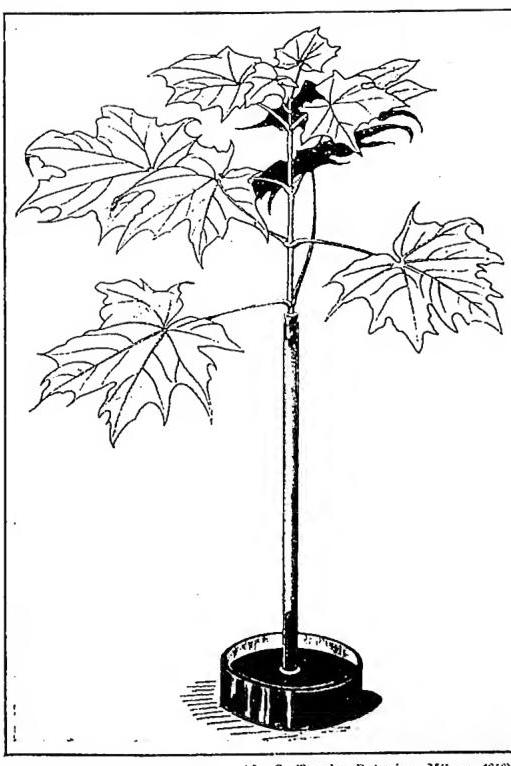
BOTANICA - Demonstration of the suction force in transpiring leaves.
highly toxic; they require sulfur compounds in the soil in a state of maximum oxidation, such as the salts of sulfuric acid, but it is evident that, little by little, all sulfate reserves in the soil would be exhausted and transformed into sulfhydryl compounds, which would make both plant and animal life impossible. However, there exist in the soil specialized bacteria for which not only is sulfhydryl sulfur harmless, but it is even necessary for life. These are the sulfur bacteria that oxidize sulfhydryl to elemental sulfur, subsequently to sulfur dioxide, which transforms into sulfurous acid and, through oxidation, into sulfuric acid. During these oxidation processes, energy is released that also ensures these bacteria the possibility of autotrophic life and chemosynthetic organization of atmospheric carbon dioxide, while simultaneously, closing the sulfur cycle, the possibility of life for other plants and animals is made possible.
Examples of such cooperations could continue. We recall further those mutually beneficial cohabitations known as mutualistic symbioses. The best known is certainly lichen symbiosis, resulting from the cohabitation of an alga with a fungus; the outcome is a kind of new organism capable of living where neither the fungus nor the alga could survive. However, this is a symbiosis whose importance for the general economy of life on Earth is quite limited. Far more important are those symbioses known as mycorrhizae, consisting of a particular form of association between the hyphae of higher fungi and the roots of a great many plants.
The importance of these associations is such that very often the life of each symbiont is impossible if they are separated, so much so that the area of distribution on Earth of many higher plants is limited by the area of distribution of the fungus, and vice versa.
The relationships between the two symbionts are not entirely clear; certainly, an exchange of materials occurs whose value is often not merely that of nutritional substances but also of indispensable vitamins. Thus, one type of nutrient may be exchanged for another; a vitamin for another; a nutrient for a vitamin; but it also happens that the two symbionts cooperate in the synthesis of a vitamin necessary to both, of whose molecule each is capable of forming only a part, so that complete synthesis is only possible through the coordination of the two symbionts' activity. Another important form of cohabitation is that which occurs between certain plants, especially those belonging to the legume family, and certain bacteria, the result of whose activity is the fixation of atmospheric nitrogen. This highly important process (which, together with the fixation of nitrogen by bacteria living freely in the soil fermenting carbohydrates, ensures the living conditions for higher plants) is possible for such bacteria only when they live in the tissues of the host. In return, a generous supply of assimilable nitrogen is made available to the host, the excess of which also passes into the soil, improving the living conditions for surrounding plants. It is to this circumstance that legumes owe their reputation as soil-improving plants, and it is for this reason that, from time immemorial, agricultural practice has used the green manuring of legumes or introduced legume cultivation into the rotation of other crops, achieving natural soil fertilization. Symbioses, moreover, also occur not infrequently between plants and animals, and it suffices to recall the existence of an abundant intestinal flora, or, in general, of bacteria living in the digestive systems of the most diverse animals, which, so to speak, are repaid for the nourishment they provide to their hosts by the benefit they derive from the latter's particular activities.
Other questions of great interest to the scholar who does not pursue biological research as an end in itself are those concerning the perfect correspondence between the external form and the intimate anatomical structure of each organ and the various functions it must serve; the modifications that such form and structure undergo in different environments, as an expression of perfect adaptation to particular environmental conditions; and many others easily found even in general treatises.
HISTORY OF BOTANY
Thus, a considerable body of knowledge was accumulated; however, from a historical perspective, we can say that true scientific botany began only from the time when written works on plants have survived: those of the rhizotomi and pharmacopoli, though of limited importance, among whom it suffices to recall the names of Diokles of Karystos and his contemporary Hippocrates of Kos (460–377 B.C.).
They are contrasted by the geoponici or georgici, who concerned themselves with the cultivation of plants, among whom we recall a certain Antrotion and the celebrated Democritus of Abdera (460–380 B.C.).
The earliest writers who left us studies on the classification and life of plants from a theoretical standpoint are Menestor of Sybaris (around 450 B.C.), Anaxagoras (497–424 B.C.), Empedocles (495–436 B.C.), Hippon of Rhegium (around 440–420 B.C.), and Plato himself. Botany made a significant advance with the work of Aristotle (384–322 B.C.), the greater part of which, however, was lost.
Aristotle considered biology a deductive science, thus proceeding from the general to the particular and not attributing importance to individual observations. He left us very valuable and original, though entirely theoretical, considerations on the life, organization, and reproduction of plants, as well as on the meaning and functioning of their organs. His disciple Theophrastus (371–286 B.C.) was the first biologist to adopt the inductive method, which moves from individual facts to theory, thus founding the true naturalistic approach. Of his works, two are particularly noteworthy: Historia plantarum and De causis plantarum.
The first, in nine books, deals with the anatomy, morphology, distribution, and systematics of plants; the second, in six books, addresses plant physiology. Theophrastus is indeed the principal representative of botany in all antiquity, as his successors were primarily physicians who concerned themselves only with medicinal plants. Among these, one could mention a great number of Alexandrian physicians, but medical botany culminates later with the names of Dioscorides, of the first century A.D., and his contemporary Pliny the Elder.
Of the latter, his Historia naturalis in 37 books is noteworthy, with books 12 to 27 dedicated to botany.
Agricultural botany also had numerous practitioners in this period, and the works of M. Porcius Cato (234–149 B.C.), M. Terentius Varro, Virgil, and Columella (around 60 B.C.) are particularly famous.
Botany did not make great progress throughout the Middle Ages; few names must be recalled in this historical summary. First, that of St. Basil, Bishop of Caesarea (330–379), for the sound observations contained in his sermons on the stages of creation; then that of Isidore, Bishop of Seville (596–636), for his often naive Origines sive Etymologiae. Also notable for botany are the works of the Arab physicians Avicenna (979–1037) and Ibn el Beithar (1197–?). In the thirteenth century, Albertus Magnus (1193–1280) should be mentioned for his work De vegetabilibus in seven books, the first five of which are dedicated to general botany, the sixth to special botany, and the seventh to economic botany. Additionally, the Franciscan friar Bartholomew Anglicus (1260–1300) and the Dominican monks Thomas of Cantimpré (1186–1270) and Vincent of Beauvais (1194–1264) are to be cited. It was during the Renaissance, and especially after the invention of printing and the art of reproducing illustrations, that botany began its greatest advances, aided also by the establishment of "botanical gardens," herbaria, and, much later, the invention of the compound microscope. Until this invention occurred, however, that is, until the early seventeenth century, the development of botany consisted primarily in the knowledge and description of an ever-increasing number of plants.
The most fundamental concepts of systematics were still very rudimentary, and nomenclature itself was irrational and confusing, so that the results achieved in this period have, above all, historical value.
Nevertheless, many illustrious names should be noted, the principal among them being Otto Brunfels of Mainz (1489–1534), Hieronymus Bock of Heiderbach (1498–1554), Leonhart Fuchs of Wemding in Bavaria (1501–1566), Conrad Gesner of Zurich (1516–1565), Rembert Dodoens (Dodonaeus) of Mechelen (1517–1585), Charles de l'Écluse (Carolus Clusius) of Arras (1526–1609), Pier Andrea Mattioli of Siena (1501–1577), Luigi Squalermo, known as Anguillara from his hometown in Lazio (1512?–1570), Castore Durante of Spoleto (1529–1590), Theophrastus Bombastus von Hohenheim (Paracelsus) of Einsiedeln (1493–1541), Gerolamo Cardano of Pavia (1501–1576), and Gaspard Bauhin of Basel (1550–1624).
The invention of the compound microscope, the rise of new sciences to which this event gave birth, and the subsequent progress of chemistry and technology gradually stripped botany of its uniformity and its original character as a purely descriptive science.
The first and entirely incidental anatomical observations are due to the English physicist R. Hooke (1665), who
(from S. Tenzig, Botanica, Milan 1917, after Wetzl)
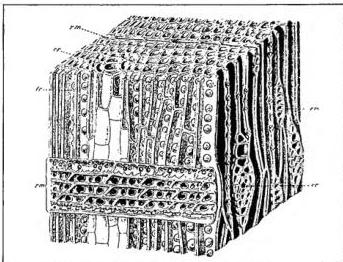
BOTANY - Structure of the homoxylous wood of a Gymnosperm (pine) in the three characteristic aspects presented by transverse, radial, and tangential sections: rm, medullary rays; cr, resiniferous canals with the tracheids of the ray; tr, pitted fibro-tracheids.
The first to observe, in thin slices of cork and elder pith, what he himself called "cells" was the English physicist R. Hooke (1665).
A contemporary of Malpighi, the Englishman Nehemiah Grew (1628-1711) published in 1671 and 1682 his observations, which, however, were largely based on those of Malpighi, though refined and expanded.
The Dutchman Leeuwenhoek (1632-1723) is credited, in the same period, with important cytological observations.
These early acquisitions, however, remained for a long time without any follow-up, and it was only at the beginning of the 19th century that plant anatomy began its most decisive progress.
In a first period, which spans from the dawn of that century until around 1840, anatomical research had a purely descriptive character. Notable in this era are the studies of the Frenchman Charles François Brisseau-Mirbel (1776-1854), the Milanese abbot Bonaventura Corti (1729-1813), Christian Ludolph Treviranus of Bremen (1812-64), Paul Moldenhauer of Hamburg (1766-1827), Pierre Jean François Turpin of Paris (1725-1840), Theodor Hartig of Dillenburg (1805-80), G. B. Amici of Modena (1786-1863), Franz Julius Ferdinand Meyen of Tilsit (1804-40), Johann Jakob Bernhardi of Erfurt (1774-1850), Heinrich Friedrich Link of Hildesheim (1767-1850), and Carl Asmund Rudolphi of Stockholm (1771-1832).
In a second period (1840-60), anatomical research was primarily characterized by the application of the embryological method, which gained prominence under the influence of Goethe’s doctrine of metamorphosis. The founder of plant embryology was the Scotsman Robert Brown of Montrose (1773-1858), though he is erroneously credited with the discovery of the cell nucleus, which was actually made by the Italian Mariano Fontana (1746-98).
Of fundamental importance in this period are the works of Hugo von Mohl of Stuttgart (1805-72), who, among other things, was the first to recognize the nature of protoplasm and demonstrated that it is the substrate of life; of Matthias Jakob Schleiden of Hamburg (1804-81), who provided the first formulation of the cell theory; of Carl Wilhelm Nägeli of Kilchberg near Zurich (1817-91), of Franz Unger of Amthof in Styria (1800-70), of Carl Gustav Sanio of Lyck (1832-91), of Johannes von Hanstein of Potsdam (1822-80), of Heinrich Anton de Bary of Frankfurt am Main (1831-88), who was the first to systematically expound the comparative anatomy of cormophytes; and finally of Wilhelm Hofmeister of Leipzig (1824-1877), who, on embryological grounds, was able to demonstrate the affinity existing among the structures of plants belonging to the different major divisions of the plant kingdom.
A third period follows, extending to the present day, dominated by the great problems arising from Darwin’s theory. In this period, however, anatomy developed in numerous directions: thanks to the work and example of Philippe Édouard Léon van Tieghem, anatomy was widely applied to problems of systematics and morphology; the embryological method, closely associated with cytological research, received its greatest impetus from the comparative morphological studies of Eduard Strasburger of Warsaw (1844-1912); by combining anatomical research with functional significance, physiological anatomy was founded, of which the foremost representative was Gottlieb Haberlandt (1854); adopting the experimental method with Leopold Kny of Breslau (1841-1916), anatomy became experimental morphology; applied to the study of pathology, it became pathological anatomy, especially as developed by Ernst Küster of Breslau (1874, living); it became indispensable to pharmacognosy through the works of Alexander Tschirch of Guben (1856-1939); and it has finally assumed numerous other aspects that cannot be recounted here.
Of more recent origin is plant physiology, whose first fundamental discoveries occurred only toward the end of the 18th century; the development of this branch of botany is somewhat intertwined with the history of modern chemistry, so much so that many scientists are remembered by both physiologists and chemists.
We briefly recall here the works of Joseph Priestley of Birstall near Leeds in England (1733-1804) and of Jan Ingenhousz of Breda in Holland (1730-99), to whom we owe the first observations on the action of green plants on carbon dioxide; observations that later allowed Joseph Pelletier of Paris (1788-1842) and Joseph Bienaimé Caventou of St-Omer (1795-1877) to elucidate the process of chlorophyll photosynthesis, and R. H. Joachim Dutrochet of Paris (1776-1847) to affirm that respiration is a phenomenon common to all living beings.
Of fundamental importance are the studies on plant nutrition by Justus von Liebig of Darmstadt (1803-73). In other chapters of plant physiology, the research of Thomas Andrew Knight (1759-1838), Thomas Graham of London (1805-69), Stephen Hales of Kent (1677-1761), Julius Sachs of Breslau (1832-97), and Wilhelm Friedrich Philipp Pfeffer of Grabenstein near Kassel (1845-1920), famous for his studies on osmotic phenomena, are classical.
As for systematics, it is as old as organography and botany itself. Antiquity bequeathed to us the names of Theophrastus, Dioscorides, and Pliny; and works useful for the identification of plants were left to us, in much less ancient times, by P. A. Matthioli, already mentioned, and Ulisse Aldrovandi of Bologna (1522-1605).
The title of pioneers of systematic botany, however, belongs, in addition to the already cited G. Bauhin, to Andrea Cesalpino of Arezzo (1519-1603), Joachim Jung (Jungius) of Lübeck (1587-1657), Robert Morison of Aberdeen (1620-83), John Ray (Rajus) of Essex (1628-1705), Augustus Quirinus Bachmann (Rivinus) of Leipzig (1652-90), and Joseph Pitton de Tournefort of Aix in Provence (1656-1708).
The works of these scholars characterize the period known as that of "artificial systems," in which attempts to arrange plants in a sufficiently rational scheme were based on the choice of arbitrary guiding characters, leading often to serious inconsistencies and, in any case, to entirely arbitrary groupings of plants and equally arbitrary distributions of these among different groups.
The apex of this period is marked by the studies of Carl Linnaeus of Råshult in southern Sweden (1707-1778). The publication of Linnaeus’s works, the most important of which are Systema naturae (1735), Genera plantarum (1737), and Species plantarum (1753), must be considered one of the greatest events in the history of systematics.
Two merits of this great naturalist are especially to be remembered: the refinement and definitive adoption of binomial nomenclature, and the felicitous intuition of the importance that, even from a strictly systematic point of view, must be attributed to the organs of fertilization. It was on their structure that Linnaeus based his system, which for this reason was called "sexual."
BIBL.:
Per la storia della b.: J. Sachs, Geschichte der Botanik, München 1875; E. Wunschmann, Geschichte der Botanik, in Kultur der Gegenwart, III, IV, 3, Leipzig 1913; M. Möbius, Geschichte der Botanik, Jena 1937; G. Montalenti, L'evoluzione, Torino 1950; V. anche le opere citate sotto le singole voci relative ai botanici ricordati.
G. GOLA.
Linneo’s attempt, however, remained just that—an attempt which, given the still limited knowledge of the time, perhaps could not have succeeded. Indeed, Linneo himself had glimpsed the idea of a natural affinity among certain plant groups; this idea gradually took more concrete form as scientific voyages and paleontological excavations secured knowledge of an ever-growing number of plants, demonstrating how new findings allowed for a more or less continuous series of all living and fossil plants.
Artificial classifications were thus abandoned, and the era of natural methods began. Since it is clear that, based on their natural affinities, plants can only be ordered in one way, it is more accurate to say that efforts began to define the natural method.
Among the representatives of this new period are Pietro Magnol of Montpellier (1638-1715), Bernard de Jussieu of Lyon (1699-1776), Antoine Laurent de Jussieu of Lyon (1748-1836), Michel Adanson of Aix-en-Provence (1727-1805), Augustin Pyrame de Candolle of Geneva (1778-1841), Alphonse de Candolle of Paris (1806-93), the aforementioned R. Brown, Adolphe Théodore Brongniart of Paris (1801-76), and Stephan Endlicher of Pressburg (1805-49).
This period coincided with great advances in the various branches of botany and science in general; the enormous ferment that resulted gradually took shape as evolutionary theories on descent took hold, whose foremost exponents were Darwin and Lamarck.
The task of systematics thus appeared to be the reconstruction of the genealogical tree of all plants, even to the point of identifying the single primitive stock from which the entire plant kingdom would have derived its most remote origin.
Among the most eminent botanists who illustrated the modern direction of systematics are Alexander Braun of Regensburg (1805-77); August Wilhelm Eichler of Neukirchen (1839-87), who proposed a classification very close to the one currently in use; Adolf Engler of Sagan (1844-1930); Richard Wettstein of Vienna (1865-1931); Jan Paulus Lotsy of Dordrecht (1867-1931); Hugo de Vries of Haarlem (1848-1935); and the Japanese B. Hayata, who died in 1934.
It must be noted, however, that while the initial enthusiasm aroused by evolutionary theories had suggested the idea of an actual genetic affinity and a single origin for all plants—indeed, for all living beings (E. Haeckel was the greatest apostle of this monistic theory)—the progress of science later demonstrated the impossibility of tracing all living organisms back to a single ancestral stock and of arranging the plant kingdom in a linear series. Thus, the existence of multiple autonomous and independent groups within the plant kingdom, derived from distinct archetypes between which no connection can be established, came to be admitted; and from a monophyletic concept, a polyphyletic one emerged. It must also be said that the affinities among systematic categories above the species level now appear to us increasingly conventional, like so many hypotheses whose proof cannot be attained.
The history of the plant kingdom has thus deepened its mysteries as attempts to penetrate them have been made. It is interesting to note that in the latest editions of Syllabus der Pflanzenfamilien by Engler and Diels, gathering the ideas of scientists from every country, the plant kingdom has been divided into 14 phyla that show no relationship to one another and are simply listed one after the other without implying, either implicitly or explicitly, a derivation of each phylum from the one preceding II. - Vedi Tav. CXVII.