
SEISMOLOGY. — The fundamental task of s. is the study of the physical characteristics of the Earth’s interior.
For this purpose, it conducts research on the propagation of waves in elastic, viscous, firmo-elastic media (which admit internal friction), etc., and compares the results of theories with those of observations. In this way it has been possible, among other things, to determine the stratification of the Earth’s crust, the surfaces of discontinuity, and to discover the central core at a depth of approximately 2,900 km.
All this presupposes the appropriate recording of the various systems of waves which, generated by an earthquake at a given point (at depths varying from 0 to approximately 800 km), propagate in all directions and to all distances. Hence the need for instruments whose recordings make it possible to reconstruct, as faithfully as possible, the actual movement of the ground.
I. INSTRUMENTAL SEISMOLOGY
The recording of seismic phenomena is obtained by resorting to pendular motion, understood in the broad sense. The first seismographs lacked damping, which rendered their recordings unusable for the purposes of scientific interpretation. The only type of damping whose action gives rise to no theoretical difficulties is that in which the damping force is proportional to the velocity of the motion. Generally, this type of damping is employed.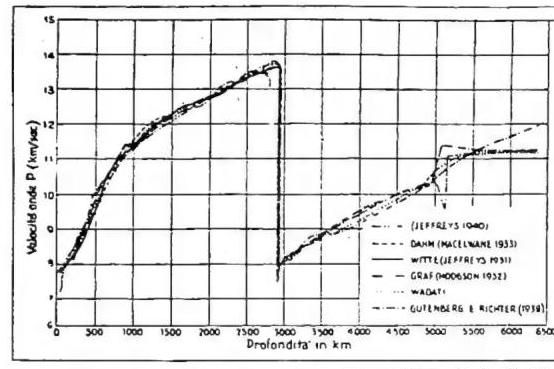
II. THEORY OF SEISMIC RAYS; INTERNAL STRUCTURE OF THE EARTH
One of the fundamental subjects, the object of extensive and profound investigations by seismologists and geophysicists, concerns the propagation of seismic energy within the Earth.Generally, reference is made to the seismic trajectory normal to the wave surface at the point under examination.
The development of the theory of seismic rays (direct propagation, refraction, diffraction, diffusion) has made it possible to pursue the most reliable knowledge currently available concerning the Earth’s interior. From this point of view, seismic rays may be regarded as the Roentgen rays of the Earth: from the characteristics displayed by seismic records obtained at different distances, it is possible to determine the surfaces of discontinuity, the abrupt jumps in velocity (table I) or acceleration, and hence the elastic and density properties of the Earth’s interior. It was by this route that Gutenberg determined the depth of the Earth’s core, assigning it a value of 2920 km. Subsequent research confirmed this value. Table I contains the velocity of seismic waves within the Earth, from the outer surface to the core. There are other methods that permit the determination of the depth of the core. One of these makes use of the recording times of longitudinal (or transverse) waves that reached the observation station after being reflected by the central core. By this means, a value of 2920 km was obtained for the depth of the core, confirming that obtained by Gutenberg.
The Japanese researchers Wadati and Masuda resolved in 1934 the problem relating to the determination of the travel times of longitudinal waves within the core: certain refinements enabled them to apply the Wiechert-Herglotz method to the core as well. From then on, investigations into the propagation of seismic waves within the core followed one another in great number.
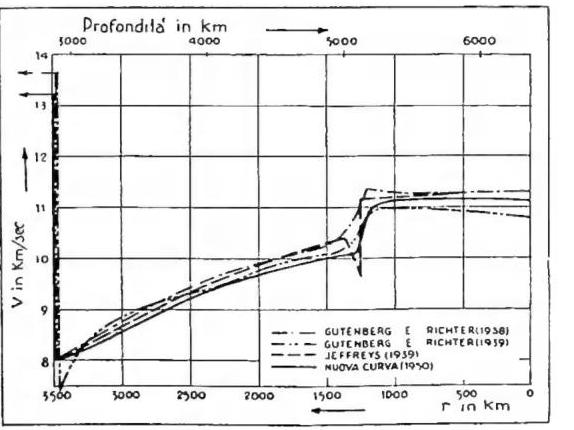
Here only the latest results will be mentioned. It has been demonstrated (Lehmann, Gutenberg and Richter, Jeffreys) that even within the core the propagation of seismic energy does not take place with a uniform variation in velocity: a discontinuity exists within the core (of the first order according to Jeffreys, of the second order according to Gutenberg and Richter) that divides it into an outer part, in which the velocity of the seismic wave is low, and an inner part, characterized by a higher velocity.
TABLE I.
| Depth km | Wave velocity | Depth km | Wave velocity | ||
|---|---|---|---|---|---|
| longitudinal km/sec. | transverse km/sec. | longitudinal km/sec. | transverse km/sec. | ||
| 0 | 5.55 | 3.3 | 1400 | 12.2 | 6.7 |
| 20 | 5.7 | 3.4 | 1500 | 12.3 | 6.7 |
| 40 | 8.0 | 4.4 | 1600 | 12.4 | 6.7 |
| 100 | 8.0 | 4.4 | 1700 | 12.5 | 6.8 |
| 200 | 8.2 | 4.6 | 1800 | 12.6 | 6.9 |
| 300 | 8.7 | 4.8 | 1900 | 12.7 | 6.9 |
| 400 | 9.1 | 5.0 | 2000 | 12.8 | 7.0 |
| 500 | 9.7 | 5.3 | 2100 | 12.9 | 7.0 |
| 600 | 10.2 | 5.6 | 2200 | 13.0 | 7.0 |
| 700 | 10.6 | 5.9 | 2300 | 13.1 | 7.0 |
| 800 | 11.0 | 6.1 | 2400 | 13.3 | 7.1 |
| 900 | 11.3 | 6.3 | 2500 | 13.4 | 7.1 |
| 1000 | 11.5 | 6.4 | 2600 | 13.5 | 7.2 |
| 1100 | 11.7 | 6.5 | 2700 | 13.55 | 7.2 |
| 1200 | 11.9 | 6.6 | 2800 | 13.7 | 7.3 |
| 1300 | 12.1 | 6.6 | 2920 | 13.7 | 7.25 |
In the three figures, the results of research conducted on the subject from 1914 to 1950 are presented graphically.
III. - Generally, the most substantial part of a seismogram is that which follows the recording of transverse waves, reflected one or more times against the Earth’s surface: this part, consisting of long-period oscillations with a pronounced sinusoidal character, is made up of waves that, in their propagation, affect only the superficial part of the Earth, and particularly the strata of the Earth’s crust. These are the waves generically designated as surface waves. In the case of distant earthquakes originating at shallow depth, their recording may last several hours.
Surface waves have been and continue to be the subject of a large number of theoretical studies, intended to explain their mechanism of production and propagation. Among the best known are the theories of Love and Lord Rayleigh. Love’s theory concerns the initial phase of surface waves, consisting of transverse-tangential waves (without a vertical component). Surface waves oscillating in the principal plane, which includes the hypocentre, the observation station, and the centre of the Earth, are instead defined as Rayleigh waves.
(courtesy of P. Caloi)
SISMOLOGIA - Variation in the velocity of longitudinal waves from the surface to the center of the Earth.
On average, the Earth’s crust is 40 km thick. In some parts of the world, instead of two layers, it appears to consist of three superimposed layers. Beneath mountain systems, the total thickness of the strata is considerably greater: approximately 60 km beneath the Sierra Nevada (California), 55–60 km beneath the Alps, and 60 km beneath the Apennines. This thickness is, by contrast, considerably reduced beneath the Oceans: approximately 20 km for the basins of the Pacific and Atlantic. The strata beneath mountains are predominantly sialic, whereas beneath the Oceans they are simatic.
IV. EARTHQUAKE
What are the causes of earthquakes? Leaving aside earthquakes of volcanic origin and those determined by strictly local, very superficial causes (landslides, slipping of strata, etc.), seismic movements may be divided into two broad categories: those originating in the earth’s crust (which has a thickness varying between 20 and 60 km.) and those coming from greater depths.Mountain chains are the vertical resultant of tangential compressive forces that manifest themselves at the sides of geosynclinal areas, in which, over geological time, great masses of sediments of considerable thickness accumulated. If the orogenic movements vigorously carried out in the geosynclines during the Tertiary period continue in our own day, as everything seems to suggest, albeit with diminished intensity, it is natural to see in earthquakes of the earth’s crust one of the forms in which those movements manifest themselves.
The other category of seismic movements concerns earthquakes that occur beneath the earth’s crust, at depths that may reach very great values (100, 200, 500, 700 and more km.).
At such depths, matter is at temperatures and pressures so high that the possibility of dislocations, collapses or fractures may be excluded. Only physicochemical phenomena involving abrupt changes in the state of matter can be invoked to explain their origin; and it is not unreasonable to attribute them to nuclear reactions analogous to those, for purposes of comparison, to which we owe the atomic bomb.
The materials constituting the earth’s crust behave as viscous (in the broad sense) when subjected to the action of forces applied over a long period; as elastic when the forces act abruptly and for a short period of time.
The first quality is evident in sedimentary rocks, once formed on the seabed and subsequently subjected to the slow corrugating action of the earth’s crust (bradissimi), also revealed by precision levelling; the second is attested by the propagation of seismic waves, produced by abrupt disruptions of equilibrium (earthquakes). Simple observation of the initial movements produced by a tremor at a certain number of observatories, suitably distributed around the epicentre, now makes it possible to deduce the physical nature of the cause to which the tremor itself is due.
If the first movement (directed longitudinal waves) occurs, at certain stations, in the station-
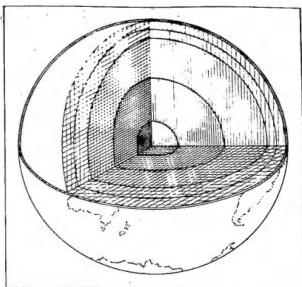
It sometimes happens that, in circular zones around the epicenter, the initial movement is unidirectional in all azimuths: if this movement is one of dilatation, we have a subsidence earthquake; if, on the other hand, it is one of compression, the earthquake is an uplift earthquake. In the Alpine region, earthquakes caused by fracture predominate; in the northern Adriatic, subsidence earthquakes; in the Apennines, on the other hand, uplift earthquakes.
V. I MICROSISMI
The name microseisms is generally used to indicate that complex of small oscillations, generally having the appearance of damped sinusoids, which are recorded by seismological instruments, especially during winter and spring. The periods of such oscillations, for microseisms properly so called, may vary from a few tenths of a second to approximately 12 seconds, depending on the cause at work and the distance from the source. Among the various types of microseisms, the most frequent and those of greatest amplitude are those in some way connected with meteorological phenomena.TABLE II.
| Regions | d_{1}^{} | Velocity of longitudinal waves km./sec. | Velocity of transverse waves km./sec. | d_{2}^{} | Velocity of longitudinal waves km./sec. | Velocity of transverse waves km./sec. |
|---|---|---|---|---|---|---|
| Nord-Ovest Europa | 17 | 6,0 | — | — | — | — |
| Württemberg | 20 | 5,6 | 3,3 | 25 | 6,3 | 3,7 |
| Alpi settentrionali e zone circostanti | 35 | 5,6 | — | 20-25 | 6,5-7,0 | 3,7 |
| Alpi Carniche | 35-40 | 5,7 | 3,4 | 15 | 6,6 | 3,7 |
| Jugoslavia | 15 | 5,5 | — | 25 | 6,3 | 3,65 |
| Italia centrale (Appennino) | 25 | 5,3 | 3,0 | 35 | 6,6 | 3,6 |
| Nuova Zelanda | 10 | 5,0-5,55 | 3,4 | 20 | 6,5 | 3,8 |
| Giappone | 20 | 5,0 | 3,15 | 20 | 6,2 | 3,7 |
| Asia centrale | 35 | 5,5 | 3,20 | 15 | 6,25 | 3,7 |
| California centrale | 10 | 5,6 | 3,3 | 25 | 6,7 | — |
| Sierra Nevada (California) | 20 | 5,6 | 3,3 | 40 | 6-7 | — |
* d_{1} = thickness of first layer; d_{2} = thickness of second layer.
It has been established that microseisms, more or less pronounced, accompany cyclones along their course over the Atlantic (in general, over the sea). Whereas the translational velocity of cyclones averages 50–60 km. per hour, microseisms may propagate at velocities on the order of 10,500–11,000 km. per hour—that is, at a velocity 200 or more times greater. This is a particularly favorable characteristic, whose importance for solving the problem of weather forecasting should not be underestimated.