
ESDRA. — Priest and scribe (Hebr. ‘Esrā’; Septuagint ‘Eσ[ē]σ[ē] = ‘E[σ]σ; Vulgate Esdras) who played a leading role in the restoration of the Jewish community in Jerusalem after the exile. His activity, carried out under difficult circumstances, is recounted in the books of Esdra and Neemia. The two books, which continue the history of the Paralipomeni, are less two different works than two parts of a single one. The ancients regarded them as one book (Fl. Giuseppe, Melitone di Sardi, Origene, Epifanio, Girolamo); the Septuagint combines them. Their subject is one: the restoration of the Israelite nation after the Babylonian exile; their purpose is identical: to proclaim God’s faithfulness and recommend observance of the law; the same character is found in the 23 chapters that make up the entire account.
I. SUBJECT
The two books cover the period from 537 to 433 or, according to others, to 398 B.C., in addition to later additions. The author does not present a continuous history of this period, but reports only certain events: the first return of the exiles led by Zorobabel and the rebuilding of the Temple (Estd. 1–6); the second repatriation of exiles led by E., in the seventh year of Artaserse, and the religious restoration (Estd. 7–10); the rebuilding of the city walls by Neemia amid much opposition (Neh. 1–6), and the political and religious organization of the Jewish community (Neh. 7–13). Various catalogues (Estd. 2, 1–70; 8, 1–20; 10, 18–44; Neh. 3, 1–31; 7, 6–69; 10, 1–27; 11, 4–12, 25) list the returning families, those who rebuilt the walls, and the signatories of the renewed covenant.II. AUTHOR
Jewish tradition attributes it to E. (Bābha' Bāthra', 15; Sanhedhrin, 93b), followed by Lamy, Kaulen, Cornely-Hagen, Hetzenauer, Seisenberger, Vigouroux, Fillion, Pelt, Sales, and Hoberg. Nevertheless, not a few hold that additions were made to E.’s work, which Hoberg, for example, assigns to the Hellenistic period. It is more probable, however (Herbst, Haneberg, Bertheau, Fischer, Mangenot, Höpfl, Cornely-Merk), that the work was compiled at a time later than E., using historical documents from the time of E. and Nehemiah. Indeed, mention is made of the “days of Nehemiah the governor and of E. the priest” (Neh. 12, 26) and of the “days of Zorobabel and Nehemiah” (Neh. 12, 46) as belonging to a past time; the Persian Darius (Neh. 12, 22) is Darius III Codomanus (335–330); E. is praised as a “skilled scribe in the Law” (Estd. 7, 6, 11). Jewish tradition must have drawn upon the Esdrine sources reproduced here (Estd. 7, 1-10, 44; Neh. 7, 73-10, 4).III. CHRONOLOGY
E. came to Palestine in the 7th year of Artaxerxes; Nehemiah in the 20th year and then in the 32nd year of Artaxerxes. The question is whether II (v.). It was commonly admitted that E. had come in the 7th year of Artaxerxes I Longimanus (458 B.C.), and Nehemiah in 445 and 433 (the 20th and 32nd years of the same king). A. van Hoonacker (followed by Torrey, Klamath, Touzard, Sales, Ricciotti) advanced in 1890 the hypothesis that Nehemiah was the first to come to Jerusalem, in the 20th year of Artaxerxes I (445 B.C.), as prefect of the province; there, together with E., he renewed the covenant (Neh. 8–10); then E. returned to Babylon, from where he set out at the head of exiled returnees in the 7th year of Artaxerxes II (398 B.C.). The principal reasons adduced by van Hoonacker are: 1. when Nehemiah deals with Artaxerxes and when he speaks of those repatriated before him, he makes no mention of E.; 2. Nehemiah openly accuses the governors and leaders preceding him of being oppressors and exploiters: could E. have been condemned in this way?; 3. when Nehemiah arrives in Jerusalem, the city walls are still lying ruined on the ground, whereas in E.’s time there is a passage (Estd. 9, 9) that presupposes the completion of the circuit of the walls; 4. at that time Sanballat the Horonite, Tobiah the Ammonite, etc., dominate Jerusalem: there is no trace of them under E.; 5. E. makes a contemporary of Iohanan son of Eliasib (Estd. 10, 6), who is probably the third in the list of high priests given in Neh. 12, 22. But these reasons do not seem sufficient to admit so considerable a displacement in the sacred text. In Nehemiah’s time, in fact, the Jews provided for the sacred worship at their own expense (Neh. 10, 32 agg.); under E., on the other hand, the Jewish colony was so poor that provision for the worship had to be made from the royal treasury (Estd. 7, 20), a poverty better explained by a time preceding Nehemiah. The settlement of the mixed marriages presupposes the present order, and if Nehemiah does not mention E.’s earlier work, this is due to its less than successful outcome. Nor is it proved that Iohanan, son of Eliasib(from A. Brückner, Polybiota Knöchel - Werfer, Berlin 1939, par. 3, fig. 1)
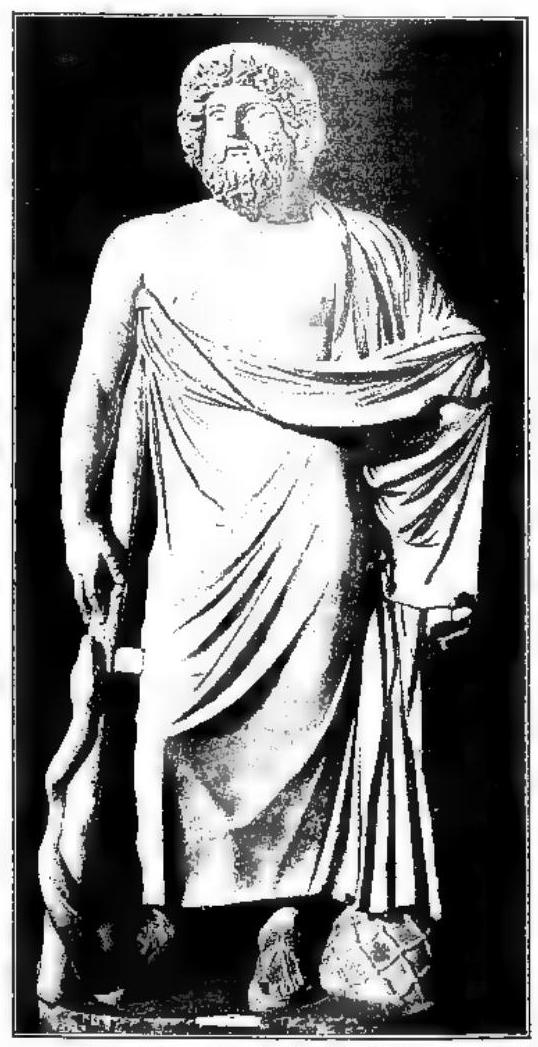
ESCULAPIO — Copy from a Greek original of the 5th century BC. Naples, National Museum.
IV. HISTORICAL AUTHORITY
The historical authority of Ezra-Nehemiah is attested by the documents appended to it and by its perfect agreement with Persian history. The differences in the names in the lists of the exiles are explained by the usual variations in the transcription of names.Cyrus’s religious policy (v.) and the agreement with formulaic expressions found elsewhere assure us of the historicity of the edict of liberation in which Jahweh is named. The silence of Esch. 44–50 should occasion no more surprise than the omission of Asa and Iosaphat, kings of Judah. The Jewish and Christian tradition, which acknowledges the divine authority of Ezra-Nehemiah, a fortiori acknowledges its historical authority—and with good reason. The Elephantine papyri, documents so closely akin to Ezra-Nehemiah in content and phraseology, confirm its historicity.
V. THE ACTIVITY OF E
E., priest and scribe, carried out his activity in difficult circumstances. After the decree of liberation issued by Cyrus (538), in 537, apparently in the spring, the first group of exiles departed under the leadership of Zorobabel and the high priest Giosuè. Work on the new Temple was begun immediately (v. AGGRO).From the time of Darius I (521) onward, the Jewish community of Jerusalem continued to be governed by two leaders: the gehāh, the “prefect,” and the high priest. Under these leaders the community lived obscurely until the middle of the fifth century. Economic conditions were difficult and moral conditions not very prosperous. Encouraged by a benevolent decree (Estd. 7, 11-26) of Artaxerxes I (the seventh year = 458 B.C.), E. came from Babylon at the head of the second group of exiles returning to their homeland. His spirit was possibly Yahwistic; his mission was principally religious. The caravan, consisting of approximately 1,800 men, departed on 12 Nīshān 458. E. eliminated the serious abuse of mixed marriages, which had become widespread among the leading men. In the Temple and before the people, E. confessed to Yahweh the grave public crime. Moved, the people swore, beginning with the guilty priests and Levites, to send away the foreign women and their children immediately. Because of the difficulty of sending away the women and children at once and during the rainy season (20 Hīshēn = November–December), a commission presided over by E. decided the individual cases. But it seems that, once the initial enthusiasm had waned, the success was not great, as the abrupt conclusion of Esdra suggests and Nehemia confirms (9, 2; 10, 30; 13, 3).
God soon sent E. help in Neemia, in the twentieth year of Artaxerxes. After the walls, gates, and towers of Jerusalem had been rebuilt in 52 days, E. (Neh. 8), at the New Year festival, read the neglected Law to the assembled people. He added some recommendations. During the subsequent Feast of Tabernacles (Neh. 9, 13 agg.), the Law was read daily for 8 days. The people and the Levites were once again instructed in the Mosaic prescriptions. Having prepared themselves through fasting, penance, confession, and prayer, Israel renewed the covenant. With this restoration, E.’s mission seems to have come to an end.
According to Jewish tradition, E. collected the sacred books; he is said to have later died in Persia, where his tomb is still shown at el-’Osejr or el-’Esr (“E.”) on the Tigris, 40 km. from its confluence with the Euphrates; but Flavius Josephus places his death in Jerusalem. It is to be presumed that, together with Neemia (II Mach. 3, 13), E. concerned himself with preserving and arranging the repository of the inspired books (v. LIBRO di).
BIBLI.: A. van Hoonacker, Néhémie et Esdras, in La Muséna, 9 (1890), pp. 151-84; id., La succession chronologique Néhémie-Esdras, in Revue biblique, 32 (1923), p. 481 agg.; 33 (1924), p. 33 agg.; J. Nikel, Die Wiederherstellung des jüd. Consumen nach dem babil. Esl. (Bibl. Studien, 5, 11-11), Freiburg 1900; L. W. Batten, The books of Esra and Nehemiah, Edinburgh 1913; H. Schaefer, Eine der Schreiber, Tübingen 1930; G. Riebert, Storia d'Israele, II, Turin 1934, p. 125 agg.; id., s. V. in Soc. Ital., XIV (1932), p. 307 ag.; R. De Vaux, Les décrets de Cyrus et de Darius sur la reconstruction du Temple, in Revue bibl., 26 (1937), pp. 29-57. Vincenzo M. Jacono