
SPORT. – An English term that has entered into the current usage of the language; it derives from the older disport, which in turn derives from the Old French desport, related to the Italian diporto (Decameron, VIII, 7); cf. Late Latin disportare, desportare, from Classical Latin deportare.
In its primitive meaning it denotes relaxation, recreation, and amusement. And, in fact, the diffusion of the term, relatively recent (19th century), came, in a general sense, to designate games and exercises of strength and skill, individual or collective, usually practised in the open air. With the 20th century, particularly after the First World War, the term assumed the most varied aspects, often contrasting with one another, retaining little or nothing in common with the value of its primitive meaning and of the ancient exercises; consequently, it is at present impossible to express it with a single exact definition.
Mosso (Mens sana in corpore sano, Milan 1903, p. 97) had proposed rendering the term “s.” with the word “agonistics,” of Greek origin, which is undoubtedly closer to the present-day inner meaning of s.; but the proposal did not gain acceptance.
Today the “phenomenon” of s. exists in at least four aspects: a) as a “state of mind.” Millions of individuals, of every race and every religious faith, under every form of government, crowd sports venues as spectators in order to admire and follow the fortunes of their “champions,” seeing the instinct for primacy, so lively in the majority of individuals, condensed in the struggle of the “athletes.” A very widespread press and an entire new literature keep this “tendency” alive, which, if nothing else, has the great merit of generally distracting millions of people through innocuous manifestations.
b) As “recreation”: that is, as a reaction to the ever-increasing advance of mechanical civilization and as an antidote to daily work through the systematic practice of gymnastic activities, with the aim of developing muscular abilities and entertaining the spirit. This is the most widespread and healthiest category of sportsmen; it includes all social classes and ranges from hikers to those who practise genuine gymnastic exercises, without any idea of “assertion.” It is the activity recommended to everyone, particularly to those who, having reached maturity, wish to preserve that certain physical well-being so greatly desired. In order to provide the desired benefits, this physical activity must be chosen according to one’s own requirements (biotypological), always taking account of one’s “state of health,” and not according to one’s inclinations, as commonly happens.
c) As “amateurism”: that is, for the affirmation of one’s personality in pursuit of a higher ideal; to the element of “recreation” is added the “agonistic” character, namely the “combative spirit” in sporting trials, the “aspiration to primacy,” and “specialization.” Amateurism is the purest expression of s., and finds its highest manifestation in the Olympic Games (v. sotto). Amateur activity is that which has the greatest appeal for young people and, provided the physical and moral integrity of those who practise it is safeguarded, ought to be encouraged and disseminated, since agonism, when it is “ethical,” is an active element in the educational process; indeed, track and field athletics, which is the queen of amateurism, when practised according to bio-psychopedagogical criteria, forms part of physical education, as do many other s. (v. fisica).
d) As “professionalism”: this is an exacerbated form of agonism, which often gives rise to bold and generous enterprises for the honour of the flag or of other ideals, but which sometimes degenerates into acrobatics through the lure of large earnings or great fame. These sportsmen practise the art of their exercise by exploiting all the qualities of their bodies without any regard for them, often exaggerating natural defects to the detriment of that equilibrium which should be the constant goal of everyone.
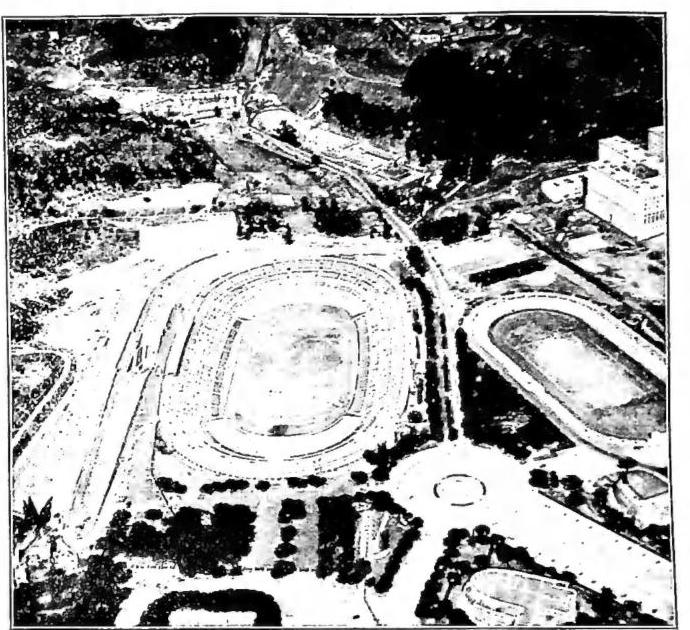
(by courtesy of the C.O.N.I.)
SPORT - New Olympic Stadium seen from the air along its longitudinal axis from south to north, inaugurated on 17 May 1933 - Rome, Foro Italico.
the continuous progress of certain important aspects of contemporary civilization.
I. SPORTS ACTIVITIES
The so-called sporting activities are numerous, and most of them are connected with the manifold traditions of all peoples.Here is an outline of the best-known sporting activities in the international field, with those practiced on the occasion of the Olympic Games marked with an asterisk.
1. Aquatic sports
Canoeing (men’s: single canoe 1000 m., double canoe 1000 m., single canoe 10,000 m., double canoe 10,000 m.; single Canadian canoe 1000 m., double Canadian canoe 1000 m., single Canadian canoe 10,000 m., double Canadian canoe 10,000 m.; women’s: single canoe 500 m.). Rowing (single sculls, double sculls, coxless pair, coxed pair, coxless four, coxed four, eight). Swimming (men’s: 100 m. freestyle, 400 m. freestyle, 1500 m. freestyle, 200 m. breaststroke, 100 m. backstroke, 4 × 200 relay; women’s: 100 m. freestyle, 400 m. freestyle, 200 m. breaststroke, 100 m. backstroke, relay). Diving (men’s and women’s: springboard, platform). Water polo (water-polo). Sailing (classes: 6 m. S. l., 5.50 m., “dragons,” “stars,” “finns”). Motorboating (in its various classes). Fishing. Underwater hunting. Water skiing.2. Air sports
Aeronautical sports (with or without engines) have undergone remarkable development in recent decades. One need only look through the tables of speed and distance records achieved by modern jet aircraft, and the altitude records of stratospheric aerostats, to appreciate the enormous progress made in the preparation of equipment and men. Parachuting, which together with aerial acrobatics represents a true school of daring, is the most recent recruit among air sports. Aeromodelling has enthusiastic adherents, particularly among the young.3. Athletic sports
Track and field athletics*: men’s (races: 100 m., 200 m., 400 m., 110 m. hurdles, 400 m. hurdles, 4 × 100 and 4 × 400 relays, 800 m., 1500 m., 3000 m. steeplechase, 5000 m., 10,000 m., marathon; jumps: high jump, long jump, pole vault, triple jump; throws: discus, shot put, javelin, hammer; walks: 10 km., 50 km.; decathlon); women’s: (races: 100 m., 200 m., 80 m. hurdles, 4 × 100 relay; jumps: high jump and long jump; throws: discus, shot put, javelin).Heavy athletics. — Freestyle wrestling (classes: flyweight, bantamweight, featherweight, lightweight, welterweight, middleweight, light-heavyweight, heavyweight); Greco-Roman wrestling (classes: flyweight, bantamweight, featherweight, lightweight, welterweight, middleweight, light-heavyweight, heavyweight); weightlifting* (classes: bantamweight, featherweight, lightweight, middleweight, light-heavyweight, heavyweight). Other exercises in heavy athletics are: Japanese wrestling or Jiu-Jitsu; Irish wrestling (Glima); Swiss wrestling (Schwingen); Turkish wrestling (Türk Güreschi).
Gymnastics*: men’s (rings, pommel horse, floor exercise, parallel bars, vaulting horse, horizontal bar, individual all-around and team competition); women’s (small apparatus, floor exercise, parallel bars, vaulting horse, balance beam, individual all-around and team competitions).
Modern pentathlon* (equestrian event with 15 obstacles, fencing, pistol shooting at a human silhouette, 300 m. freestyle swimming, cross-country race of approximately 4000 m.).
4. Combat sports
Boxing (classes: flyweight, bantamweight, featherweight, lightweight, light welterweight, welterweight, light heavyweight, middleweight, light-heavyweight, heavyweight). Fencing (men’s: foil, sabre and épée, individual and team; women’s: foil). French boxing (savate). Shooting* (free pistol, artificial pigeon, free rifle, silhouette shooting, running deer, small carbine, small-calibre rifle). Archery. Clay-pigeon shooting. Hunting. Tauronachia (corrida).5. Equestrian sports
Horse races include competitions involving horses that are harnessed or ridden (galloping, trotting, steeplechase* etc.). Polo.6. Winter sports
Ice hockey (Hockey). Tobogganing (bob): skeleton, two-man, four-man. Skating: men’s, women’s, pairs, 500 m. speed skating, 1500 m., 5000 m., 10,000 m. Skiing: cross-country, long-distance, ski jumping, downhill, women’s downhill, women’s slalom, women’s alpine combined.7. Mechanical sports
Motor racing (on roads and tracks) in its various classes. Cycling*: cycling events may be road races, track races, pursuit races, time trials, or stage races (Giro d’Italia, “Tour de France,” etc.). The Olympic events are: sprint, team pursuit, 1000 m. time trial, 2000 m. tandem, road race. A combination of cycling and running is cyclo-cross. Motorcycling (on roads and tracks) in its various classes.8. Touring sports
Mountaineering (hiker, climber, rock climber, etc.). Camping.9. Sporting games
Bocce. Football (Foot-ball Association). Golf. Field hockey. Base-ball. Basketball* (Basket-ball). Pallacorda (Lawn-tennis). Handball (Hazená). Palla a martello (Croquet). Palla a sfratto. Palla a spatola (Cricket). Rugby football (Foot-ball Rugby). Volleyball (Volley-ball). Tamburello. Table tennis (Ping-pong). Tug-of-war. Relay race, etc.II. THE OLYMPIC GAMES
In antiquity, the highest expression of athletic exercises was provided by the ethical-religious manifestations of the games: particularly famous were the Olympic Games (v. GIUOCHI).In the modern age, on the initiative of Baron Pierre de Coubertin (1863–1937), in 1892 the idea was launched of restoring the Olympic Games as the greatest modern sporting manifestation of worldwide amateurism. The initiative succeeded, and in 1896 the first modern Olympiad was held in Athens, with 13 nations participating. From that date, except for the interruptions in 1916, 1940, and 1944 due to wartime circumstances, the event was repeated every four years: in 1900 (Paris), 1904 (St-Louis), 1908 (London), 1912 (Stockholm), 1920 (Antwerp), 1924 (Paris), 1928 (Amsterdam), 1932 (Los Angeles), 1936 (Berlin), 1948 (London), and the last, the XV (the chronological numbering also counts those not held), took place in 1952 in Helsinki, with representatives of 70 nations participating. From 1924 (Chamonix), following the initiative undertaken in 1921 at Lausanne on the occasion of the Congress of the Winter Olympic Committee, the “winter games” have also been held; these were repeated every four years in 1928 (St-Moritz), 1932 (Lake Placid), 1936 (Garmisch), 1948 (St-Moritz), and 1952 (Oslo). The events admitted to the Olympic manifestations are listed above, marked with an asterisk.
III. ORGANIZATION
Almost all sporting activities are organized in national federations which, generally in turn, belong to international federations, with the aim of better coordinating and developing the issues relating to the individual sporting activities. In Italy, the Italian National Olympic Committee (C.O.N.I.) was founded by a group of enthusiasts in 1908, on the occasion of the IV Olympiad (London), to coordinate the activities of the sports federations in preparation for each Olympiad; in 1927 it underwent a substantial reform, becoming “the Federation of Federations.” Under the law of 16 February 1942 no. 426 and the subsequent amendments introduced by R.D.L. 2 August 1943 no. 704 and D.L. 11 May 1947 no. 362, the C.O.N.I., through the “Olympic” and “non-Olympic” sports federations, provides for the preservation, control, and development of the national sporting heritage; it coordinates and regulates sporting activity, however and by whomever exercised; it has supervisory and protective authority over all organizations devoted to s. and ratifies their statutes and regulations, directly or through the national sports federations; it prepares athletes and the appropriate means for the Olympic Games and for all other national or international sporting events, with a view to Olympic preparation or the achievement of other aims. For the Catholic sporting movement in Italy V. CENTRO SPORTIVO ITALIANO (C.S.I.); FEDERAZIONE ASSOCIAZIONI SPORTIVE CATTOLICHE ITALIANE (F.A.S.C.I.).IV. RELIGIOUS AND MORAL PROBLEMS
The various gymnastic and sporting activities just described, since they concern a not inconsiderable part of human education, raise, in addition to the problems assessed by the various positive sciences, other problems of a religious and moral nature, whose solution is necessary for proper guidance and for the attainment of an end worthy of the human person, considered under its twofold aspect, natural and supernatural. Now, an appropriate solution and norms are offered by the penetrating analysis of the subject contained in the address of His Holiness Pius XII to the «National Scientific Congress on Sport and Physical Education», delivered on 8 November 1952 (AAS, 44 [1952], pp. 868–76).The elements that contribute to the exercise of an art — and sporting activity may fittingly be compared to an art — are three: the instrument, the artist, and the use of the instrument; as in every other activity, they must conform in their exercise to the end or ends to be achieved.
Now, the proximate end of sport is to educate and strengthen the body in its static and dynamic aspects; its more remote end is the use which the soul must be able to make of the body for external and interior development and therefore for the perfection of the person; the supreme end, which belongs to the human person and is therefore common to all his activities, is to draw man closer to God and procure his eternal happiness. In our case, moreover, the instrument is the body; the artist is the soul united to it in the unity of nature; the use is the practice of gymnastics and sport. From this there logically follows a whole series of valuable teachings.
a) The body. — To the marvels of structure and form, of functions, instincts and energies, which make it an enchanting masterpiece of beauty, harmony and vitality, religious and moral thought adds a further characteristic: sacredness. Formed, in fact, from the clay of the earth, vivified by the spiritual and immortal soul, it was raised by the Creator to the dignity of a temple of God himself, present in the soul with a wholly particular presence through supernatural Grace, and destined finally to share in the eternal happiness of the soul, to which it was united on earth (I Cor. 6, 13–20; 15, 42–43). Nevertheless, in the human composite it does not occupy the first but the last place, primacy belonging to the soul. It must therefore be esteemed, respected, cared for and invigorated, but not deified, just as neither race, blood, nor any other somatic presupposition or element should be deified.
Moreover, as a consequence of original sin, the instincts and powers of the body tend to prevail over right reason, drawing man toward evil. Now, if there are forms of sport whose severity helps to restrain the instincts, there are others that awaken them with violent force and with the seductions of sensuality. There are also environmental circumstances, nudism that is neither necessary nor appropriate, and an exhibitionism of gestures and poses, which inoculate the poison. Religious and moral sensibility therefore vetoes this manner of practising sport.
b) The soul. — Without the soul, sport would be merely a vain agitation of the limbs, a display of fleeting beauties and an ephemeral satisfaction; the soul is the principal and determining factor in the movements of the limbs, in their various agile and skilful displacements, and in the contractions of the muscles. Religious and moral spirit therefore entails and requires: 1) that in evaluating sport, in judging the person of athletes, and in admiring their achievements, the hierarchy of values be observed, so that the greater esteem be given not to the person’s muscles but to the person who best knows how to dominate them and subject them to the rule of the spirit; 2) that in the event of conflict, the higher and inviolable interests of the soul not be sacrificed for the advantage of the body (probity, justice and equity, moral integrity and natural modesty, the dutiful care of life and health, of the interests of the family and profession, of reputation and honour); 3) that the joy of possessing robust strength and the capacity for success and victory not be regarded as either the sole or the principal element of action, and that consequently neither gymnastics nor sport be elevated into the supreme purpose of life.
c) Practice. — In the practical exercise of sport, it will be necessary to remember that, like every other activity, it must submit to and respect the natural law and the positive laws of the Church and of the competent authority; consequently: 1) the Lord’s Day must be sanctified by fulfilling one’s religious obligations; 2) family obligations must be remembered and not neglected, since they must take precedence over the supposed demands of sport and sporting associations; 3) one must not thoughtlessly expose one’s own or another’s life or health to serious dangers. While this applies to all forms of sport, it must apply with even greater force to competitive activity, especially professional competition, which can easily degenerate into brutality.
When the religious and moral content of sport is thus carefully respected, sport will become integrated into life as an element of balance, harmony and perfection, as a valuable aid in fulfilling other duties, as well as a flourishing of physical and psychological health in the service of the spirit. — Vedi tav. LXXVII.
BIBL. V. GINNASTICA.