Machine translation of the 1948–1954 Italian original. The original text is authoritative.
ACCOLTI, PIETRO. - Son of Benedetto and brother of Bernardo, born in Firenze in 1455; he was lecturer in canon law at Pisa; then, having entered the ecclesiastical career, he became auditor of the Rota (from at least 1484 until 1505, holding the office of dean of the Rota from 17 Nov. 1500), then bishop of Ancona (from 4 Apr. 1505), and cardinal of the title of S. Eusebio (consistory of 10 March 1511, held by Leone X at Ravenna).
As a cardinal he was highly influential in the Curia, held various posts (among other things, he drafted the first outline of the fine Essurge Domine, by which Leone X, on 15 July 1520, condemned Lutero), and held important offices: he was successively cardinal vicar (from 1505) and bishop of the suburbicarian dioceses of Albano (from 8 Dec. 1523), Palestrina (from 20 May 1524), and Sabina (from 15 June 1524); during this same period he held in administration, for brief terms, the dioceses of Cadice, Arras, Ancona, Maillezais, Cremona, and Ravenna.
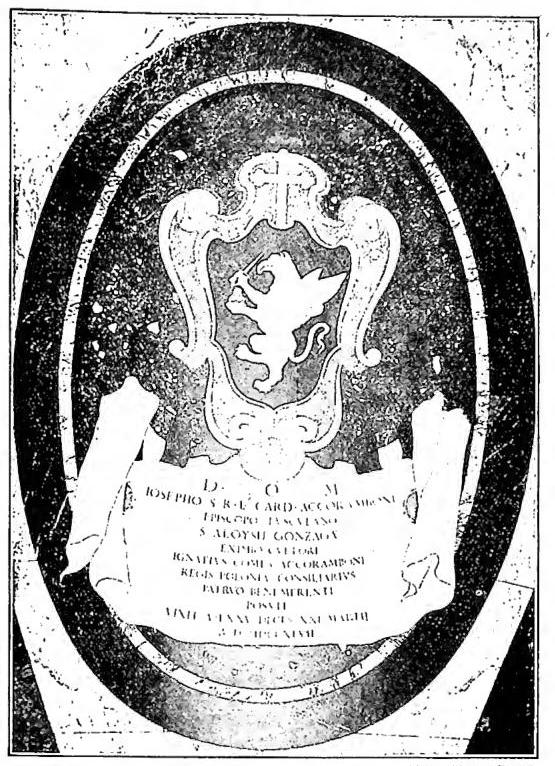
(photo Enc. Catt.)
ACCORAMBONI - Tomb of Card. G. A. Marble inlay (1747) - Rome, Church of S. Ignazio.
He died in Rome on 12 Dec. 1532 and is buried in the church of S. Maria del Popolo.
BIBL.: Pastor, IV, passim; E. Cerchiari, Cappellani Papae et Apostolicae Sedis, II, Rome 1920, p. 74; Eubel, II, 2nd ed., Münster 1923, pp. 12, 107, 283. Pio Ciprotti
Cite this article
“ACCOLTI, PIETRO.” Enciclopedia Cattolica, vol. I (1948), p. 146. Azione Romana digital edition, https://azioneromana.com/article/accolti-pietro.