
ECCLESIASTICAL DRESS. – Garment ordinarily worn by the secular and regular clergy; it is to vestments (v.), which ministers of worship wear during sacred functions. In the first centuries ecclesiastical dress differed in no respect, either in form or in color, from the clothing of the laity. But when, beginning in the 5th century, short garments introduced by the barbarians began to come into fashion among the laity, the councils forbade them to ecclesiastics and prescribed that the latter should always wear long, closed garments, without superfluous ornamentation, of a color that was not garish but rather dark: « Humilitatem, quam corde gestant... habita demonstrent » (Council of Aix-la-Chapelle of 816, can. 124; cf. also the German Council of 742, can. 7). However, no universal norm was issued on the matter until the Fourth Lateran Council (1215) and the Council of Vienne (1312), which prohibited clerics from wearing certain forms and colors of clothing (reproduced in the Corpus Iuris Canonici: cf. c. 15, X, III, 1; c. 2, III, 1, in Clem.). The color black, introduced by the Benedictines, did not become obligatory until the 15th century, and even more so in the 16th century, under the influence of s. Carlo Borromeo and the Council of Trent. The latter imposed penalties on clerics who did not wear appropriate dress, leaving further determinations to the ordinaries and local customs (sess. XIV, de ref., chap. 6). Sixtus V (constitution Cum sacrosanctam, 9 January 1589) prescribed the cassock for all clerics; but particular laws and local customs have determined different forms in many regions.
Ecclesiastical dress is called « sottana », because it is to be worn beneath the sacred vestments. It is now black for priests; violet for bishops; red for cardinals (since Paolo II, 1464–71); white for the Pope.
The Code of Canon Law requires clerics always to wear suitable ecclesiastical dress, in the form established by local laws or customs (can. 136).
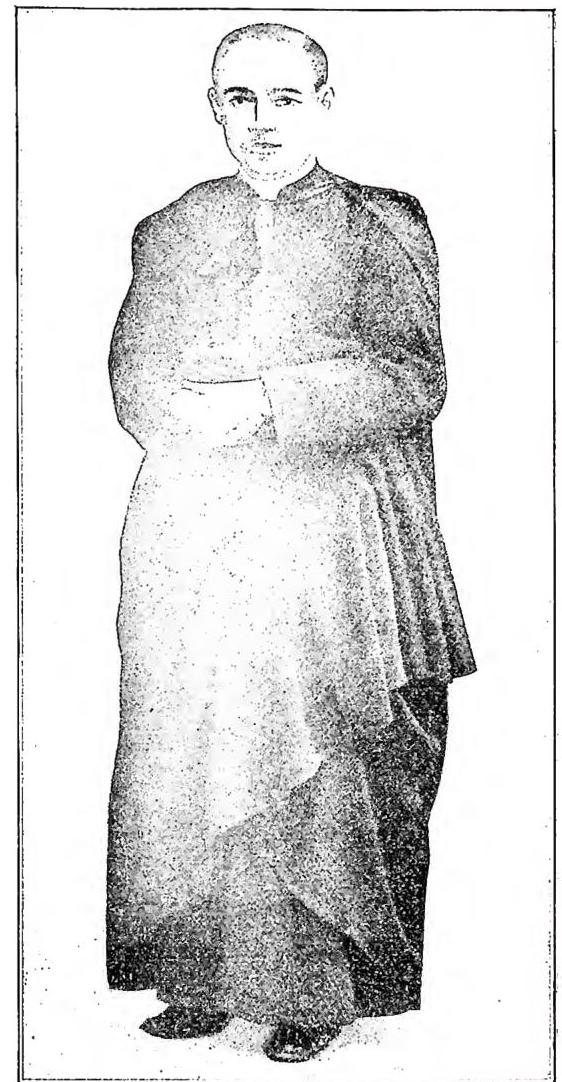
Serious canonical sanctions exist against clerics who improperly fail to wear the prescribed ecclesiastical a. (cann. 136 § 3, 188, n. 7, 2379); from this it is rightly deduced that these are provisions imposing a grave moral obligation, although, as is obvious, there may be plausible reasons permitting them to dress otherwise, such as, for example, a state of persecution or travel in a region with different customs.
Article 498 of the Italian Penal Code, substantially reproducing (but, according to the most common interpretation, extending it also to non-Catholic churches) the provision
of art. 29 i of the Concordat, punishes with a fine of 1,000 to 10,000 lire (now to be multiplied by eight) anyone who improperly wears ecclesiastical a. in public. Although, under the Concordat, for this penalty to be applicable to clerics or religious deprived of the use of the a., it was necessary for the deprivation measure to have been notified to the civil authority, such notification no longer seems necessary, since the Penal Code makes no mention of II. - Vedi Tav. VI.