
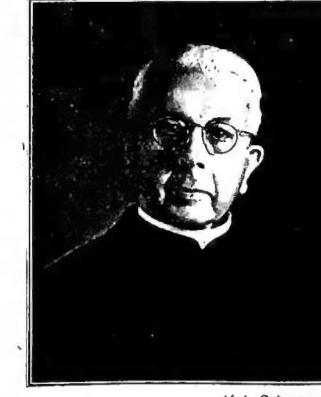
STEIN, JOANNES WILHELMUS JACOBUS ANTONIUS. – Jesuit, astronomer, born at Grave (Netherlands) on 27 February 1871, died in Rome on 27 December 1951.
He entered the Society of Jesus in 1888 and studied mathematics, physics, and astronomy at the University of Leiden (1895–1901). Ordained a priest in 1903 at Maastricht, he was called to Rome in 1906 to the Vatican Observatory as assistant to Fr. Hagen. In 1910 he returned to his homeland and taught until 1930 at St. Ignatius College in Amsterdam. On returning from a journey to Egypt, undertaken at the command of Pius XI to explore the possibility of establishing a branch of the Vatican Observatory in Ethiopia, he was appointed in 1930 as Fr. Hagen’s successor in the direction of the Vatican Observatory, an office he held until his death.
In 1901 he obtained a degree in physical and astronomical sciences with a dissertation on the determination of the variation of latitude at Leiden (Beobachtungen zur Bestimmung der Breitenvariation in Leiden nach der Horrebow-Methode). An expert in the theory of variable stars, he published various studies and compiled, for the great encyclopedia on stars
in a gas chamber of the Auschwitz concentration camp in Poland in 1942, apparently on 10 August.
A student and later assistant of E. HUSSERL, EDMUND (v.) at Göttingen and Freiburg im Breisgau, her speculative activity was oriented toward bringing the phenomenological method into relation with Thomistic gnoseology and metaphysics. In her view, in fact, one can rely on St. Thomas (De verit., q. 10) in recognizing in the world
variable stars of Fr. Hagen, the second volume, Die Veränderlichen Sterne, 2. Band. Mathematisch-physikalischer Teil, (Freiburg 1924), in which he set out the mathematical and physical aspects involved in explaining the variation in the light of these stars. After Fr. Hagen’s death, he edited the eighth series of his Atlas stellarum variabilum (1934) and compiled its ninth and final series (1941). He also collaborated on the Astrographic Catalogue, searching for double stars in the zone assigned to the Vatican Observatory. Fr. Hagen’s experiments concerning the rotation of the earth led him to rescue from oblivion the classic experiments of Kamerlingh-Onnes, preparing a new edition of them in French with appropriate additions (1910). On the occasion of the reappearance of Halley’s comet, he published a historical study (Caliste III et la comète de Halley, Rome 1909), in which he thoroughly refuted the legend that Callistus III had excommunicated the comet. On that occasion he also published (1910) Un documento inedito del 1066 sulla cometa di Halley, found by Msgr. G. Bevilacqua in the archives of the cathedral of Viterbo. Although his teaching duties at the school considerably impeded his scientific research, this period was no less fruitful in his activity as a writer and popularizer. Some fifty scientific articles appeared in Studien, the Dutch Jesuits’ journal of general culture. He exerted an inspiring influence in the circles of Dutch amateur astronomers and was editor of their journal Hemel en Damphring for the astronomical section; until his departure for Rome, he had contributed 106 articles on the most diverse subjects.
His most important and most fruitful work for astronomy remains his intelligent reorganization of the Vatican Observatory, which he transferred to Castel Gandolfo as a more favorable site and succeeded in equipping with instruments suited to modern research. In addition, under the direction of Fr. Gatterer, he added an astrophysical laboratory and increased the staff devoted to scientific research.
He was a member of various scientific societies, an ordinary member of the Pontifical Academy of the New Lincei, and later a supernumerary member of the reorganized Pontifical Academy of Sciences, as well as a corresponding member of the Royal Netherlands Academy of Sciences.