Machine translation of the 1948–1954 Italian original. The original text is authoritative.
FILIPPO L'ARABO (M. Iulius Philippus). - Roman emperor, born about 204 at Šuhbah in Trachonitis, died at Verona in October 249. Son of Julius Marinus, an Arab sheikh, he married Otacilia Severa, by whom he had a son also named F. Little is known of his life before his accession to power. He first appears as an officer in the Roman army during the war waged by Gordian III against the Persians in 242-43. At the death of Timesitheus, Gordian’s father-in-law, he was appointed praetorian prefect. Taking advantage of the power conferred by this office, he stirred up discontent among the soldiers against the Emperor, and, heading a conspiracy, in March 244 he killed Gordian, succeeding him.
Having obtained the approval of the Roman Senate, to which he gave to understand that Gordian had died of illness, he quickly concluded peace with the Persians. He left his brother Priscus in the East and came to Rome, where he managed to overcome the hostility directed against him. The first two years of his reign were spent in fighting the Carpi, who were harassing the Roman colonists on the lower Danube, and in 247 he celebrated a splendid triumph. Meanwhile, in the eastern provinces of the Empire, revolts broke out led by pretenders to the throne; the most dangerous was that in Moesia, where F.’s father-in-law was governor. To suppress it, he sent the general Decius, who, upon arriving, was acclaimed emperor by the soldiers. F. marched against him, but at Verona he was defeated and killed, while his son was slaughtered in Rome by the Praetorians.
Although he had come to power through intrigue and assassination, F. proved energetic and generous; he issued laws to elevate public morality. According to a tradition recorded by Eusebius (Hist. eccl., VI, 34), St. Jerome (De viris illustr., 54), and St. John Chrysostom (De s. Babyla, 6), F. would have been the first Christian emperor. Eusebius reports that during his journey to Rome, while F. was in Antioch on the eve of Easter, the bishop forced him to ask forgiveness for his misdeeds and to join the penitents. Certainly F. showed great benevolence toward Christians; he allowed Pope Fabian to bring back to Rome the bodies of his predecessor Pontian and that of Hippolytus, who had died in Sardinia (Lib. Pont., I, p. 125); he was in correspondence with Origen (Eusebius, Hist. eccl., VI, 36). However, it must be said that his Christianity, if he truly embraced it, remained
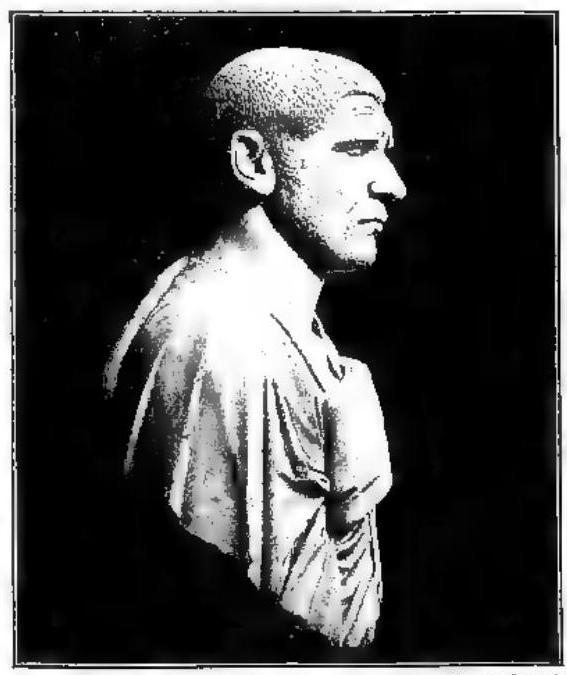
FILIPPO L'ARABO - BUGO - ROMA, Vatican Museum.
in a latent and inward state and never reached an explicit and external profession of II. Indeed, during the millennial solemnities of the founding of Rome in 247, celebrated with religious and popular festivities, PHILIP clearly showed himself to be a pagan. In the last months of his reign, a fierce revolt broke out against the Christians in Alexandria: the pagans, incited by a fanatical poetaster, plundered and burned their houses; there were also martyrs: some faithful were flogged and stoned, a certain Serapion had his limbs broken and was then thrown from his own house, the virgin Apollonia, after having her jaws broken, was burned alive (Eusebius, Hist. eccl., VI, 41).
BIBL.: E. Stein, s. V. in Pauly-Wissowa, X, cols. 735-70; A. Manaresi, L'Impero romano e il cristianesimo, Turin 1914, pp. 317-20; P. Allard, Storia critica delle persecuzioni, Italian ed., II, Florence 1935, pp. 207-43, 450-54. Agostino Amore
Cite this article
“FILIPPO L'ARABO (M. IULIUS PHILIPPUS).” Enciclopedia Cattolica, vol. V (1950), p. 786. Azione Romana digital edition, https://azioneromana.com/article/filippo-l-arabo-m-iulius-philippus.