
PSEUDO-ISIDORE. — This name conceals a person or, rather, a group of persons of the 9th century, whose identity has still not been established and to whom one of the most famous falsifications known to history must be attributed. Their work is not only the so-called Collectio Pseudo-Isidoriana, also called the Pseudo-Decretals or Pseudo-Isidorian Decretals, but also the collection of the Capitularies of Benedict Levita, that called Capitula Angilranini (v. ANGILRAMNO), and the form of the Hispana that goes by the name of the Hispana of Autun (v. COLLEZIONI CANONICHE).
The personality and work of P.-I. cannot be understood apart from their historical environment. In the Kingdom of the Franks, various forms of ecclesiastical discipline had accumulated: the ancient universal law, the regional particularisms of the Churches of Gaul, and the ascetic-moral norms of penitential discipline that the missionaries of the Insular Church had brought with them; moreover, Germanic juridical conceptions were undermining ecclesiastical discipline, gradually causing its genuine decline.
Then, as a result of the political conditions, the hierarchy too was a victim of this decline, since the highest offices
There were few remedies for this situation. The princes were ready to undertake reform only insofar as it did not affect them; the bishops, besides being divided, lacked sufficient authority to impose themselves. The Pontiffs therefore intervened only in individual concrete cases, when their authority was invoked in the face of disagreement among the ordinary ecclesiastical bodies (bishops, metropolitans, councils), but not in order to reorganize from the foundations an entire situation that required a general and theoretical elaboration of principles.
At that moment, a group of reformers, convinced of the ineffectiveness of all legitimate means—which had failed to bring about the reform that had been invoked for a hundred years in the Frankish Kingdom—thought of making up for this with illegitimate means. In other words, they decided to project into the past a necessary positive legislation, making it appear, through falsifications of attributions (inscriptiones) and texts, as though what bishops and civil princes were required to observe in matters of ecclesiastical discipline and life had been enacted in the past by the two supreme authorities (Pontiffs and Frankish kings).
Pseudo-epigraphy and the apocryphal character of texts had already been employed, as the history of earlier canonical collections demonstrates; here, however, it involved a grandiose work of systematic falsification.
Its principal instrument was the Hispana, which in the second half of the eighth century had enjoyed wide circulation throughout the Carolingian Kingdom and contained the canons of the universal and particular Councils of the individual regions of the Church: the East, Africa, Gaul, and Spain; and, in its second part, a series of Decretals of the Pontiffs from Damasus to Gregory the Great. In Gaul, this collection had undergone a very profound alteration, probably in not a few codices, with regard to the integrity of the texts. This form of the Hispana is called the Hispana Gallica and owes its origin to an unintentional corruption.
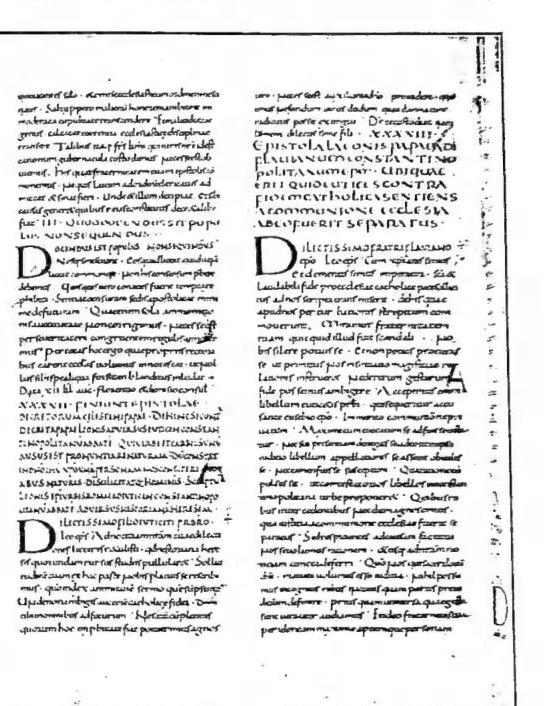
The Pseudo-Isidorian falsifiers used it to create another form of the Hispana, the so-called Hispana Augustodunensis, which represents the group’s first work. It consisted in the systematic interpolation of genuine texts according to the precise aims pursued by the reformers, and was to serve as the preparation for the principal of the Pseudo-Isidorian collections, namely the Decretales Pseudo-Isidorianae.
These, generally called the Pseudo-Isidoriana, thus appear as the Hispana chronologica, enlarged and further falsified. A first, genuinely new part consists of a series of Decretals of the Roman Pontiffs from Clement I to Melchiades (90–314); the second part corresponds to the first part of the Hispana (the canons of the Councils); and the third part reproduces the second part of the Hispana and contains the Decretals, increased in number, from Silvester to Gregory II (314–731).
It was necessary, however, to prove, in the face of the temporal lords, that the very principles contained in the ecclesiastical documents had been proclaimed by the most famous Carolingians. For this reason, the same reformers compiled a collection of royal provisions, called Capitularies (especially those of Pippin, Charlemagne, and Louis the Pious), which a certain Benedictus Levita of Mainz was said to have discovered there. These provisions were arranged in three books, which were to be added to the four books of the already existing (genuine) collection of Ansegisus. A little later, four further Additiones followed.
Meanwhile, another small collection had been compiled under the name Capitula Angilrammi (v. ANGILRAMNO), containing texts concerning the question of the forum of clerics and the right to accuse them.
These four collections may be called the concrete fruit of Pseudo-Isidorian activity. The falsifications carried out in them are of different kinds and extent. First, they consist of purely formal interpolations, which make the texts linguistically more fluent and intelligible. Secondly, they affect the substance itself, insofar as they restrict, extend, or alter the meaning of the provisions contained in the genuine texts; they attribute original texts to different material sources (e.g., provisions of ecclesiastical authority to civil authority, or vice versa; texts of the Holy Fathers to Councils or to the Roman Pontiffs; and, above all, provisions of later popes to popes who had lived centuries earlier). Finally, there are also texts invented outright, although composed of genuine fragments. They are found especially among the Decretals of the Roman Pontiffs: the entire series (60) in the first part of the Decretales Pseudo-Isidorianae and many (more than 40) in the series of the third part. In this work of fabricating Pontifical Decretals, the falsifiers proceeded with the utmost circumspection: they did not invent and attribute texts arbitrarily, but, scrutinizing the historical sources—especially the Liber Pontificalis—they reconstructed documents of which historical information had been preserved, adhering to the tenor and wording of that information.
Through these interpolations and falsifications, the intentions of the falsifiers can be discerned. Although they collected material embracing the whole of ecclesiastical discipline, they insisted particularly upon the fundamental points that were to ensure a lasting reform of the historical conditions mentioned above. Thus, an attempt was made to free the Church, and the bishops in particular, from every form of interference, by combating everything that diminished their authority: every right of laymen to judge or even merely to accuse clerics; the same right on the part of inferior clerics with regard to their superiors; every excessive power of the metropolitan, who, being too often a creature of the temporal lord, sided with him against the well-intentioned bishop; the power of the chorepiscopi; and even synods, insofar as they were often instruments of metropolitans and of persons subservient to the enemies of reform.
The period in which the collections of what may be called the spurious Carolingian reform were compiled was relatively short. On the basis of internal and external criteria, especially those provided by usage, it may be concluded that they were composed between the extreme limits of 845 and 857, but in all probability between 847 and 852, in the following order: the Hispana of Antun, Capitula Angilrammi, Capitularia Benedicti Levitae, with the Additiones, and the Decretales Pseudo-Isidorianae.
The question of their place of origin is still debated today. The thesis of a Roman origin has been abandoned by everyone, since it was evidently inspired by sectarian preconceptions supported by a superficial assessment of the exaltation of the Roman Primacy found in the collections. The thesis of a Magdeburg origin, at least for the definitive work, has also been almost set aside. Three hypotheses remain, each with its own defenders and arguments, though none is strong enough to prevail over those of the others. Some favor Le Mans in the province of Tours, others Reims; more recently, the collections have been attributed to the court chapel of Carlo il Calvo.
The equally enigmatic problem of the person of P.-I. is evidently connected with this. Today there is agreement that this cannot concern a single man, but rather a group of forgers. This group must have included, either as leaders or as executors, the most intelligent and erudite men of the time, the most profound experts in the Latin language and its style in the various historical periods and in the different Chanceries. The entire work of forgery presupposes supreme competence. It is also certain that the name Benedictus Levita, like that of Isidorus Mercator (Mercatus, Peccator), is a pseudonym, probably chosen skilfully to conceal the trick and divert attention, as is certainly the case in the combination of Isidorus (which was meant to evoke the memory of the great Isidore of Seville) with Mercator, an appellation that suggested another man, Marius Mercator, a fifth-century writer, to whom the first words of the introduction precisely allude (cf. Hinschius [V. infra], 17 and PL. 48, 753).
The fortunes of the collections varied according to place and time. The Pseudo-Isidorian Decretals spread rapidly, at least the texts reproducing Pontifical Decretals, beyond the Alps. On this side of the Alps they achieved considerable dissemination and peaceful recognition (though not entirely so!) only from the time of the Gregorian reform. From then onward they retained an almost uncontested dominance for four centuries. Despite occasional doubts raised against their authenticity, it was only in the fifteenth century, through the work of the humanists, that the forgery was recognized and demonstrated. The other collections, although they enjoyed less intensive success, enjoyed it for a longer period: it was only in the last century that the origin and spurious character of the other three, as belonging to the same pseudo-Isidorian workshop, were decisively and definitively recognized.
As regards the influence exerted by this bold fraud on ecclesiastical discipline and the development of Church law, it may be observed that the forgers generally did nothing other than “codify” what was actually the conviction and normal practice of the time, and what could not have caused any surprise when found in provisions issued by well-intentioned and exemplary ecclesiastical and civil authorities. The influence of P.-I. on discipline may therefore be called in part merely formal, inasmuch as it gave a form, committing to writing in the guise of positive laws, to what materially already existed both in the principles of ancient discipline and in the practice of all genuine Christians, but which at that time, owing to circumstances, lacked a legitimate, respected, and effective legislative authority.
Besides this purely formal influence, it also exerted a more substantial one. In one sense, by giving impetus—according to the individual provisions, more or less significant—to a further development, in a particular direction, of certain juridical institutions (for example, the elimination of the chorepiscopate, the limitation of metropolitan power, a renewed practice of clerical privileges, the use of appeals, ecclesiastical procedural practice, etc.). In a second sense, by seeking to introduce new norms considered necessary, which the forgers took care to demonstrate as conforming to the principles of ancient discipline (the prohibition against laymen accusing clerics; the restoration of property to the person despoiled before proceedings were initiated against him; permission from Rome for the celebration of synods; the Pope’s intervention for a definitive sentence of deposition against a bishop). It was precisely these points, however, because they constituted new applications, that struggled to gain acceptance and were in part not accepted.
This demonstrates that the apocryphal documents did not, taken as a whole, constitute a substantial innovation; rather, they stood in continuity with the universal law of antiquity represented by the earlier, more famous, and more authoritative compilations, revived or brought forth by the genuine Carolingian reform, such as the Dionisio-Hadriana, the Hispana, and the Dacheriana.
The Roman Primacy in the Pseudo-Isidorian collections must be judged within this same framework: these collections not only did not create it, but presupposed it; they are a clear testimony to its existence in the conviction of contemporaries. The texts that exalt it do not pursue an end in itself, but constitute a means of attaining the aims of the reform. The Roman Primacy was therefore regarded by the forgers as the most effective instrument for the success of their enterprise, and they exploited it across the entire field of their activity, making it the pivot of their action. If a provision appeared throughout the tradition of the Pontifical Decretals, it had to be genuinely ecclesiastical and therefore observed. They knew, then, that this conviction was so universally accepted that nothing more was needed to secure obedience. It is true, however, that this insistent appeal to the Roman Primacy greatly promoted its authority and exercise; and in this sense it must be said that P.-I. contributed substantially to its development, understood as a practical affirmation.
This judgment concerning pseudo-Isidorian influence on this particular point, and with regard to the development of the whole of Church law, is moreover shared by scholars of every confession. Not in the history of canon law itself, but in the history of the collections, P.-I. constitutes a milestone. It is enough to cite, among others, the unbiased view of one of the most distinguished and competent authorities in this field, E. Seckel: with P.-I., he says, a new period does indeed begin in the history of the sources, but not a new era in the law of the Church.
Eds.: the Hispana Augustodunensis is unpublished; it is found in cod. ms. Vat. lat. 1341; G. H. Pertz, Capitularia Benedicti Levitae in MGH, Legea, II, part 2, Hannover 1837, p. 17 ff.; also in PL 97, 698 ff.; P. Hinschius, Decretales Pseudo-Isidorianae et Capitula Angilramni, Leipzig 1863. PL 130, 1 ff. reproduces the unsatisfactory ed. of the Decretales Pseudo-Isidorianae from Merlinus, Coll. Concil., Cologne 1530.