
OCKEGHEM, JOHANNES. - Polyphonist, born in Flanders c. 1430, died in Tours c. 1495. In
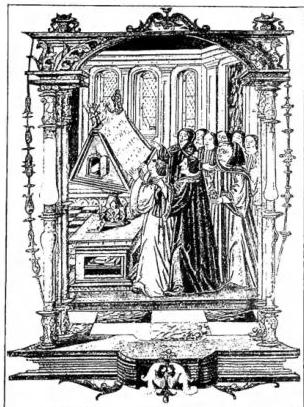
He is considered the founder of the second Flemish school of polyphony (Franco-Flemish school) of the 15th century. Of his vast artistic production, the most important part was sacred music, which he illustrated in an admirable way with masses and motets, in addition to having composed 20 chansons. Following in the footsteps of Riemann, much has been said about the principle of imitation as a fundamental element for O.'s music; imitatory technique, in truth, was practiced on a vast scale throughout the entire Flemish period from its inception, and finds in O. a worthy follower due to the fact that he does not like to cut off all the voices at the same time; as if he feared silence, he gives an "eternally flowing" melodic character to his compositions.
Among the Masses built on a liturgical cantus firmus, the foremost is Ecce Ancilla Domini (based on the antiphon Missus est Angelus Gabriel), while among the many others elaborated on a secular theme, those titled (after the homonymous chansons upon which they are built) De plus en plus, Fors seulement, L'Homme armé, etc., stand out. Among the most famous motets, for artistic beauty and religious inspiration, the two antiphons Alma Redemptoris Mater and Salve Regina are especially noteworthy, along with the motet, also Marian, Intemerata Dei Mater.
Upon his death, laments and epitaphs were composed by his pupils and others (J. Desprez, G. Cretin, etc.), all praising the peculiar virtues of his exquisite art.