
ALLEGRI, FAMIGLIA. — Name of various musicians of the sixteenth century, the greatest of whom was GREGORIO, born in Rome in 1582, died there on 17–18 February 1652. As a child he was, like his brothers Domenico and Bartolomeo, a boy chorister in the church of S. Luigi dei Francesi, under the guidance of Giovanni Bernardino Nanino. When his voice changed, he ceased to belong to the chapel, but continued to take part in services, especially on feast days, as a tenor, from 1601 to 1604, under the direction of the other Nanino, Giovanni Maria. After this period, only fragmentary information about him is available, such as the record of a benefice he held at the cathedral of Fermo in 1619. On 6 December 1620 we find him as a papal singer in the Sistine Chapel, where, as a contralto, he remained for 22 years, that is, until his death. We know that he also held other benefices at Tivoli, but without an obligation of residence. In 1650 he was appointed director « pro tempore » of the Sistine Chapel and, in that capacity, composed psalms, magnificats, improperia, Te Deum, motets (1621), and many Masses (among which the one for 8 voices, Christus resurgens ex mortuis, stands out), which pleased Urban VIII. Notable among his works are two Lamentations (the 1st of the 3rd matins, written in 1640, was sung, as Baini testifies, with undiminished success for almost 200 years) and, more famous than any other, the celebrated Miserere for 2 choirs of 4 and 5 voices, performed on Holy Wednesday and Good Friday in the papal chapel: the episode of the young Mozart is well known in connection with it; in 1770 he transcribed it from memory, by hearing it only, since the chapel regulations did not permit its transcription from the original.
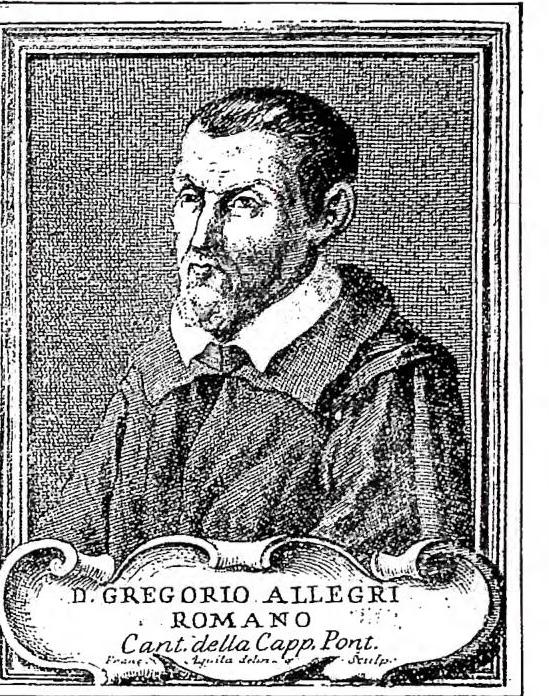
DOMENICO, born in Rome in 1585, died there on 5 September 1620, brother of Gregorio. He too was a boy chorister at S. Luigi dei Francesi from 1595 to 1601. In 1616 he was appointed chapel master at the basilica of S. Maria Maggiore.
BARTOLOMEO, born in Rome around 1592, died there in 1609, brother of the two preceding. From 13 January 1602 until the end of 1607 we find him as a boy chorister at S. Luigi dei Francesi, and from December 1607 until the end of June 1609 as an additional contralto in the chapel, with a salary of two scudi. After that, no further information about him is available, nor is anything known about his musical compositions.
LORENZO, a contemporary, but perhaps not related to the three above. The only information about him is that he published the I libro delle musiche (B. Magni, Venice 1618), dedicated to the Grand Duke of Tuscany and containing six-part sinfonias, vocal pieces, and instrumental pieces.